

The Data Dilemma in High-Stakes Decision Making. Astut is here with some answers!
AI systems today are only as good as the data they are trained on. When faced with entirely new or unpredictable situations, a geopolitical crisis, an emerging cyberattack or a global supply chain disruption the traditional predictive models often falter.
Most business and government decisions depend on historical data to forecast outcomes. But what happens when history offers no precedent?
That’s the question Astut, an Oxford University spin-out, aims to answer. Its technology targets what the company calls “High-Stakes Unseen Decisions (HSUDs)”, moments when leaders must act confidently despite a lack of prior data or known patterns.
From defence strategy and energy resilience to corporate crisis response, Astut’s Hybrid AI system is built to provide analytical support where uncertainty dominates. Its mission is simple yet profound: enable better decisions when traditional AI can’t.
The Technology Behind Astut’s Hybrid AI
Unlike most machine learning models that depend entirely on large datasets, Astut’s Hybrid AI combines data-driven inference with logical reasoning, resulting in systems that can explain, justify and adapt. At its core, the technology integrates:
A generative AI layer, capable of simulating possible outcomes and scenario variations.
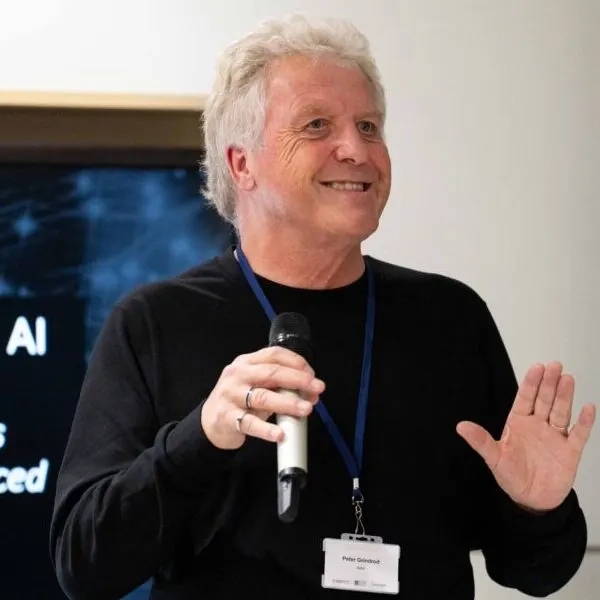
A mathematical reasoning engine, based on years of Oxford research, which constrains those outcomes using logic, probability and human-defined rules. This combination produces decisions that are both flexible and interpretable, allowing organisations to see why a model recommends a particular course of action, a key requirement in defence, healthcare and financial governance. The concept was pioneered by Professor Pete Grindrod CBE, a mathematician at Oxford whose research focuses on systems that can reason in uncertain, data-scarce environments.
“We’re moving from predictive AI to cognitive A. From pattern recognition to reasoning,” Professor Grindrod explained in earlier academic work that inspired Astut’s creation. Astut’s hybrid architecture enables robust decision-making in the unknown, an essential capability for a world where historical data often no longer predicts tomorrow’s realities.
The Seed Round and Growth Strategy of Astut
Astut has raised £1.6 million in seed funding, co-led by East X Ventures and Sure Valley Ventures, with participation from the UK Innovation & Science Seed Fund (UKI2S).
The fresh capital will be used to:
- Scale Astut’s Hybrid AI Decision Engine for enterprise and government clients.
- Expand its team of mathematicians, data scientists and product engineers.
- Build partnerships in industries most affected by high-stakes uncertainty and they are defence, energy, finance and national infrastructure.
Early pilots are already underway in sectors such as strategic defence planning and energy grid management, where decisions must be made amid fast-changing conditions and incomplete information.
The funding also positions Astut as one of the leading AI spin-outs from Oxford’s mathematics research ecosystem, a region now known for pioneering explainable, human-centric AI models that challenge the black-box approach of mainstream machine learning.
Implications for Industry and AI’s Next Frontier
Astut’s innovation represents more than a technological leap. It signals a philosophical shift in artificial intelligence as well
Today’s AI excels at correlation, spotting patterns in vast datasets. But in volatile markets or crises, data is often contradictory, sparse or entirely absent. Astut’s Hybrid AI tackles this by combining machine learning’s creativity with mathematical discipline.
This approach could redefine how enterprises handle risk, compliance and crisis strategy:
- Defence & Security: Simulating adversarial behaviour in unpredictable conflict zones.
- Energy & Infrastructure: Modelling system resilience without complete failure data.
- Finance: Stress-testing investment portfolios for black swan events.
- Public Policy: Informing decisions when evidence is uncertain or incomplete.
As more organisations confront “unknown unknowns,” systems like Astut’s could become core infrastructure for confident decision-making, much like spreadsheets once were for finance.
From Oxford to Industry. The Deeptech Continuum
Astut’s journey also exemplifies the power of academic spin-outs in translating advanced research into practical impact. Built on years of mathematics research at Oxford, the company joins a growing list of deep-tech ventures bridging academic rigour and commercial readiness. Its roots in research lend it both credibility and a long-term advantage which is the ability to explain, not just predict.
In an AI landscape dominated by data-heavy models, Astut’s reasoning-first approach could redefine how intelligence is measured: not by how much data a model consumes, but by how clearly it can think in the absence of it. Astut represents the next evolution in artificial intelligence. One where reasoning, transparency and context-awareness replace blind pattern-matching. By building AI that can think beyond data, the company is addressing one of the field’s most pressing limitations: the inability to act reliably in unseen situations.
In a world of growing uncertainty, from climate volatility to geopolitical flux, the ability to make confident, explainable decisions without precedent may define the next decade of AI innovation.
As The Futurism Today continues to track the frontiers of deep tech and human intelligence, Astut stands out as a reminder that the real challenge for AI isn’t learning from the past, it’s reasoning about the future.