

Avesta Labs Signals Shift Toward Reliable Production-Grade AI Agents
Enterprises are moving past AI demos. Companies like Avesta Labs are building AI agents that actually run Operations. For much of the past two years, organizations approached artificial intelligence as an exploratory technology. Teams tested chatbots for customer service, copilots for productivity, and generative models for content creation. Demonstrations showed impressive capabilities, and proof-of-concept deployments spread quickly across departments. Yet moving from demonstration to daily operational use proved far more difficult.
Many early implementations produced inconsistent results. Systems generated plausible but incorrect answers, struggled with edge cases, and lacked accountability when errors occurred. The gap between an impressive demo and a dependable operational system became clear. Businesses discovered that intelligence alone was not enough. Reliability, traceability, and control mattered just as much as capability.
By 2026, the industry conversation began to change. The question was no longer whether AI could assist employees, but whether it could safely execute tasks inside real workflows without constant supervision.
The Reliability Problem Enterprises Now Face with AI agents
In enterprise environments, even minor mistakes can create cascading effects. A financial miscalculation, an incorrectly interpreted legal document, or an improperly processed request can trigger compliance risks and financial losses. This makes organizations cautious about allowing autonomous systems to act without guardrails.
Traditional automation removed repetitive actions but relied on predefined rules. Generative AI introduced flexibility but also unpredictability. Companies needed a middle ground: systems capable of reasoning but constrained by governance frameworks.
As a result, enterprises began shifting focus from experimentation to operational discipline. Instead of asking how intelligent a model is, leaders started asking whether the system could be monitored, audited, and improved continuously. This change has given rise to a new category often described as production-grade AI or AgentOps, where evaluation, safety, and oversight are as important as performance.
The Rise of Operational AI Systems
Operational AI differs from earlier tools by emphasizing lifecycle management. Systems must be tested before deployment, observed during operation, and adjusted as conditions change. Rather than isolated assistants, organizations are deploying specialized agents responsible for specific tasks such as document review, analysis, reporting, or customer interaction.
However, multiple agents introduce coordination challenges. If several AI systems operate simultaneously, organizations must ensure they behave consistently and comply with policies. This requires orchestration layers that connect workflows, manage permissions, and maintain records of actions taken.
The focus therefore shifts from building AI features to building AI infrastructure. Companies increasingly treat artificial intelligence as an operational system comparable to databases or cloud platforms, where reliability is fundamental to adoption.
Avesta Labs as a Case Study in Reliable AI
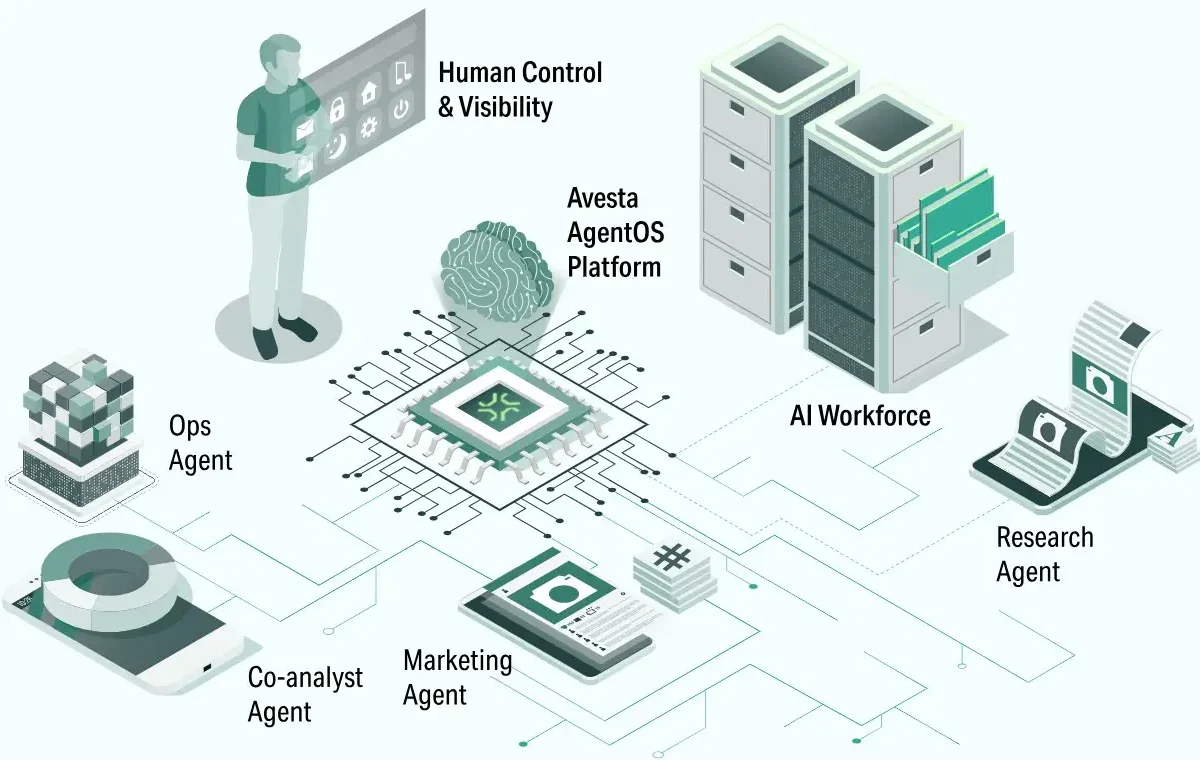
Ahmedabad-based Avesta Labs represents this emerging approach. The company develops production-grade AI agents designed to operate within real business workflows rather than experimental environments. AgentOS platform integrates governance, evaluation, and monitoring capabilities alongside automation.
Instead of generic conversational tools, the company emphasizes skill-specific agents tailored to particular operational tasks. The platform incorporates continuous observation and improvement processes intended to reduce unpredictable behavior. By focusing on workflow-level deployment, the company attempts to move organizations from pilot projects to measurable operational outcomes.
Avesta Labs also structures adoption gradually. It begins with identifying limited use cases, defining measurable success criteria, and scaling only after predictable performance is achieved. This reflects a broader industry understanding that reliability must precede expansion.
Observations From the India AI Impact Summit 2026, New Delhi
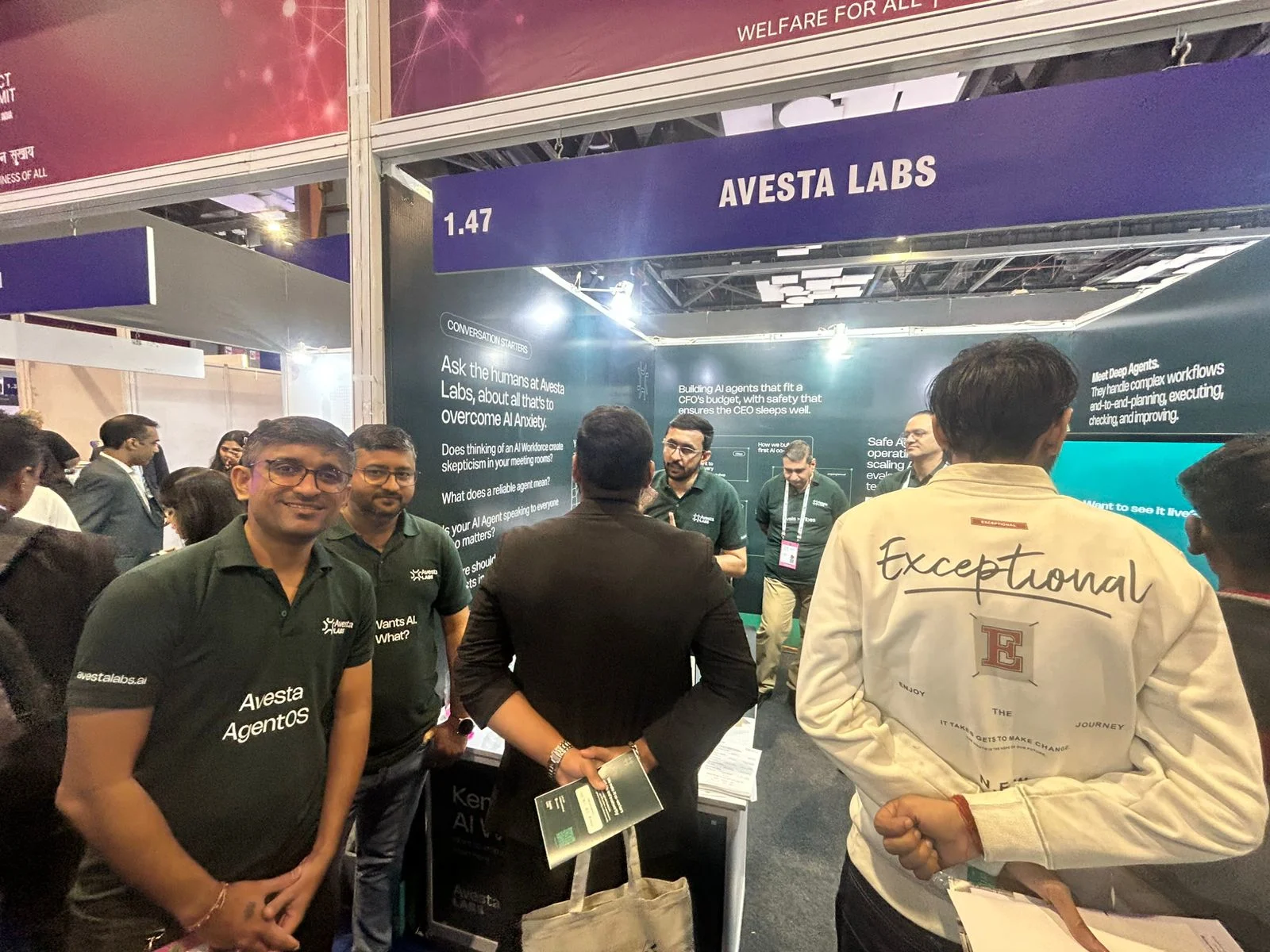
At the India AI Impact Summit 2026 held at Bharat Mandapam, discussions consistently highlighted the same concern among enterprises: organizations are less interested in new AI capabilities and more focused on whether systems can be trusted in production environments.
During the event, The Futurism Today interacted with Gaurav Soni and Naresh Tank from Avesta Labs. They described how enterprises are shifting attention from experimentation to operational adoption, seeking systems that can integrate deeply into workflows while remaining observable and controlled. The emphasis was on predictable outcomes rather than novelty.
Across multiple sessions, participants echoed similar priorities. Companies want AI systems that align with compliance requirements, operate transparently, and deliver measurable value. The tone of conversations suggested that the industry has entered a phase of practical implementation rather than exploration.
What This Shift Means for Enterprise Technology?
The progression of enterprise AI appears to follow a familiar pattern seen in earlier computing waves. Initial excitement leads to rapid experimentation, followed by a period of skepticism when limitations emerge. Eventually, infrastructure evolves to stabilize the technology, allowing widespread adoption.
Artificial intelligence now seems to be entering that stabilization phase. Instead of competing over model performance alone, companies are competing over operational reliability. The winners may not be those with the most advanced algorithms, but those capable of deploying AI safely within complex organizational processes.
If this trajectory continues, AI systems will gradually resemble operational infrastructure rather than optional features. Businesses will expect them to function consistently, integrate seamlessly, and remain accountable for decisions made.
The conversation around artificial intelligence is quietly maturing. Early adoption was driven by curiosity and competitive pressure, but sustained adoption depends on trust. Companies are realizing that intelligent systems are only valuable when they behave predictably in real conditions. Platforms focused on governance and operational reliability indicate the industry’s transition from experimentation to execution. The next phase of AI competition may therefore center less on how impressive systems appear and more on how dependably they perform in everyday business environments.