

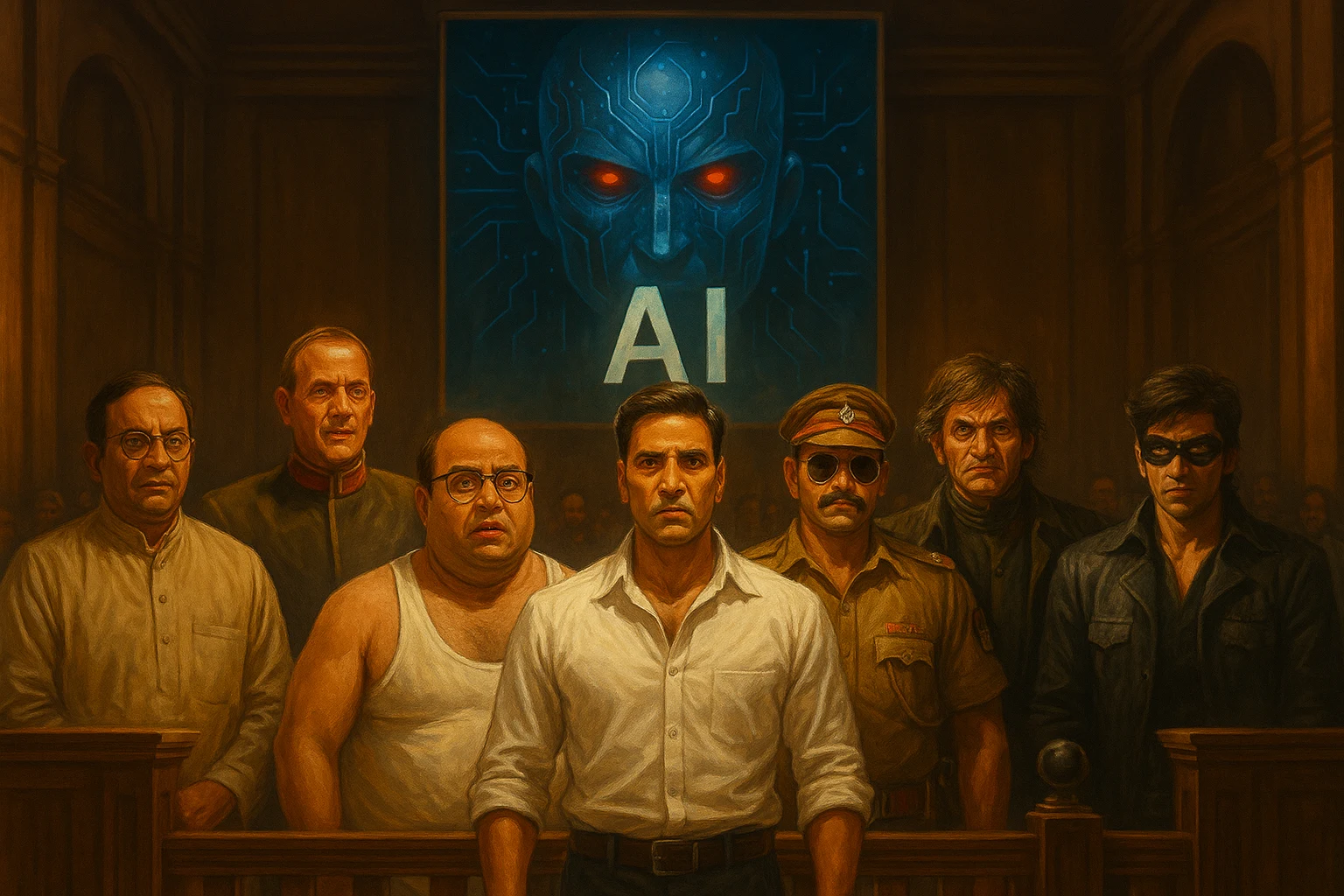
The Deepfake Dilemma Hits Bollywood. KHILADI is not impressed!
What started as clever AI trickery has turned into an existential question for India’s entertainment industry. On 15th October 2025, Bollywood superstar Akshay Kumar approached the Bombay High Court seeking protection of his personality rights which includes his name, voice, likeness and mannerisms from unauthorized commercial use. He isn’t alone.
Over the past few months, a string of Bollywood icons such as Aishwarya Rai Bachchan, Abhishek Bachchan, Hrithik Roshan, Suniel Shetty and Ranveer Singh have either filed or supported similar pleas in Indian courts. Their concern: the explosive rise of AI-generated deepfakes and synthetic content that mimic their likeness, voices and actions without consent is often in misleading, defamatory or commercial contexts.
From fake brand endorsements to manipulated trailers and counterfeit merchandise, celebrity identity is becoming the new intellectual property battleground.
When Fame Becomes a Digital Liability
A surge of AI-generated videos featuring Bollywood actors is flooding the internet, spreading misinformation and posing serious risks. From Maharishi Valmiki to Prime Minister Narendra Modi, some YouTube channels have shown the ‘Khiladi’ of Bollywood playing every possible role.
In his recent plea, Akshay Kumar addressed a doctored trailer circulating online that depicted him as the Chief Minister of Uttar Pradesh. Although the video was labeled as a fan-made trailer, the channel had over 471K subscribers and this video garnered more than 2 million views before it was taken down. The video was entirely synthetic, generated by AI without his consent or involvement. In a country where many citizens are easily influenced by what they watch, such deepfakes can dangerously distort perceptions, especially when they involve one of India’s most popular actors portraying the nation’s top political figures.
Similarly, Aishwarya Rai and Abhishek Bachchan have filed a joint petition in the Delhi High Court to restrain Google, YouTube and other social media platforms from hosting AI-generated content featuring their likenesses. Their plea goes further, demanding platforms prevent future AI model training using unauthorized celebrity imagery or voice samples.
In another case, the Delhi High Court granted Hrithik Roshan protection against unauthorized commercial use of his persona, ordering takedowns of deepfake content linking him to fake brand endorsements.

The Legal Vacuum Around Personality Rights
India does not yet have a dedicated law protecting personality or publicity rights, but courts have relied on privacy, defamation and intellectual property doctrines to fill the gap.
The Delhi High Court’s 2022 judgment in Anil Kapoor vs Unknown Defendants set an early precedent, recognizing an individual’s “right to control the commercial use of one’s identity attributes.” The recent spate of 2025 petitions pushes this boundary further, demanding proactive protection against synthetic manipulation using AI.
In the absence of specific AI or deepfake laws, courts are invoking John Doe injunctions, restraining unknown offenders, to issue temporary bans. The Bombay High Court recently extended such protection to Akshay Kumar, granting him interim relief against misuse of his likeness or voice. However, lawyers caution that judicial orders can only go so far. Enforcement remains patchy and digital takedowns lag behind the speed at which new AI content is generated and reshared.
Deepfakes: Beyond Entertainment, a Societal Concern
Deepfakes are not limited to celebrity misuse. In a paper on deepfakes, KPMG cited the McAfee study, confirming that over 75% of Indians online have encountered some form of deepfake in the past year, with at least 38% experiencing a deepfake-related scam.
Bollywood’s legal resistance is now being viewed as a proxy fight for broader digital rights, a movement that may eventually benefit not just celebrities but every Indian internet user.
India’s AI & Deepfake Rulebook (2025 Snapshot)
Where India Stands Today
India currently operates in a grey zone, with no dedicated AI or deepfake regulation, but several intersecting legal and policy mechanisms:
- No single AI law yet: Courts and ministries rely on existing IT, privacy and IP frameworks to act against misuse.
- Intermediary Rules & IT Act: Platforms must remove unlawful or manipulated content within 36 hours of a complaint.
- CERT-In Deepfake Advisory (2024): India’s cybersecurity agency has issued guidelines on detection and mitigation of AI-generated fake media.
- DPDP Act (2023): The Digital Personal Data Protection Act covers the use of personal data, including biometric and voice information, but loopholes exist for publicly available data scraped from the web.
- MeitY Advisory (2024–25): The IT Ministry has directed platforms to label and take down deepfakes more proactively.
- Judicial protections: Courts continue to use John Doe injunctions (Akshay Kumar, Hrithik Roshan, Suniel Shetty cases) for interim relief.
- Bottom line: India’s response is reactive and fragmented, but evolving rapidly toward a national AI framework emphasizing transparency, consent and traceability.
Global Lessons in Protecting Digital Identity
India isn’t alone in facing the deepfake crisis.
- The U.S. has a patchwork approach with regulations focused on specific harms, such as non-consensual sexual imagery and election interference, rather than a comprehensive federal law on all AI. While states have led the charge on political deepfakes and personality rights, federal action is targeted, with the TAKE IT DOWN Act (May 2025) criminalizing non-consensual intimate imagery and requiring platforms to provide a 48-hour takedown process.
- Comprehensive and risk-based. The EU AI Act (effective from August 2024, with disclosure obligations from February 2025) takes a broad, horizontal approach. It requires providers of generative AI to ensure their content is identifiable, with specific transparency obligations for deepfakes that could mislead the public. Penalties for non-compliance are significant, with fines of up to €35 million or 7% of global turnover.
- China’s regulatory framework is centrally controlled and emphasizes state power and stability. The “Measures for the Administration of Deep Synthesis Internet Information Services” (effective September 1, 2025) mandates both visible labels and invisible, technical watermarks for all AI-generated content, including text. The state also regulates content that could impact public opinion and requires providers to ensure traceability.
India’s approach is still judicial and policy-driven, but experts say the country will likely mirror EU/China style labeling laws in coming years to build trust and accountability..
Public Sentiment & Industry Reaction
Most actors have voiced support for these lawsuits, calling them “a fight for digital dignity.” However, opinions remain divided among creators. Some digital artists argue that overregulation could stifle satire, fan edits and parody, which often celebrate rather than exploit celebrity personas.
Meanwhile, production houses and OTT giants like Netflix India and Amazon Prime Video are drafting AI ethics clauses in contracts to ensure likenesses of actors aren’t digitally altered without consent. Industry observers predict that Bollywood’s united front could accelerate India’s long-awaited AI legislation, balancing creative freedom with the right to identity.
TFT’s view on Bollywood’s latest nightmare!
The battle between Bollywood and deepfakes is not about protecting fame. This is about protecting authenticity in the age of synthetic reality. For decades, actors licensed their faces to posters and brands. In 2025, they must defend them from algorithms that can copy, clone and distort at will. Already struggling with revenue and content challenges, the industry now finds itself battling a new threat, DEEPFAKES.
As India inches closer to its first AI-specific regulatory framework, these courtroom fights could shape the legal DNA of digital personhood, defining who truly owns your face, your voice and your virtual self. Technology may evolve faster than the law, but one truth stands firm: In the AI era, authenticity is the new currency, and Bollywood is fighting to keep it real.