

OpenAI Launches ChatGPT Translate
OpenAI has officially launched ChatGPT Translate, a new built-in translation capability that positions ChatGPT as a direct competitor to Google Translate, one of the most widely used consumer tools on the internet. While translation may appear like a modest feature addition on the surface, the move carries far deeper implications for how OpenAI sees the future of ChatGPT as a universal interface for language, work, and everyday tasks.
For years, Google Translate has dominated global translation by offering speed, scale, and accessibility across hundreds of languages. OpenAI’s entry into this space is not about matching accuracy. Instead, ChatGPT Translate reframes translation as a contextual, conversational, and intent-aware experience, signaling a shift in how language tools are expected to behave in the AI era.
This launch places OpenAI squarely into one of Google’s most defensible territories and does so with a fundamentally different philosophy.
Why Translation Matters More Than It Appears ?
Translation is one of the most frequently used digital utilities in the world. It serves students, travelers, migrants, professionals, creators, and businesses across borders. Unlike many AI features that cater to niche or professional users, translation is habitual, universal, and repeated daily.
By embedding translation directly into ChatGPT, OpenAI is targeting one of the most powerful forms of user retention: daily reliance. Translation is something they return to again and again. This makes it a strategic gateway feature for mass adoption, particularly among non-technical users.
More importantly, translation is fundamentally about understanding meaning. That distinction plays directly to the strengths of large language models.
From Literal Translation to Contextual Understanding
Traditional translation tools focus on converting text from one language to another as accurately and efficiently as possible. While modern neural translation systems have improved dramatically, they often struggle with tone, cultural nuance, slang, ambiguity, and intent.
ChatGPT Translate introduces a different paradigm. Instead of delivering a single static translation, users can interact with the result. They can ask follow-up questions, request alternative phrasings, adjust tone, localize expressions, or clarify meaning.
This conversational layer transforms translation from a one-shot output into an iterative understanding process. Users are no longer forced to accept a translation at face value. In fact now, they can shape it. This matters deeply in real-world scenarios such as Professional communication, Legal contexts, medical contexts, Creative writing, Cross-cultural collaboration, Education and learning.
By placing translation inside a dialogue-driven system, OpenAI is effectively merging translation with explanation, reasoning, and refinement.
A Direct Challenge to Google’s Utility Empire
Google Translate has long been insulated from competition due to its sheer scale, speed, and deep integration across Google’s ecosystem. It is fast, reliable, and available everywhere.
However, its experience remains largely static. Users paste text, receive a translation, and move on. There is little room for interaction, interpretation, or personalization.
ChatGPT Translate will not only outscale Google immediately, but will out-experience it.
This difference becomes increasingly important as AI tools are judged on usefulness, adaptability, and trust. The launch also reinforces a broader competitive reality that OpenAI is building tools around Google’s ecosystem and it is increasingly building alternatives to google as well.
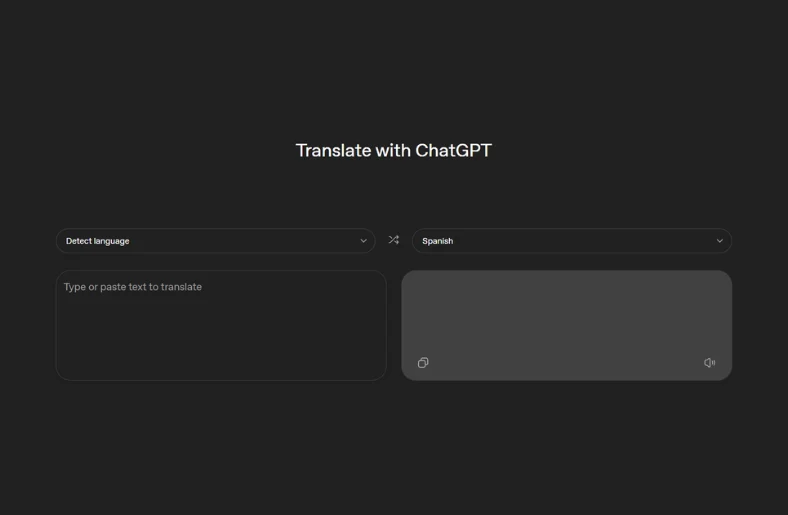
ChatGPT’s Quiet Expansion Into Daily Life
Translation is part of a larger pattern. Over the past year, ChatGPT has steadily absorbed functions that were once handled by separate apps or websites: browsing, document analysis, image generation, coding, research, and now translation.
Each addition strengthens ChatGPT’s position as a single, unified interface rather than a collection of isolated features. The strategy is subtle but powerful. Instead of asking users to switch between tools, OpenAI is consolidating workflows into one environment.
This approach mirrors how operating systems evolve by slowly becoming indispensable. Translation is particularly effective in this strategy because it introduces ChatGPT to users who may never think of themselves as “AI users” at all.
The Competitive Ripple Effect Across the Translation Market
OpenAI’s move raises uncomfortable questions for standalone translation platforms. If ChatGPT Translate reaches a level of reliability that satisfies most users, the rationale for opening a separate translation app diminishes. This does not mean traditional translation services will disappear overnight. Specialized use cases, enterprise contracts, and offline scenarios still matter. However, the market dynamic is shifting.
Translation is increasingly becoming a feature. The same disruption pattern has already played out in areas like note-taking, summarization, and basic coding assistance. Translation appears to be next.
Trust, Accuracy, and the Stakes of Language
Language carries legal, cultural, and emotional weight. Errors in translation can have serious consequences, from business misunderstandings to medical or legal risks.
OpenAI’s challenge will be maintaining reliability at scale while handling ambiguity responsibly. Context-aware translation is powerful, but it also requires transparency and restraint.
The company’s long-term success in this space will depend on how well it balances flexibility with accuracy and how clearly it communicates uncertainty when language does not map cleanly across cultures.
What Does this “TRANSLATE” tool Say About OpenAI’s Long-Term Vision ?
ChatGPT Translate is a signal. OpenAI appears to be positioning ChatGPT as the default language interface between humans and the digital world. Translation, in this context, is foundational. It enables access, inclusion, and global reach.
Rather than competing app-by-app, OpenAI is competing at the interface level and redefining how users interact with information, tools, and now languages themselves. If successful, this strategy could reshape how digital products are designed in an AI-first world.
The translation space is about to become far more competitive and far more intelligent. Google will not stand still, and other AI players will follow as well.
What matters now is who understands best and not who translates fastest. With ChatGPT Translate, OpenAI has made it clear that it believes context is the future of communication, and that AI’s role is to help humans truly understand one another. ChatGPT Translate is less about translation and more about control of the language interface.