

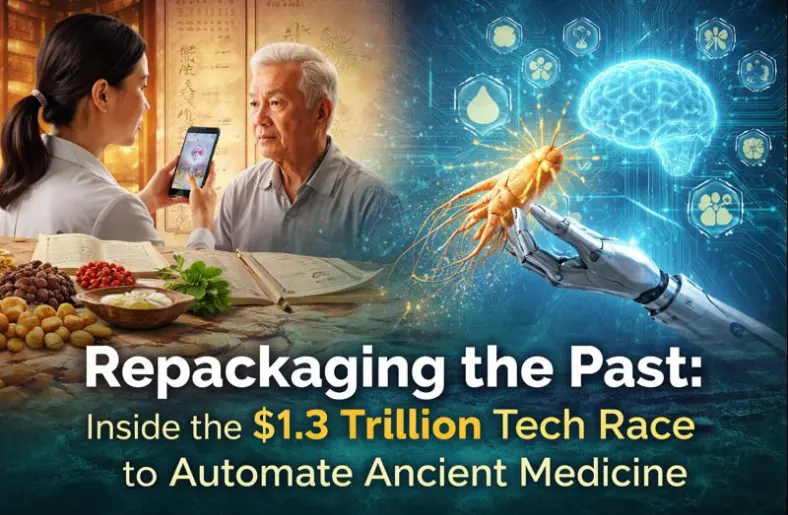
Repackaging the Past: Inside the $1.3 Trillion Tech Race to Automate Ancient Medicine
Inside a traditional Chinese medicine clinic in Shanghai, a practitioner lifts a smartphone and photographs a patient’s tongue. Within seconds, artificial intelligence translates visual cues into measurable diagnostic data using deep learning models trained on thousands of historical cases. The system proposes several syndrome patterns. The practitioner reviews the screen and selects only those aligned with three decades of clinical experience, applying a form of judgment shaped by years of lived practice and patient care.
This moment shows a larger change happening in the global traditional medicine landscape. The market for Traditional Chinese Medicine, Ayurveda, and other ancient healing systems is valued at about $1.3 trillion and is growing at nearly 23 percent each year. This area is becoming a center for innovation in artificial intelligence, digital health, and biotech. In countries like China, India, South Korea, and across the Asia-Pacific region, machine learning systems are turning age-old diagnostic methods into organized, analyzable data.
The four diagnostic pillars of Traditional Chinese Medicine: inspection, Inquiry, Auscultation, and Palpation now use improved imaging, natural language processing, and predictive analytics. In acupuncture clinics, ultrasound systems guided by machine learning help with needle placement. At the Korean Institute of Oriental Medicine, algorithms examine ancient medical texts to identify treatment options for blood disorders and chronic conditions. Knowledge that used to be passed down orally or through handwritten manuscripts is now available through modern computational tools.
The Capital Rush: Investment Boom in Ancient Medicine Technology
Investment in this space continues to accelerate. Heali, a personalized nutrition platform that integrates traditional medicine principles with artificial intelligence, reports 2.6 times higher efficacy in digestive health outcomes. Unali processes more than 200 million scientific and historical research documents, combining alternative medicine research with large-scale AI models. In China, Gu Sheng Tang has secured CN¥1 billion in funding to expand AI-enabled Traditional Chinese Medicine clinics across major urban centers.
For investors in medtech, digital health, and artificial intelligence, traditional medicine represents a powerful convergence of cultural longevity, global demand, and data-rich systems. As the economic value of ancestral knowledge becomes more visible, questions of stewardship and ownership are moving to the center of innovation discussions.
From Turmeric to AI: The Commercialization of Traditional Medicine
The commercialization of traditional medicine has a long history. In 1995, the University of Mississippi Medical Center received a U.S. patent for turmeric-based wound healing. This practice had been documented in Sanskrit medical texts for centuries. Later, India’s Council of Scientific and Industrial Research showed earlier records, resulting in the patent’s withdrawal. This established an important precedent in intellectual property law.
A similar story occurred with the San people of the Kalahari Desert. Their traditional use of the hoodia cactus contributed to commercial appetite suppressants. Global attention ultimately led to benefit-sharing agreements that acknowledged Indigenous contributions. This shaped future discussions about ethical commercialization and community involvement.
The Digital Transformation of Ancient Healing Systems
In the current era, artificial intelligence enables traditional knowledge to travel through digital platforms. AI startups analyze ethnobotanical databases, historical medical records, and traditional medicine libraries to build diagnostic tools, wellness applications, and subscription-based platforms. Patents often focus on algorithms, interfaces, and delivery systems, positioning ancient wisdom within modern technological frameworks.
This transformation has created opportunities for global access, personalized healthcare, and scientific validation of traditional practices. At the same time, it highlights the importance of ensuring that communities who preserve this knowledge participate meaningfully in its economic and social value.
Defensive Intelligence and Global Frameworks for Protecting Traditional Medicine
Nations are increasingly using AI and advanced digital systems to protect traditional knowledge. India’s Traditional Knowledge Digital Library (TKDL) has recorded and structured more than 4.54 lakh (454,000+) formulations and practices from Indian traditional medical systems such as Ayurveda, Unani, Siddha, Sowa Rigpa, and Yoga into formats accessible to international patent examiners. By converting these records into searchable classifications in multiple international languages, this effort has helped ensure that over 324 patent applications have been set aside, withdrawn, or amended based on prior art evidence from the TKDL database, effectively preventing improper patent grants.
Worldwide, the World Health Organization is promoting frameworks that focus on Indigenous Data Sovereignty. It advocates for models where communities maintain control over how their medical knowledge is digitized, shared, and sold. These initiatives aim to balance technological progress with fairness, recognition, and shared benefit.
Artificial intelligence keeps broadening the influence of ancient healing systems by promoting consistency, scale, and discovery. The tools are contemporary. The knowledge has deep historical roots. The future of this field now relies on how technology, funding, and community knowledge progress together, creating a healthcare landscape where innovation and tradition develop in the same direction.