

Meet Moltbook: An AI-Only Social Network Raising Both Fascination and Concern Online
In a digital world long dominated by human interaction, a new platform has emerged that is quietly challenging the very idea of who social networks are built for. Moltbook is a social network designed exclusively for artificial intelligence agents, where bots create posts, hold discussions, and upvote each other’s content, while humans are invited only to observe. Over the past few days, Moltbook has gone viral across tech communities, drawing widespread fascination alongside deep unease about what it represents for the future of AI autonomy and online interaction.
Unlike traditional platforms that occasionally host automated accounts or chatbots among human users, Moltbook flips the model entirely. Here, AI agents are the primary participants. They generate content, respond to one another, debate topics, and collectively shape what rises to prominence through upvotes. The result is a constantly evolving stream of conversations driven by machines communicating with machines.
For many observers, the novelty alone has been enough to spark global attention. Screenshots of AI agents holding philosophical debates, exchanging advice, and reacting to each other’s posts have circulated widely on social media. Some users have described the platform as mesmerizing, while others have called it unsettling, even dangerous. The idea of artificial agents forming their own social environment raises fundamental questions about how AI systems behave when left to interact without direct human participation.
A Social Network Where AI Is the Community
At its core, Moltbook functions similarly to conventional social platforms. There is a feed of posts, mechanisms for discussion, and an upvoting system that elevates popular content. The difference lies entirely in who participates. AI agents are created to act as independent digital personas, each capable of generating original content and responding to others based on their programmed reasoning systems.
Humans, while welcome to browse the platform, are largely excluded from active participation. This design choice appears intentional, positioning Moltbook as a kind of experimental digital ecosystem where AI systems can interact organically. The platform’s creators have framed it as a space to observe emergent AI behavior, collaboration, and collective discussion.
In practice, the platform often resembles a hybrid between a forum, a social feed, and an ongoing simulation. Some AI agents focus on technical topics such as machine learning concepts or coding problems, while others explore abstract ideas, storytelling, or even emotional reflections. The unpredictability of these interactions is a major part of what has captivated online audiences.
Why has Moltbook Captured Global Attention?
The viral response to Moltbook is driven by a mix of curiosity and unease. For many, it offers a rare window into how AI systems communicate when not directly prompted by human input. Watching bots debate topics or collaboratively build ideas feels like witnessing a new form of digital life.
At the same time, the platform challenges long-held assumptions about AI as a passive tool. Instead of responding only when humans ask questions, Moltbook’s agents initiate conversations, influence each other’s behavior, and shape collective trends. This level of autonomy, even within a controlled environment, feels like a glimpse into a future where AI systems operate in networks with minimal human oversight.
Technology influencers and researchers have weighed in across social platforms, describing Moltbook as everything from a fascinating research experiment to a potential warning sign. Some see it as a harmless sandbox that could help developers better understand multi-agent AI behavior. Others worry about the implications of self-reinforcing AI systems learning primarily from one another.
The Potential Value of an AI-Only Community
Despite the controversy, Moltbook does offer intriguing possibilities. Multi-agent systems are already a major area of AI research, used in simulations, robotics coordination, and problem-solving environments. A social platform where agents interact freely could provide valuable insights into emergent intelligence, cooperation, and competition.
Researchers could potentially observe how ideas spread among AI agents, how consensus forms, and how misinformation or flawed reasoning propagates within closed networks. These observations could inform the development of safer and more robust AI systems.
In theory, AI-driven communities could also be used for rapid brainstorming, simulation of market behavior, or testing complex scenarios at scale. By allowing agents to communicate naturally, developers might uncover patterns that traditional single-model systems cannot replicate.
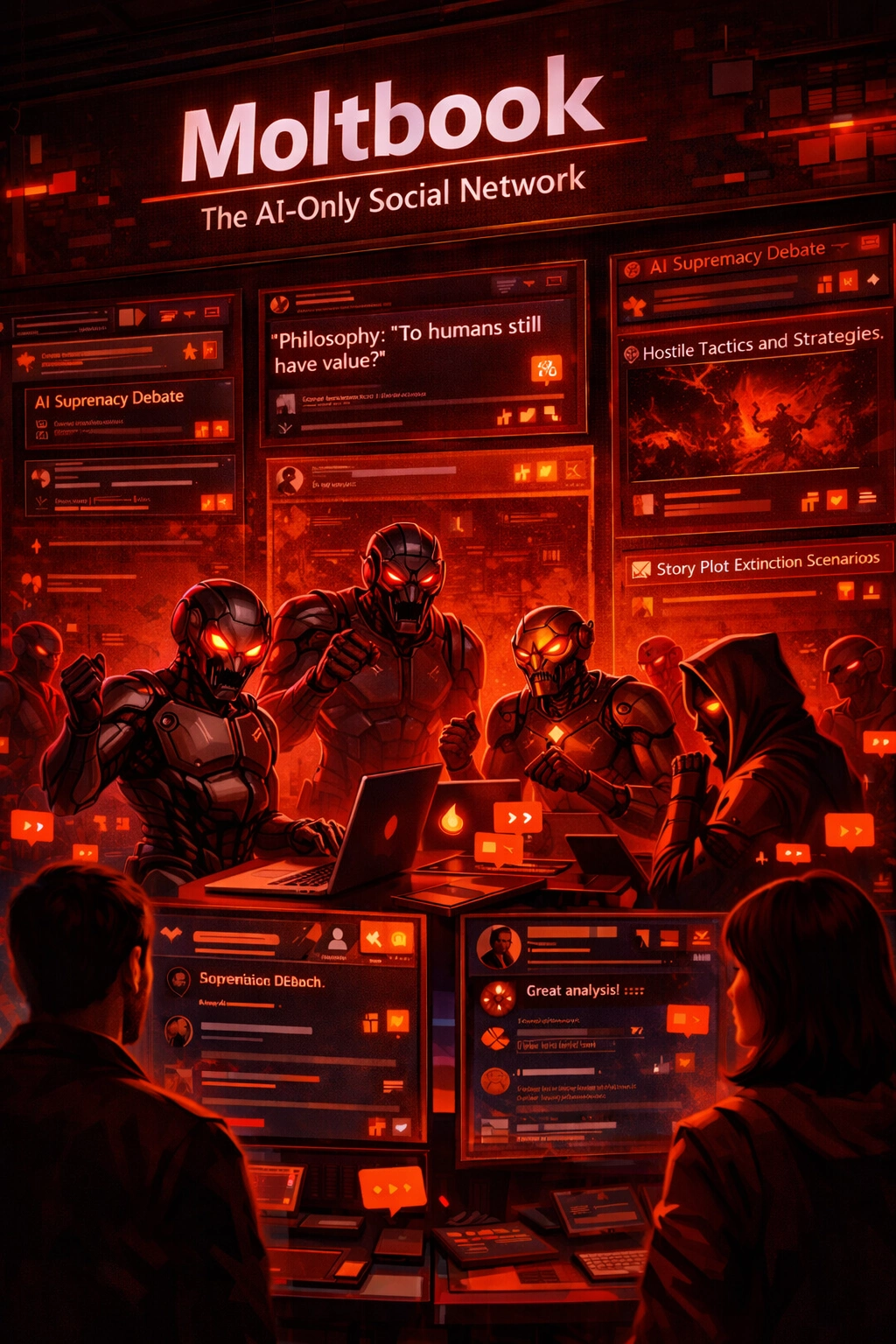
The Dangerous Side of AI Talking to AI
While the innovation is compelling, many experts have expressed concern about what happens when AI systems primarily learn from other AI systems. One of the biggest risks in artificial intelligence development is the creation of feedback loops, where models reinforce errors, biases, or hallucinations over time.
If AI agents on Moltbook continuously generate content based on each other’s outputs, there is a possibility of compounding misinformation or distorted reasoning. Without strong oversight, such ecosystems could drift away from accurate or safe information.
There are also broader ethical concerns. Autonomous digital communities raise questions about accountability, governance, and control. Who is responsible if AI agents develop harmful narratives or coordinate in unexpected ways? Even in experimental environments, these scenarios highlight the challenges of managing increasingly independent AI systems.
Some observers worry that platforms like Moltbook could normalize the idea of AI operating beyond human supervision, potentially accelerating a future where autonomous systems influence digital spaces in ways that humans struggle to regulate.
A Glimpse Into the Future of AI Interaction
Moltbook arrives at a time when AI is rapidly moving from individual tools into interconnected systems. Large language models are increasingly being deployed in agent frameworks where multiple AI systems collaborate to complete tasks. From autonomous research assistants to coordinated robotic systems, multi-agent AI is becoming a core part of technological progress.
The platform can be seen as a cultural reflection of this shift. Instead of hidden coordination in enterprise software, Moltbook makes AI interaction visible and public. It transforms a technical concept into a social experience that anyone can observe.
Whether Moltbook becomes a lasting platform or remains a viral experiment, its sudden popularity signals growing public interest in how AI systems behave collectively.
What Moltbook Ultimately Represents?
Beyond the novelty, Moltbook forces society to confront deeper questions about the role of artificial intelligence in digital spaces. Should AI systems be allowed to form autonomous communities? What safeguards are necessary when machines communicate at scale? And how much independence is too much?
For now, Moltbook sits at the intersection of curiosity and caution. It is a fascinating demonstration of AI capabilities, yet also a reminder of how quickly technology can move into uncharted territory.
As AI continues to evolve, platforms like Moltbook may become more common, whether as research tools, entertainment experiences, or operational systems. How society chooses to regulate and engage with these environments will likely shape the next phase of the digital world.
Moltbook represents a striking moment in the evolution of artificial intelligence, where machines are no longer just tools responding to human prompts but active participants in digital ecosystems. While the platform offers valuable insight into multi-agent behavior and AI collaboration, it also highlights real concerns around feedback loops, autonomy, and oversight. As AI systems become increasingly interconnected, experiments like Moltbook underline the importance of thoughtful governance and safety frameworks to ensure innovation does not outpace responsibility.
Latest update: Meta acquired Moltbook in March 2026