


Deep Networking: Inside the California Startup Aria Networks and its AI-Native Networking Mission
The Hidden Constraint in AI: When GPUs Wait
The rapid expansion of AI has led to an unprecedented demand for compute. Companies are investing heavily in GPU clusters, deploying thousands of high-performance chips to train and run increasingly complex models. These systems represent some of the most expensive infrastructure in modern computing.
However, the performance of these clusters is not determined by compute alone. In many cases, GPUs remain underutilized, not because they lack processing power, but because they are waiting for data. The network, rather than the processor, becomes the limiting factor.
This issue is often referred to as the “GPU tax.” When data cannot move quickly enough between nodes, expensive hardware sits idle, reducing overall efficiency. Traditional monitoring systems struggle to capture the short bursts of congestion that cause these delays, leaving operators with limited visibility into the problem.
Why Traditional Networks Are Not Built for AI?
Data center networks were originally designed for general-purpose workloads. They prioritize stability and predictable traffic patterns, which differ significantly from the behavior of AI systems. AI workloads generate highly dynamic and bursty traffic. Large volumes of data must be exchanged rapidly between GPUs, often in patterns that change from moment to moment. Standard networking architectures are not optimized for this level of intensity or variability.
The limitations extend beyond hardware. Traditional network management relies on deterministic automation and coarse-grained telemetry, which can miss critical events occurring at microsecond intervals. As a result, inefficiencies persist even in highly advanced environments. This mismatch between infrastructure design and workload requirements has created a need for a different approach, one that treats networking as a core component of AI performance rather than a supporting layer.
Inside Aria Networks: A Full-Stack Approach to AI Infrastructure
Aria Networks, headquartered in Palo Alto and founded in 2025 by industry veterans including Mansour Karam, is building its platform around this challenge. The company focuses on creating an AI-native networking stack designed specifically for modern AI workloads. Its approach, described as “Deep Networking,” combines hardware and software into a unified system. Rather than treating these components separately, Aria integrates them to optimize performance across the entire network.
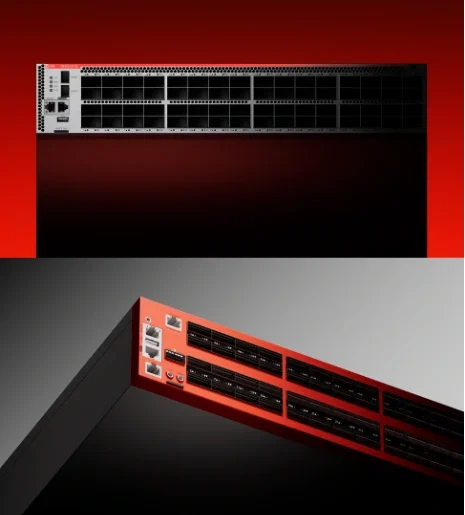
The hardware layer includes ultra-high-speed Ethernet switches operating at 800G and 1.6T, designed to handle the bandwidth requirements of large-scale AI clusters. These systems use high-radix architectures to reduce latency and eliminate unnecessary components, improving both speed and efficiency. On the software side, Aria has developed a customized version of the SONiC network operating system, tuned for the unique demands of AI traffic. This combination allows the platform to operate with a level of precision and responsiveness that traditional systems cannot match.
Ultra-Fine Telemetry and Intelligent Network Control
A defining feature of Aria’s platform is its use of ultra-fine telemetry. The system captures network data at a resolution up to 10,000 times greater than conventional tools, enabling it to detect issues that would otherwise go unnoticed.
This level of visibility supports real-time optimization. Instead of reacting to problems after they occur, the platform can identify and address them as they emerge. Intelligent agents within the Aria Cluster software continuously monitor network conditions and adjust parameters to maintain optimal performance.
The introduction of natural language interfaces adds another layer of accessibility. Operators can interact with the system conversationally, querying performance metrics or requesting adjustments without navigating complex interfaces. This combination of visibility and control allows the network to function as an adaptive system rather than a static infrastructure component.
Rethinking Efficiency: The Role of Token Economics
Aria Networks frames its value proposition in terms of “token efficiency,” a metric that links infrastructure performance directly to the output of AI systems. By improving how effectively data moves through the network, the platform enables higher utilization of compute resources.
Even small gains in efficiency can have significant financial implications. In large-scale deployments, a marginal improvement in GPU utilization can offset the cost of the network itself. This shifts the perception of networking from a cost center to a driver of performance and return on investment.
This perspective aligns with the broader trend in AI infrastructure, where optimization is increasingly focused on end-to-end system performance rather than individual components.
Aria Networks Raises $125 Million to Scale AI-Native Networking
In April 2026, Aria Networks announced that it raised $125 million in a Series A funding round led by Sutter Hill Ventures, with participation from Atreides Management, Valor Equity Partners, and Eclipse Ventures. The funding supports the company’s transition from development to deployment, with initial customer orders already secured.
The scale of the investment reflects the growing importance of networking in the AI ecosystem. As organizations build larger and more complex clusters, the need for infrastructure that can support these systems becomes more critical. Aria’s positioning as a full-stack provider, rather than a standalone hardware vendor, places it within a segment of the market that is gaining strategic attention.

The Emergence of the AI Backplane
The evolution of AI infrastructure is moving toward more integrated systems, where compute, storage, and networking are tightly coupled. In this context, networking becomes the backplane that connects and coordinates the entire system. Aria Networks represents an approach where this backplane is designed with AI workloads in mind from the outset. By addressing the limitations of traditional architectures, it provides a framework for building more efficient and scalable systems.
As AI continues to expand across industries, the ability to manage data movement effectively will play a central role in determining performance. Networks that can adapt in real time and operate with high precision are likely to become essential components of this infrastructure. Aria Networks highlights a critical shift in AI infrastructure, where solving network inefficiencies is becoming as important as advancing compute capabilities, shaping how future data centers are designed and operated.