

Commonwealth Fusion Systems has teamed up Nvidia & Siemens!
Commonwealth Fusion Systems has long argued that fusion energy is not a distant scientific curiosity but an engineering challenge that can be solved with the right combination of physics, capital, and execution. That argument is now taking a decisive step forward. At CES 2026, the company announced a collaboration with NVIDIA and Siemens to accelerate the path toward commercial fusion power by applying advanced digital engineering, AI-driven simulation, and real-time operational modeling to fusion reactor development.
The announcement reflects a broader shift underway in the fusion sector: progress is no longer measured only by laboratory milestones, but by how quickly fusion can integrate into real-world energy systems. For Commonwealth Fusion Systems, the goal is clear, to bring fusion energy to the grid fast enough to matter.
Why is Fusion being Treated as an Engineering Problem ?
Fusion promises clean, secure, and virtually limitless energy, but decades of research have struggled to translate theoretical breakthroughs into reliable power generation. What differentiates CFS from earlier efforts is its emphasis on industrial execution. Rather than pursuing ever-larger experimental reactors, the company has focused on compact, high-field tokamaks enabled by high-temperature superconducting magnets. This design philosophy aims to reduce complexity, shorten development timelines, and lower costs which are the key barriers that have historically delayed fusion commercialization.
The collaboration with NVIDIA and Siemens underscores this mindset. Fusion reactors are among the most complex machines ever conceived, combining extreme heat, magnetic confinement, and precision engineering. Treating fusion as a digitally modeled, continuously optimized system allows engineers to iterate faster and identify risks earlier than traditional build-and-test cycles allow.
Digital Twins Enter the Fusion Equation
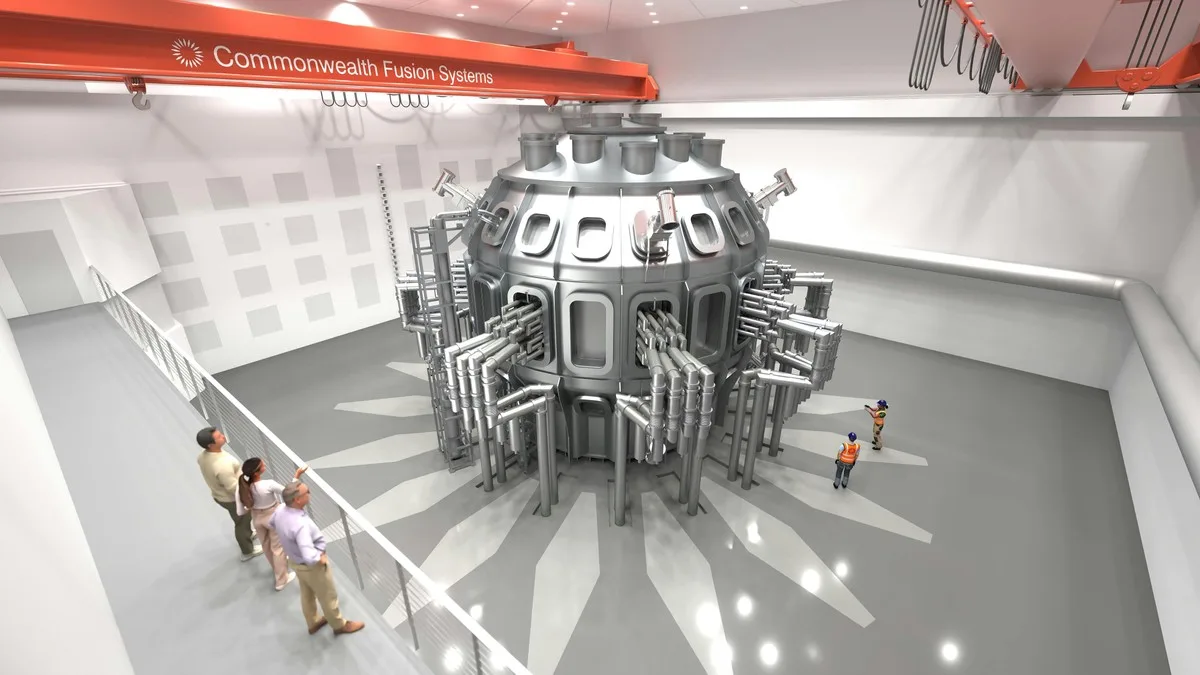
At the center of the partnership is the creation of a high-fidelity digital twin of CFS’s SPARC fusion reactor. Using Siemens Designcenter NX and NVIDIA Omniverse, engineers can build a virtual replica that integrates design data, real-world sensor inputs, and AI-accelerated physics simulations. This digital foundation enables teams to explore how the reactor behaves under different operational conditions, anticipate maintenance needs, and test design refinements without waiting for physical experiments.
Digital twins have already transformed industries such as aerospace and advanced manufacturing by compressing development cycles and reducing failure risk. Applying the same approach to fusion represents a turning point, allowing fusion engineers to operate with tools that match the complexity and urgency of the challenge they face.
SPARC and ARC: A Commercially Oriented Fusion Roadmap
CFS’s near-term focus is SPARC, a compact fusion device designed to demonstrate net fusion energy, producing more energy than it consumes. SPARC is not intended as a power plant, but as a validation step toward ARC, the company’s planned commercial fusion reactor. ARC is envisioned as a scalable, grid-connected power source capable of delivering steady, carbon-free electricity.
A core enabler of this roadmap is CFS’s work on high-temperature superconducting (HTS) magnets, widely regarded as a breakthrough for fusion energy. These magnets allow for stronger magnetic fields in smaller reactors, reducing the size and cost traditionally associated with fusion facilities. Commonwealth Fusion Systems has already demonstrated these magnets at record-breaking field strengths, giving credibility to its claim that fusion plants can be built more compactly and efficiently than previously thought possible.
AI-Driven Simulation Accelerates Learning Curves
Fusion reactors operate in regimes where physical testing is expensive, slow, and inherently limited. By combining sensor data from SPARC with AI-accelerated simulations, Commonwealth Fusion Systems aims to create a continuous feedback loop between the physical reactor and its digital twin. This approach allows engineers to refine models based on real-world behavior and explore operating scenarios that would be impractical or risky to test directly.
The use of AI in this context is not about automation for its own sake, but about scaling human expertise. Fusion engineers can evaluate more design variables, detect emerging issues earlier, and converge on optimal configurations faster. This data-driven approach aligns fusion development with how other highly complex systems (from jet engines to semiconductor fabs) are engineered today.
Capital, Talent, and Industrial Momentum
CFS has raised more than $2 billion in funding, giving it the largest war chest in the fusion energy sector. That capital has enabled the company to attract top talent across physics, engineering, manufacturing, and software, while investing heavily in infrastructure and supplier relationships. The scale of investment also signals growing confidence among investors and policymakers that fusion energy is transitioning from speculative research to credible energy infrastructure.
The company’s engagement with policymakers and industrial partners reflects an understanding that commercial fusion will require more than technical success. Grid integration, regulatory pathways, supply chains, and public trust will all shape how fusion is deployed. Commonwealth Fusion Systems has positioned itself as a company preparing to operate power plants in the real world.
Fusion Steps Onto the Main Technology Stage
Fusion’s appearance at CES, a venue traditionally associated with consumer electronics and digital innovation, highlights how perceptions of fusion energy are changing. No longer confined to academic conferences or government labs, fusion is increasingly being discussed alongside technologies that define modern life, from AI infrastructure to electric mobility.
Commonwealth Fusion Systems has emphasized that fusion’s potential extends beyond clean electricity for homes and businesses. High-density, always-on energy sources could play a critical role in powering data centers, industrial processes, and future technologies that demand reliable, large-scale energy inputs. As energy demand grows alongside electrification and AI adoption, Commonwealth Fusion Systems will be a long-term stabilizing force within the energy mix.
From Breakthroughs to the Grid
The collaboration with NVIDIA and Siemens reflects a new phase in the journey. One where fusion development is increasingly driven by industrial discipline, digital tools, and execution speed. By combining advanced magnets, AI-driven simulation, and digital twins, Commonwealth Fusion Systems is attempting to compress timelines that once spanned generations.
Whether fusion ultimately reshapes the global energy system will depend on continued technical progress and successful commercialization. What is increasingly clear, however, is that fusion is no longer treated as a distant promise. It is being engineered, modeled, and prepared for deployment with the same rigor as the world’s most advanced industrial technologies.
The use of digital twins and AI by Commonwealth Fusion Systems mirrors how other complex technologies have moved from prototypes to infrastructure. If fusion succeeds, it will be because it adopted the tools and mindset of modern engineering and not because it waited for a perfect scientific moment.