

Gnani.ai Voice-to-Voice AI Signals Next Interface Beyond Chatbots
Computing has historically evolved through interfaces. Early systems required command lines understood only by specialists. Graphical interfaces expanded access to general users. Smartphones then compressed computing into touch-driven screens carried everywhere.
Artificial intelligence now suggests another transition. Instead of navigating menus or typing instructions, users increasingly interact with systems conversationally. Yet most current AI still relies on text input and output, meaning the screen remains central. Voice assistants improved convenience but remained limited, often unable to reason across complex workflows or sustain natural dialogue.
The next step is not simply speech recognition or text-to-speech playback. It is continuous spoken interaction where machines listen, interpret, respond, and act in real time.
Why Are Enterprises Moving Beyond Chatbots to Voice AI?
Chatbots demonstrated how natural language could simplify software interaction, but they also revealed limitations. Typing questions and reading responses still requires attention, literacy, and manual confirmation of actions. In fast-moving environments such as customer service, logistics, or banking support, friction remains. Human conversation works differently. People interrupt, switch languages, clarify intent, and respond emotionally. Traditional conversational systems struggle to manage these behaviors because they process input sequentially rather than interactively.
Latency becomes critical. Even a short delay breaks conversational rhythm. Multilingual communication adds complexity. Many systems translate text but cannot sustain fluid spoken dialogue across languages. As a result, organizations still rely heavily on human intermediaries. Real-time voice AI attempts to remove this boundary, allowing software to participate directly in conversation rather than waiting for commands.
How Voice-to-Voice AI Turns Conversation Into the Interface?
Voice-to-voice large language models aim to process speech directly and respond with speech without requiring text conversion as the primary interface. Instead of the sequence of speech-to-text, text processing, then text-to-speech, the system operates as a continuous conversational loop.
This reduces latency and preserves conversational nuance such as tone and pacing. It also allows AI systems to handle interruptions, maintain context, and interact naturally across languages.
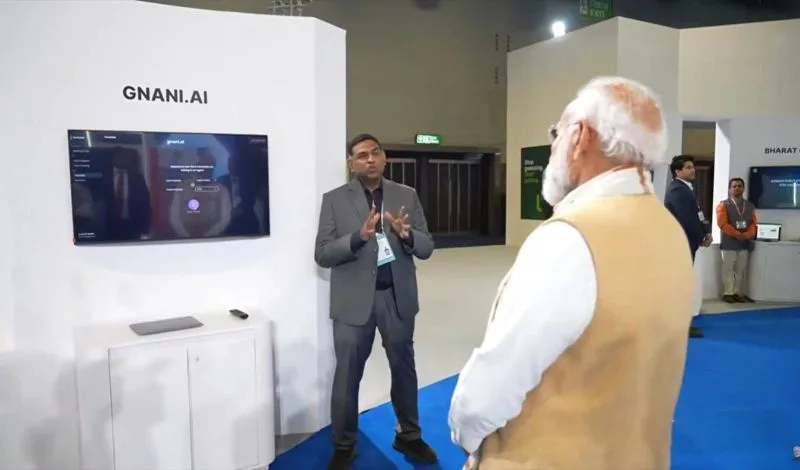
During the India AI Impact Summit 2026, Bengaluru-based Gnani.ai demonstrated and launched its voice-to-voice LLM, showing real-time translation and conversational interaction scenarios. The system was presented as capable of supporting natural communication between humans and machines without traditional interface constraints.

Gnani.ai: Platform Designed for Operational Conversations
Gnani.ai positions its technology not as a consumer assistant but as enterprise infrastructure. Its platform combines speech recognition, language models, and orchestration systems to automate customer interactions across voice and chat channels.
The company reports handling tens of millions of daily interactions across more than forty languages, including multiple Indian languages that often lack strong digital representation. Rather than generic conversation, its models are tuned for domain-specific use cases such as banking verification, collections, healthcare communication, and customer support workflows.
Its product suite spans authentication through voice biometrics, automated workflow execution, agent assistance, and post-interaction analytics. Together, these components form a system where conversation becomes the operational interface rather than a support layer.
The difference is subtle but important. Traditional software requires users to navigate processes, while conversational systems guide and execute those processes within dialogue.
Why Multilingual Societies May Lead the Voice AI Era?
Voice-native computing has particular relevance in multilingual societies. Text-based systems assume literacy in a standard digital language, but many populations operate across multiple spoken languages and dialects. This creates barriers when services rely heavily on forms and typed interaction.
Real-time spoken interfaces reduce these barriers. If a system can understand and respond across languages instantly, digital services become accessible without training users to adapt to software conventions.
At the summit, the company demonstrated live translation capabilities where spoken Hindi could be understood and responded to in another language. International visitors observing the demonstration highlighted how such systems could support communication across regions without shared linguistic infrastructure.
This suggests a potential shift where digital inclusion depends less on device familiarity and more on natural communication ability.
From Support Tool to Decision Layer
Enterprise automation has historically separated conversation from action. A customer calls a support center, describes an issue, and a human operator translates the request into system inputs. AI chatbots improved routing and information retrieval but still relied on structured workflows behind the scenes.
Voice-to-voice AI changes this relationship. Instead of acting as an intermediary, conversation becomes the workflow itself. An authenticated caller could verify identity, request a transaction, and complete it within a single continuous interaction.
This transforms conversational systems from assistance tools into operational layers. Rather than helping employees operate software, the system itself operates software through dialogue.
Such architecture requires reliability and contextual awareness. Misinterpretation carries consequences, especially in financial or healthcare scenarios. Therefore, domain-specific tuning and validation become central to adoption.
How Gnani.ai Converts Conversation Into Executable Workflows?
Identity, Understanding and Action in One Pipeline
To support this shift from conversation to execution, Gnani.ai has built a stack designed specifically for operational reliability rather than generic dialogue generation. Its platform combines real-time speech recognition, text-to-speech synthesis, voice biometrics authentication, and conversational reasoning into a single continuous pipeline. Instead of routing users across IVR menus or multiple agents, the system can identify the speaker, understand intent, and complete actions such as authentication, support resolution, or collections workflows within the same interaction. This reduces the fragmentation typically seen in contact-center automation where verification, understanding, and execution occur in separate stages.
The Enterprise Stack Behind the Voice Layer
The company’s enterprise suite reflects this architecture. Automate365 handles workflow automation across voice and chat interactions, Assist365 provides real-time guidance during human conversations, Armour365 enables speaker verification through voice biometrics, and Aura365 analyzes conversations for compliance and operational insight. Alongside these tools, Gnani.ai also offers a no-code development environment called Inya that allows organizations to deploy domain-specific conversational agents without building speech systems from scratch. Rather than functioning as standalone bots, these components operate as coordinated parts of an execution layer connected to enterprise systems.
Multilingual Operations Instead of Multilingual Interfaces
Because the platform is built for multilingual environments, the system supports dozens of languages and can switch between them during a conversation without restarting context. This is particularly relevant in sectors such as banking, telecom, healthcare, and logistics where customers frequently alternate languages while describing problems. By combining language flexibility with operational workflows, the platform moves beyond answering questions to completing regulated processes, a distinction that determines whether conversational AI remains a support channel or becomes an operational interface.
Implications for Human-Machine Interaction
If conversational systems reach sufficient accuracy and speed, the screen may no longer be the primary access point to digital services. Interfaces would shift from navigation to communication.
Applications might be replaced by services reachable through natural speech. A user could request an insurance update, schedule a service appointment, or resolve billing questions without opening software. For businesses, this reduces friction and operational cost. For users, it reduces the need to understand system structure.
The transition parallels earlier computing shifts. Graphical interfaces removed the need to memorize commands. Mobile interfaces removed location constraints. Conversational interfaces could remove interaction complexity altogether.
A Future Where Software Is Spoken, Not Opened
While customer interaction is the immediate use case, the broader implications extend further. Real-time voice reasoning could support field operations, internal enterprise workflows, accessibility services, and multilingual collaboration.
In environments where workers cannot interact with screens easily, such as manufacturing floors or logistics operations, spoken interaction may become the primary control method. Instead of navigating dashboards, employees could communicate directly with operational systems. Over time, software may evolve from a collection of applications into a conversational environment where tasks are executed through dialogue rather than navigation.
Artificial intelligence has largely been measured by how convincingly it generates responses. The next phase may be measured by how seamlessly it participates in action. Voice-to-voice systems suggest a transition from information retrieval to operational execution through conversation. If reliable at scale, this approach could reshape how digital services are accessed, especially in multilingual societies. The significance lies not only in automation but in accessibility, as technology adapts to human communication rather than requiring humans to adapt to technology.