

Lace AI: The Revenue System Transforming Trades Call Centers
For plumbing, HVAC, electrical, and garage door companies across America, the phone is still the lifeblood of the business. Every inbound call is a potential booked job, a revenue opportunity, and a customer relationship in the making. Yet for most home services companies, the majority of what happens on those calls is invisible. Managers spot-check a handful of recordings each week if they are lucky. Customer service representatives handle dozens of calls a day with little systematic feedback on how to improve. Opportunities are lost silently, and nobody knows exactly why. Lace was built to change that, and in doing so it has become one of the most impactful AI platforms operating in the trades industry today.
What Is Lace AI? The AI System Built for One Industry and One Problem
Lace is an AI-powered revenue system purpose-built for call centers in the trades, meaning businesses in home services sectors such as plumbing, HVAC, electrical, garage door, and related fields. The platform operates across two interconnected product lines: the AI Revenue Engine, which analyses every inbound call to surface revenue intelligence and coach customer service representatives in real time, and the AI CSR, an autonomous AI agent that answers calls, books jobs, and follows up on missed opportunities around the clock, including nights, weekends, and holidays when human teams are unavailable.
The company’s founding insight is straightforward but operationally powerful: in trades businesses, between 80 and 90 percent of revenue originates from phone calls, yet those calls have historically been the least visible and least systematically managed part of the entire operation. By analysing 100 percent of calls rather than a sample, and by turning that analysis into structured, actionable intelligence for managers and representatives, Lace transforms the call center from a cost centre into a measurable, optimisable revenue engine.
The Problem Lace Solves: The Invisible Revenue Leak Every Trades Business Has
The challenge Lace addresses is one that virtually every home services business above a certain scale faces, though most have come to accept it as simply the cost of doing business. When a call center handles hundreds or thousands of calls per week, manual quality assurance becomes impossible at any meaningful depth. A typical QA team listening to calls manually can review a fraction of total volume, and that fraction is almost never representative.
Calls that go wrong, customers who raise objections, bookings that are lost because a representative missed a cue or did not know how to handle a specific situation: all of this happens in the dark, visible only in the aggregate revenue numbers but never pinpointed to its root cause.
The consequences compound quickly. A single percentage point improvement in booking rate at a company like A1 Garage Door Service, one of Lace’s most prominent customers, is worth approximately $3 million in additional annual revenue. That figure, cited by A1 owner Tommy Mello, illustrates why the stakes around call center performance are so high in the trades. Every unanswered call, every unbooked appointment, every customer who calls after hours and reaches voicemail rather than a live booking agent represents not just a lost transaction but potentially a lost customer relationship for life, since trades customers who find another provider in a moment of need often do not return.
Lace attacks this problem on both fronts simultaneously: making existing human teams dramatically more effective through data-driven coaching, and filling the coverage and capacity gaps that human teams cannot address alone.

The AI Revenue Engine: Intelligence That Drives Coaching
The AI Revenue Engine is the intelligence layer of the Lace platform. It processes every call that passes through a client’s call center, transcribes and analyses the conversation, and extracts a structured set of insights that would previously have required a large manual QA team to generate, and even then only for a fraction of call volume.
100 Percent Call Coverage
Unlike manual QA, which by definition is limited to whatever sample size a team can review, Lace analyses every single call. This completeness is foundational to the value of the insights it generates. When you can see every call, patterns become statistically reliable rather than anecdotal. The reasons customers decline to book, the objections most commonly raised, the times of day when conversion drops, the specific representatives who are outperforming or underperforming on particular call types: all of these become visible with a precision that spot-checking can never match.
Targeted CSR Coaching
Armed with complete call data, Lace identifies exactly where each customer service representative is losing bookings and delivers targeted coaching recommendations that address those specific gaps. Rather than generic call handling training, representatives receive feedback grounded in their own actual calls, with the specific moments and missed opportunities surfaced for review.
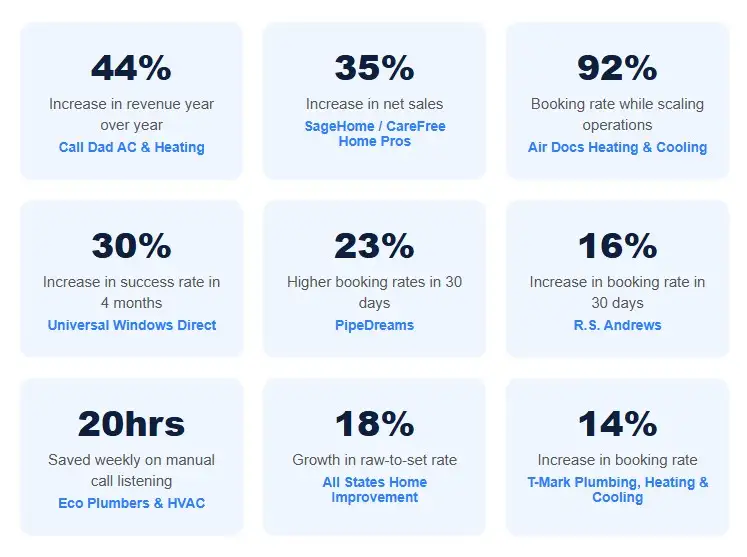
This kind of precision coaching has a measurable impact: at PipeDreams, an HVAC and plumbing aggregator operating across multiple US markets, a single representative increased their individual booking rate by nearly 50 percent after engaging with Lace’s performance data. Across the team, the company’s qualified booking rate rose from approximately 65 percent to over 85 percent within a month of implementation.
Objection Intelligence and Business Insights
Beyond individual representative performance, Lace surfaces business-level intelligence that managers and owners can use to make strategic decisions. The platform categorises every objection raised by a caller and identifies whether the lost booking was the result of a representative’s handling, a genuine business gap such as a missing service or geographic coverage limitation, or another factor entirely. This distinction matters enormously for decision-making.
If representatives are losing bookings because customers are asking for a service the business does not offer, coaching those representatives harder will accomplish nothing; the business needs to expand its offering.
Lace makes this distinction automatic and quantitative, enabling leadership to direct resources to the right problems rather than treating every booking shortfall as a training issue.
Second Chance Leads and Rehashing
Lace’s Revenue Engine also identifies calls that ended without a booking but where the customer’s needs were addressable, and automatically initiates outbound follow-up via phone and SMS to give those opportunities a second chance. In the trades industry, where a customer who called about a leaking pipe or a broken air conditioner is likely to try another company within hours if their first call did not result in a booking, the ability to follow up rapidly and automatically can recover significant revenue that would otherwise be permanently lost.
Industry Benchmarks and Best Practice Playbooks
Lace also provides clients with access to industry benchmarks drawn from its broader customer base of top-performing home services companies, as well as proven playbooks from leading call centers in the trades. This contextual intelligence helps businesses understand not just how they are performing in absolute terms but how they compare to peers, and what the most effective operators are doing differently.
The AI CSR: 24/7 Coverage and Autonomous Booking
The second major component of the Lace platform is the AI CSR, an autonomous AI agent designed to handle inbound calls, book appointments, and follow up on missed opportunities without human intervention. In the trades, after-hours coverage is a persistent and expensive challenge.
Customers do not restrict their plumbing emergencies or HVAC failures to business hours, but maintaining a fully staffed call center around the clock is prohibitively expensive for most businesses. The result is that calls go unanswered at night, on weekends, and during peak periods when hold times exceed what callers are willing to wait.
Zero Abandoned Calls
The Lace AI CSR is designed to ensure that every call receives a response, at any hour. By eliminating the category of unanswered call entirely, it addresses one of the most significant and least visible sources of lost revenue in home services businesses. Tommy Mello of A1 Garage reports that the AI CSR is booking over 85 percent of the calls it handles, a conversion rate that compares favourably with top-performing human representatives.
Direct Integration with ServiceTitan
The AI CSR books appointments directly into ServiceTitan, the industry-standard field service management platform used by the majority of professional home services companies. It can match the right technician to the right job type based on Average Contribution Per job criteria, ensuring that scheduling decisions made by the AI agent reflect the same operational logic a human dispatcher would apply. This deep integration means the AI CSR is not a standalone booking tool that creates parallel data; it feeds directly into the same operational workflow the business already runs.
Outbound Follow-Up and SMS Rehashing
Beyond inbound call handling, the AI CSR also runs outbound follow-up campaigns targeting calls that ended without a booking. Using both outbound calling and SMS, it re-engages customers who expressed need but did not commit, turning what would otherwise be permanently lost opportunities into booked jobs. The combination of inbound coverage and outbound rehashing means the AI CSR operates as a complete lead recovery system rather than simply a call answering service.
Who Lace Serves? Built for the Trades, Trusted by the Best in the Business
Lace is built specifically for home services businesses in the trades, including plumbing, HVAC, electrical, garage door, and related sectors. Its customer base spans businesses of different scales, from regional operators to some of the largest home services companies in the United States. The platform is most impactful for businesses where the call center is central to revenue generation, which in the trades typically means any company relying on inbound call volume to drive job bookings.
Both single-location operators and multi-market aggregators use Lace, and the platform’s ability to surface performance data at the individual representative and aggregate level makes it equally relevant for businesses managing small teams and those overseeing dozens of CSRs across centralised call centers.
Lace partners with Nexstar and ServiceTitan, two of the most influential organisations in the home services industry, as well as training and consulting firms including Power Selling Pros, BDR, and Lennox. These partnerships position Lace within the existing ecosystem of tools, training, and standards that professional trades businesses already operate within, rather than asking owners and managers to adopt an entirely separate technology stack.
Proven Results Across Real Businesses
The scale and consistency of results reported by Lace’s customers is one of the most compelling aspects of the platform’s commercial story. Across a client base that includes some of the most recognisable names in US home services, the outcomes follow a clear pattern of material, measurable improvement within weeks of implementation.
The PipeDreams case study is particularly instructive in illustrating what full call visibility unlocks at an operational level. The company was handling up to 18,000 calls per month with 25 CSRs and had previously relied on a team of six to seven QA staff listening to calls manually, at significant cost and with inherently incomplete coverage.
After implementing Lace, that QA function was fulfilled by one or two people, representing a 5.5 times reduction in QA cost, while the quality and completeness of the resulting insights improved dramatically. Managers could now see every objection that led to a lost deal in real time, categorise them by root cause, and make staffing and service decisions accordingly.
Everything You Need to Know Before Getting Started with Lace AI
Does Lace replace my call center team?
No. Lace is designed to work alongside existing teams rather than replace them. The AI Revenue Engine makes human representatives more effective by giving them precise, data-driven coaching. The AI CSR fills gaps in coverage, particularly after-hours and during peak periods, that human teams cannot practically address. The result is a combined human-plus-AI call center that outperforms what either could achieve alone.
Does Lace work with ServiceTitan?
Yes, and this integration is central to the platform’s operational value. The AI CSR books appointments directly into ServiceTitan, matching technicians to job types based on ACP criteria and feeding directly into the existing dispatch and scheduling workflow. Lace is a ServiceTitan partner, reflecting the depth of this integration.
How quickly does Lace deliver results?
Multiple customers report material improvements within the first 30 days of implementation. R.S. Andrews saw a 16 percent increase in booking rate within a month. PipeDreams’ qualified booking rate moved from approximately 65 percent to over 85 percent in the same timeframe. The speed of impact reflects the fact that Lace does not require a long behaviour change programme: it surfaces immediately actionable insights that managers and representatives can apply to the next call.
What types of businesses is Lace designed for?
Lace is specifically designed for home services trades businesses, including HVAC, plumbing, electrical, garage door, and related sectors, where the call center is the primary revenue channel. It is relevant for businesses managing small call center teams and for large multi-market operators handling tens of thousands of calls per month.
Why Lace Matters for the Trades Industry? The Moment the Trades Industry Stopped Flying Blind!
The home services industry in the United States is a multi-hundred-billion-dollar market that has historically operated with relatively limited technology investment in its core revenue operations. Marketing technology, field service management, and dispatch software have all advanced significantly, but the call center, the point at which marketing spend converts into actual booked jobs, has remained a relative blind spot.
Lace’s emergence as a dedicated AI revenue platform for this specific context represents an important moment of maturation for the industry’s technology stack.
What makes Lace’s approach distinctive is its specificity. Rather than applying a generic call center analytics tool to the trades context, Lace has built its platform around the operational realities, the terminology, the objection types, the booking workflows, and the revenue metrics, that define how home services businesses actually work.
The integration with ServiceTitan, the partnerships with Nexstar and industry training organisations, and the customer base of recognised trades businesses all reflect a deep understanding of the sector that generic enterprise software cannot replicate.
For home services business owners who have accepted call center visibility as an unsolvable problem, and managers who have coached their teams on instinct rather than data, Lace represents a fundamental shift in what is possible. Every call is analysed. Every opportunity identified. Every lost booking is given a second chance. That is the promise, and based on the results its customers are reporting, it is one Lace is delivering on.