


Northwood Space Raises $100M to Transform Satellite Ground Networks
Northwood Space is emerging as one of the most ambitious infrastructure players in the modern space economy, focusing not on satellites themselves but on the critical ground systems that allow space missions to function at scale. While much of the space industry’s attention has been placed on launch vehicles, satellite constellations, and orbital platforms, the ability to receive, process, and route data back to Earth has quietly become one of the biggest operational bottlenecks. Northwood is working to solve this problem by building an advanced, vertically integrated ground network powered by phased array technology, designed to support high-throughput, low-latency, and resilient space communications across multiple orbits.
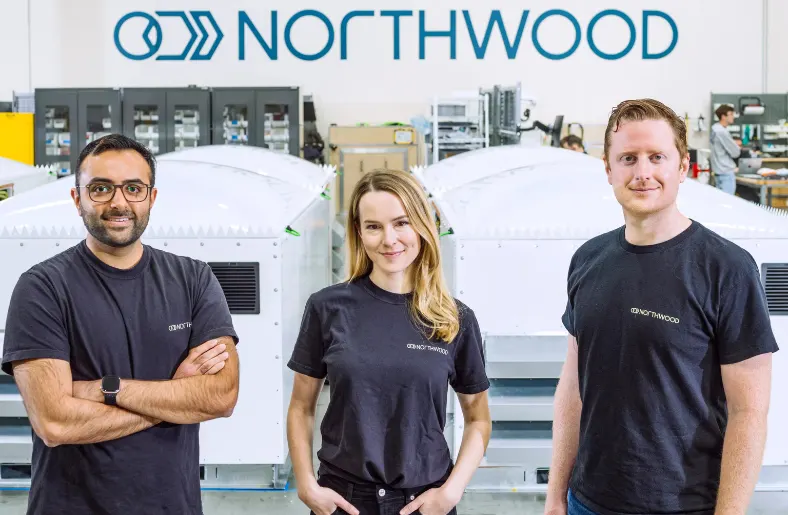
The company was founded by Bridgit Mendler, Griffin Cleverly, and Shaurya Luthra with the mission of expanding access to space by modernizing satellite backhaul infrastructure. Their approach centers on owning the full ground stack, from concept and hardware design to deployment and live data delivery. By vertically integrating the entire system, Northwood aims to collapse timelines that traditionally take years into months, and in some cases days, enabling faster and more flexible space operations for both government and commercial missions.
The Hidden Backbone of Space Operations
Satellite missions today generate unprecedented volumes of data, especially as low Earth orbit constellations multiply and sensing platforms become more sophisticated. Traditional dish-based ground stations, which must mechanically move to track satellites, struggle to keep pace with this growth. They are slow to deploy, limited in flexibility, and often unable to support simultaneous connections across different orbital regimes. These constraints increasingly limit how quickly space systems can operate, scale, and deliver real-time intelligence or communications.
Northwood’s phased array technology represents a fundamental shift in how ground infrastructure operates. Unlike mechanical dishes, phased array antennas electronically steer beams, allowing them to connect with multiple satellites at once without moving parts. This enables dynamic, high-power communication links across low Earth orbit (LEO), medium Earth orbit (MEO), and geostationary orbit (GEO) simultaneously. According to the company, its first product, Portal, is capable of connecting with multiple satellites across all three orbital layers, a capability that significantly increases throughput and operational flexibility.
The company has already demonstrated rapid execution with Portal. Northwood designed what it describes as the highest power commercial communications phased array ever built, reached production volumes of eight Portal units in less than a month, and deployed systems halfway around the world within twelve hours. These milestones highlight a speed of development and deployment that is rare in traditional aerospace infrastructure.
Major Funding and Government Validation
Northwood’s momentum was recently underscored by a $100 million Series B funding round led by Washington Harbour Partners LP and co-led by Andreessen Horowitz. The financing follows less than a year after the company’s $30 million Series A round, signaling strong investor confidence in Northwood’s execution and long-term infrastructure vision.
Beyond venture backing, Northwood has also secured substantial government contracts, including a $49.8 million agreement with the United States Space Force to support the Satellite Control Network. This contract is particularly notable for the speed of delivery. Northwood achieved a three-month turnaround from contract execution to fully operational communication links, a timeline that stands out in defense procurement, where deployments often take years.
The Space Force partnership serves as a strong validation of Northwood’s technology in high-stakes environments where reliability, security, and performance are critical. It also positions the company as a key player in the evolving national security space infrastructure ecosystem, where rapid deployment and resilient communications are becoming increasingly important.
Vertical Integration as a Strategic Advantage
One of Northwood’s defining strategies is its vertically integrated model. Rather than relying on a patchwork of vendors for hardware manufacturing, software systems, deployment logistics, and operations, the company controls the entire lifecycle of its ground network. This approach allows Northwood to move faster, optimize performance across layers, and respond quickly to evolving mission requirements.
By owning the full stack, Northwood can rapidly iterate on antenna design, scale manufacturing, and deploy systems globally without waiting on external suppliers. This flexibility is particularly valuable as space missions become more proliferated and dynamic, requiring ground networks that can adapt in real time rather than rely on fixed infrastructure built years in advance.
The company is already setting ambitious deployment goals. By the end of 2026, Northwood is targeting over 82 operational beams across 18 global ground sites. These sites will support a range of use cases including high-power dynamic beams for space operations, low-latency communications for satellite constellations, and rapidly deployable antennas for space sensing and defense applications.
Why is Ground Infrastructure Becoming Strategic?
The growing importance of companies like Northwood reflects a broader shift in the space industry. As satellite constellations expand and missions demand near real-time data delivery, the ground segment is increasingly becoming the limiting factor in performance. Launch costs have fallen dramatically, satellite manufacturing has become more modular, and orbital capacity has surged. Yet without modern ground networks to support this growth, much of that potential remains constrained.
For defense and national security, resilient ground infrastructure is essential for command and control, intelligence gathering, and rapid response capabilities. For commercial operators, efficient backhaul determines the quality of services ranging from broadband connectivity to Earth observation analytics. In both cases, the ability to scale quickly and operate across multiple orbits is becoming a competitive and strategic necessity.
Northwood’s phased array approach aligns closely with these emerging needs. Dynamic beamforming, multi-orbit connectivity, and rapid deployment are well suited for a future where space systems are more distributed, adaptive, and data-intensive. By treating ground infrastructure as a scalable network rather than fixed installations, the company is effectively applying modern cloud-like principles to space communications.
A New Era of Space Infrastructure
Northwood Space’s rapid progress highlights how the next phase of the space economy will be built on the ground. As space becomes increasingly integrated into everyday communications, navigation, defense, and scientific research, the systems that connect satellites to Earth will play a central role in determining performance and reliability.
The company’s combination of advanced phased array technology, vertical integration, and fast execution positions it as a foundational infrastructure provider for the modern space era. While many startups focus on launching more satellites or developing new payloads, Northwood is addressing the less visible but equally critical challenge of how data moves between space and Earth.
With significant funding, government validation, and aggressive expansion plans, Northwood Space is shaping a future where space missions can operate faster, scale more easily, and deliver real-time capabilities across the globe.
Northwood Space is tackling one of the most underestimated constraints in the modern space economy: outdated ground infrastructure. While launches and satellites dominate headlines, the ability to move data efficiently between orbit and Earth ultimately determines mission success. Northwood’s vertically integrated, phased-array approach reflects how space operations are becoming more networked, dynamic, and time-sensitive. As commercial and defense space activity continues to expand, companies modernizing the ground segment are likely to become as strategically important as those building systems in orbit.