


Is Glasgow-Based Ochil Astronautics the Next Space AgTech Leader?
The Problem Space Exploration Cannot Ignore: Food
Human space exploration has made significant progress in propulsion, robotics, and satellite systems. Missions are becoming longer, more complex, and more ambitious. Plans for sustained lunar presence and eventual missions to Mars are no longer theoretical discussions.
Yet one constraint remains fundamental. Humans need food, and not just in packaged or pre-supplied form. As mission durations extend, reliance on resupply missions becomes impractical, both logistically and economically. Carrying all required nutrition from Earth is not a scalable solution.
This creates a requirement that goes beyond convenience. Long-duration missions will depend on the ability to produce fresh food in controlled environments. The challenge lies in doing this reliably in conditions that are hostile to traditional agriculture, including microgravity, radiation exposure, and limited resources.
Why Space Agriculture Is Still an Unsolved Engineering Problem?
Growing plants in space is not a new concept. Experiments on the International Space Station have demonstrated that crops can be cultivated in controlled environments. However, scaling these experiments into dependable systems for continuous food production presents a different set of challenges.
Space agriculture requires systems that can operate autonomously, tolerate extreme conditions, and deliver consistent output without failure. Variables such as light, water, nutrients, and temperature must be precisely controlled, often with limited human intervention.
Reliability becomes the defining factor. A failure in a space-based food system is not a minor inconvenience; it is a critical risk. This shifts the focus from experimentation to engineering systems that can operate with a high degree of certainty.
Inside Ochil Astronautics: Engineering for “No-Fail” Environments
Ochil Astronautics, based in Glasgow and led by RAF veteran Stuart Preston, is building its approach around this requirement for reliability. The company focuses on developing hardware designed to operate in the most challenging environments, with a particular emphasis on resilience and autonomy.
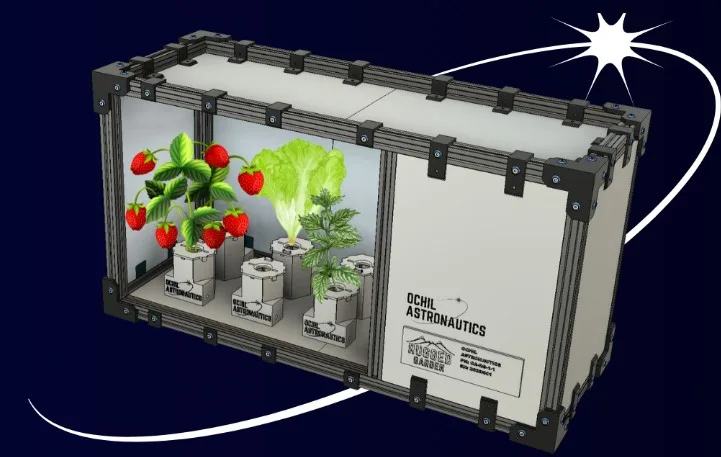
Its systems, including Rugged Garden and Botanic Sky, are built to provide controlled cultivation in conditions where traditional agriculture is not possible. These platforms are designed with a focus on durability, ensuring that they can function in environments ranging from space missions to remote or unstable regions on Earth.
The engineering approach reflects a combination of military-grade reliability and advanced cultivation techniques. By prioritizing robustness, the company aims to address one of the most critical barriers to scaling space agriculture.
From Orbit to Earth: Dual-Use Applications
While the long-term vision is centered on space exploration, Ochil Astronautics is also developing its technology for immediate applications on Earth. Environments such as conflict zones, disaster relief areas, and remote locations share some of the same constraints as space missions.
In these contexts, access to fresh food can be limited or unreliable. Systems that can operate independently and produce nutrition locally offer a practical solution. By applying space-focused technology to terrestrial challenges, the company is creating a dual-use model that supports both current needs and future missions.
This approach also accelerates development. Deploying systems on Earth allows for testing, iteration, and validation in real-world conditions, reducing the risks associated with eventual space deployment.
Recognition and Momentum in the UK Space Ecosystem
Ochil Astronautics has begun to gain recognition within the UK’s growing space and innovation ecosystem. The company was recently named among the top five Scottish finalists at the UK StartUp Awards 2026, reflecting its emerging presence in the sector.
This recognition sits alongside broader institutional support. Ochil Astronautics is the only space-sector company selected for the STAC Scale Programme in Glasgow, providing it with structured support for scaling its operations. It is also part of the UK Space Agency’s Explore accelerator, further embedding it within the national space innovation framework.
These milestones indicate that the company is not operating in isolation. It is part of a wider effort to develop capabilities that support the future of space exploration and related industries.
Building the Infrastructure for Long-Duration Missions
The broader significance of Ochil Astronautics lies in its role within the emerging infrastructure of space exploration. As missions extend beyond low Earth orbit, the requirements for sustainability become more complex.
Food production is one component of this infrastructure, but it is closely linked to other systems, including life support, resource management, and habitat design. Reliable cultivation systems contribute to a more self-sufficient environment, reducing dependence on external supply chains.
This shift toward in-situ resource utilization is a key theme in current space strategies. The ability to produce essential resources locally is critical for enabling longer missions and expanding human presence beyond Earth.

Investment, Standards, and Strategic Positioning
Ochil Astronautics’ trajectory is supported by a combination of investment and strategic alignment with industry standards. The company secured investment from Pera International in late 2025, providing additional resources to advance its technology and scale its operations.
It has also committed to BSI Flex 1969 sustainability standards, reflecting an emphasis on responsible and scalable development. This alignment with established frameworks is particularly relevant in a sector where safety, reliability, and compliance are essential.
By combining technical development with institutional support and standards compliance, the company is positioning itself within a structured pathway toward broader adoption.
What Comes Next for Space Agriculture and Food Systems
The development of space agriculture systems marks an important step in the evolution of human spaceflight. As missions become more ambitious, the ability to sustain life beyond Earth will depend on technologies that can operate independently and reliably.
Ochil Astronautics represents one approach to addressing this challenge, focusing on hardware that can deliver consistent performance in extreme conditions. Its work highlights the importance of practical engineering solutions in enabling broader exploration goals.
At the same time, the overlap between space and terrestrial applications suggests that innovations in this field may have wider implications. Technologies designed for extreme environments often find relevance in addressing challenges on Earth, particularly in areas related to food security and resource management.
Companies like Ochil Astronautics point toward a future where solving the practical challenges of sustaining life in space also contributes to addressing critical needs on Earth, particularly in food production and resilience.