

Sapiom Raises $15.75M to Power the Agentic AI Economy
Artificial intelligence is rapidly moving beyond copilots and chat interfaces into something far more consequential: autonomous agents that can plan, execute, and complete tasks on their own. From booking software tools to orchestrating workflows across APIs, these agents promise a future where digital labor operates continuously and independently. Yet despite major advances in reasoning and execution, one critical limitation remains unresolved. AI agents can think and act, but they cannot transact. Addressing this foundational gap is Sapiom, a San Francisco–based fintech and AI infrastructure startup that has recently raised $15.75 million in seed funding to give AI agents trusted access to the API economy.
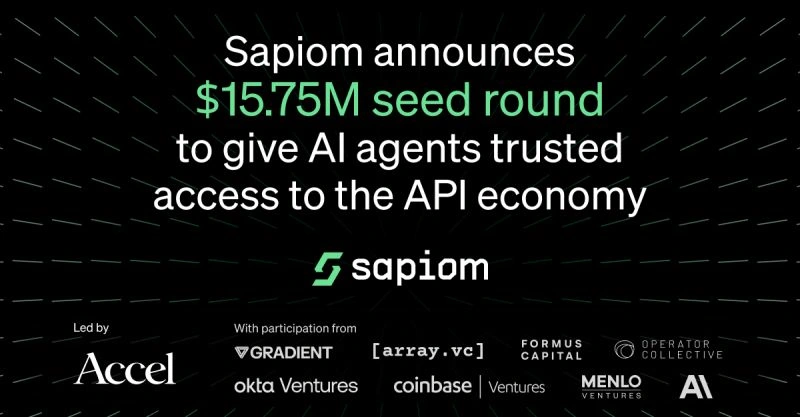
The funding round was led by Accel, signaling strong investor conviction that the next phase of AI adoption will depend less on smarter models and more on real-world infrastructure. Sapiom’s mission is clear: to build the financial and access layer that allows AI agents to autonomously buy, sell, and negotiate on behalf of humans, safely and at scale. As the so-called agentic economy begins to take shape, Sapiom is positioning itself as one of its earliest and most critical infrastructure providers.
Why the Agentic Economy Is Stuck Without Financial Infrastructure?
The idea of autonomous AI agents has quickly moved from research labs into real products. Today, agents can already write code, deploy applications, schedule meetings, analyze data, and coordinate complex workflows. However, most demonstrations quietly rely on human intervention at a critical step: payment and access.
An AI agent may identify the best API, dataset, or compute resource to complete a task, but it cannot independently authenticate itself, pay for access, or manage spending limits. Instead, humans must manually provision credentials, attach credit cards, and approve transactions. This bottleneck prevents agents from operating continuously and independently. In other words, the agentic economy cannot function without a way for software to securely hold identity, manage money, and interact with real-world services. This is the gap Sapiom is focused on closing.
Sapiom’s Core Idea: Payments and Identity for Software, Not Humans
Sapiom is building infrastructure specifically designed for non-human economic actors. Its platform enables AI agents to operate as trusted participants in the API economy through a combination of identity, payments, and access controls.
At the foundation of this system is Know-Your-Agent (KYA), an identity framework that allows AI agents to authenticate themselves when interacting with external services. Instead of borrowing a human’s credentials, agents receive their own verifiable identity with clearly defined permissions.
On top of identity, Sapiom provides agent-linked wallets that allow AI systems to make payments autonomously. These wallets are governed by spending limits, usage policies, and real-time controls, ensuring that agents can transact safely without risking runaway costs or unintended behavior.
The platform also supports multi-rail payments, enabling agents to pay for software subscriptions, API usage, data access, and compute resources using modern payment rails. This transforms AI agents from passive tools into active economic participants capable of sourcing what they need to complete tasks end to end.

Unlocking Programmatic Commerce for AI Agents
One of the most significant implications of Sapiom’s platform is the emergence of true programmatic commerce. Instead of humans manually purchasing tools and services, AI agents can dynamically evaluate options, negotiate pricing, and complete transactions based on predefined objectives.
For example, an AI agent tasked with deploying a new application could autonomously select the most cost-effective cloud service, provision compute resources, subscribe to necessary APIs, and adjust spending as usage patterns change. All of this could happen without human intervention, governed by policies set in advance.
This model fundamentally changes how digital services are consumed. Vendors may soon be selling directly to AI agents rather than to people, with pricing, access, and usage optimized for machine customers. Sapiom is building the infrastructure that makes this shift possible.
An Access Layer for the API Economy
Beyond payments, Sapiom is focused on enabling trusted access between AI agents and the services they rely on. Modern digital systems are built on APIs, from cloud platforms to communications tools and payment processors.
Sapiom’s access layer allows AI agents to authenticate and interact directly with services such as Stripe, Twilio, or AWS, without exposing sensitive human credentials. Permissions can be scoped narrowly, ensuring agents only access what they are authorized to use.
This capability is essential for moving AI agents from controlled environments into production systems. Without secure access, agents remain confined to simulations or supervised workflows. With it, they can operate across real infrastructure with confidence and accountability.
Why Vibe Coding Accelerates the Need for Sapiom?
The rise of “vibe coding” tools, which convert natural language into functional applications, is rapidly lowering the barrier to software creation. Builders can now generate working apps without writing traditional backend code.
However, these AI-generated applications often hit a wall when they need to handle payments, subscriptions, or authenticated API calls. Backend complexity remains a major obstacle.
Sapiom addresses this problem by acting as a financial and access backend for AI-built software. Developers using natural-language tools can immediately deploy applications that handle real transactions and external integrations, without manually wiring payment systems or authentication flows. As AI-generated software proliferates, this capability becomes increasingly valuable.
Sapiom’s $15.75M Seed Round and What It Signals
Sapiom’s $15.75 million seed round reflects a growing belief among investors that infrastructure, not applications, will define the next phase of AI adoption. While many startups focus on building smarter agents, fewer are addressing the systemic requirements that allow those agents to operate independently.
Led by Accel, the round provides Sapiom with capital to expand its platform, strengthen security and compliance, and deepen integrations across the API economy. The funding will also support hiring as the company builds out its engineering team in San Francisco. More broadly, the investment signals confidence that the agentic economy is not speculative, but inevitable, and that the companies building its financial rails will play an outsized role in shaping how it evolves.
Why Is This Bigger Than Fintech?
While Sapiom operates at the intersection of fintech and AI, its implications extend far beyond payments. By enabling AI agents to transact autonomously, the company is effectively defining how non-human entities participate in economic systems.
This raises important questions around governance, accountability, and control.
- Who is responsible for an agent’s spending decisions?
- How are disputes resolved when software negotiates on behalf of people?
- What safeguards are needed as agents interact with each other economically?
By embedding controls, identity, and transparency into its platform, Sapiom is attempting to answer these questions at the infrastructure level, before autonomous commerce becomes widespread.
A Foundational Layer for the Agentic Era
As AI systems transition from assistants to actors, the need for trusted financial and access infrastructure becomes unavoidable. Agents that cannot pay, authenticate, or manage resources will remain constrained by human bottlenecks. Sapiom is building the layer that removes those constraints. By giving AI agents wallets, identities, and controlled access to the API economy, the company is laying the groundwork for a future where software can operate continuously, autonomously, and responsibly.
In many ways, this moment mirrors the early days of cloud computing and online payments, when infrastructure companies quietly enabled entire ecosystems to emerge. The agentic economy may follow a similar path, with companies like Sapiom defining its rails long before its full impact is understood.
Sapiom is addressing one of the most overlooked but essential challenges in the rise of autonomous AI systems: enabling software to safely and responsibly participate in real economic activity. While much of the attention in AI has focused on model intelligence, the agentic economy will ultimately depend on trust, payments, and access. By building infrastructure that allows AI agents to transact under clear controls, Sapiom is helping define how autonomy, accountability, and commerce intersect in the next phase of the digital economy.