

TerraSpark: Europe’s Startup Turning Space Sunlight Into Earth Power
In late April 2025, a massive power outage swept across Spain and Portugal, plunging tens of millions of people into darkness and grinding transport, hospitals, and industry to a halt. It was not caused by a cyberattack or a natural disaster. It was caused by an overloaded, fragile grid collapsing under the strain of modern electricity demand. For most observers, it was a wake-up call about the vulnerability of Europe’s energy infrastructure. For Jasper Deprez, Sanjay Vijendran, and Matthias Laug, the three founders of TerraSpark, it was a confirmation of something they had already spent months building a company to address.
On March 30, 2026, TerraSpark announced it had raised more than five million euros in pre-seed funding to pursue what remains one of the most ambitious energy visions in modern engineering: harvesting solar energy in space and beaming it wirelessly to Earth.
An Idea Whose Time Has Finally Come
Space-based solar power is not a new idea. It was first proposed seriously in 1968 by aerospace engineer Peter Glaser, and has been studied, modelled, and periodically revived by national space agencies and research institutions ever since. The concept is compelling in its physics: in orbit, solar panels are exposed to sunlight continuously, without the atmospheric filtering, weather interference, or day-night cycle that limits terrestrial solar farms.
A solar panel in Low Earth Orbit receives roughly 144 percent of the maximum solar intensity achievable on Earth’s surface, and in higher orbits can operate around the clock with no seasonal variation. A study published in August 2025 by researchers at King’s College London estimated that space-based solar power could reduce Europe’s need for land-based renewable energy by up to 80 percent by 2050.
What has historically made the concept impractical is not the physics but the economics. Getting enough hardware into orbit to generate power at meaningful scale has been prohibitively expensive, and the technology for transmitting that power back to Earth with acceptable efficiency and safety has been experimental rather than commercial.
What has changed in the past decade is significant: the dramatic reduction in launch costs driven by reusable rockets, the rapid maturation of satellite manufacturing at scale, advances in orbital robotics, and the development of increasingly efficient radio frequency-based wireless power transmission systems. These converging trends are what have transformed space-based solar power from a theoretical exercise into something that serious engineers and investors are now treating as an addressable engineering problem.
TerraSpark’s CTO, Dr Sanjay Vijendran, is among the most credentialled people on the planet to make that judgment. Before co-founding TerraSpark, Vijendran was the lead scientist on ESA’s Solaris programme, which spent years evaluating the technical and economic feasibility of space-based solar energy for Europe, and was directly involved in the Mars Sample Return Mission at the European Space Agency. When he says the technology is now within reach, it carries the weight of a decade of institutional research behind it.
What Makes TerraSpark Different From Every Other SBSP Concept?
The history of space-based solar power is littered with ambitious proposals that never made it off the drawing board because they were designed at city or nation-scale from the outset, requiring billions of dollars and a decade of development before generating a single commercial kilowatt-hour. TerraSpark’s founding insight is that this approach has the sequencing backwards. The company is not building a moonshot. It is building a commercial staircase.
Rather than targeting megacity power grids with orbital solar farms in high geostationary orbits, TerraSpark begins in Low Earth Orbit, where launch costs are significantly lower, orbital mechanics are more manageable, and the time from satellite to power transmission is measured in years rather than decades. More importantly, before it puts anything in orbit at all, it is first building a commercial business around the wireless power transmission technology itself, validated and revenue-generating on Earth, that will eventually move to space. This sequencing is not a compromise. It is the core commercial strategy.
The initial target markets are deliberately chosen for their pain points rather than their scale. Remote industrial sites, island nations, disaster zones, military and humanitarian operations in off-grid environments: these are places where the cost of energy is already extremely high, where diesel generators currently provide power at costs ranging from 70 cents to 1.50 euros per kilowatt-hour, and where the ability to deliver clean, reliable power wirelessly without cables or grid infrastructure has immediate and measurable value.
TerraSpark does not need to compete with subsidised grid electricity to win these markets. It needs to compete with diesel, and that is an economic problem it can solve.
The Technology: Wireless Power Transmission as the Core Innovation
The technical heart of TerraSpark’s system is radio frequency-based wireless energy transmission, the same fundamental physics that enables mobile communications but applied to energy delivery at commercially meaningful power levels. Solar energy collected by panels in orbit is converted to radio waves, beamed to a ground receiver, and converted back to electricity.
The key engineering challenges are alignment accuracy, the beam must maintain precise pointing between the satellite and the receiver as both move; energy density, the beam must carry enough power per unit area to be economically useful; and atmospheric tolerance, the transmission must maintain efficiency through weather and atmospheric conditions.
TerraSpark’s Phase 1 roadmap, scheduled for 2026, is specifically designed to validate all three of these parameters under real-world conditions on Earth, transmitting power over controlled distances between a transmitter and a receiver before any orbital hardware is involved. This approach is both technically sensible and commercially strategic: it allows the company to demonstrate the technology, generate early revenue from industrial pilot customers, satisfy safety and regulatory requirements, and build the operational playbook for wireless power delivery before the additional complexity of orbital mechanics is introduced.
From Ground to Orbit: The Three-Phase Roadmap
Wireless Power Transmission on Earth (Phase 1 — 2026)
Demonstrate power beaming over controlled distances on Earth, including a live event pilot application. Validate alignment accuracy, energy density, and atmospheric tolerance. Establish commercial relationships with early industrial customers. Satisfy safety and regulatory requirements for wireless energy transmission.
Orbital Technology Demonstrator and First Space-to-Earth Transmission (Phase 2 — 2027 to 2028)
Launch an SBSP satellite prototype in Low Earth Orbit. Demonstrate space-to-Earth power beaming for the first time, transmitting solar energy collected in orbit to a ground receiver. Validate the orbital mechanics, pointing precision, and end-to-end system efficiency at demonstration scale.
Commercial Constellation and Global Deployment (Phase 3 — 2030 and beyond)
Begin constructing a full-scale constellation of SBSP satellites capable of delivering continuous, weather-independent energy worldwide. Scale from remote industrial and off-grid applications toward broader commercial and eventually grid-scale deployment as economics improve with scale.
TerraSpark Team That Gives This Vision Credibility
Space energy startups are not short of bold founders with ambitious slide decks. What distinguishes TerraSpark is the specific combination of credentials its three founders bring to a problem that is simultaneously an aerospace engineering challenge, a hardware commercialisation challenge, and a scaling and business model challenge.
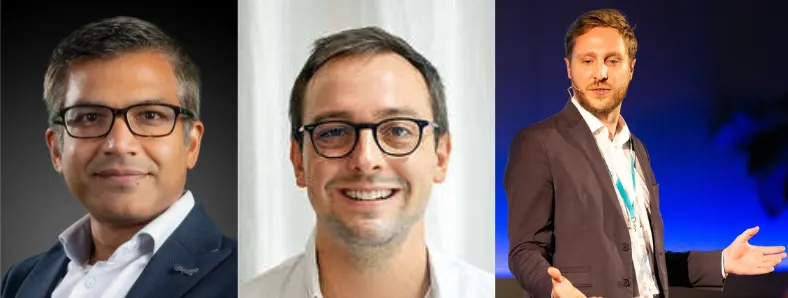
Jasper Deprez, founder and CEO, is a serial entrepreneur who previously bootstrapped Tradler into a global HR technology platform, building a company from nothing to international scale without external capital. That background in capital-efficient, customer-driven building is directly relevant to TerraSpark’s commercial-first approach to what every other actor in the SBSP space has treated as a pure engineering project.
Dr Sanjay Vijendran, co-founder and CTO, led ESA’s Solaris programme on space-based solar energy and was part of the team behind hardware that landed on Mars. He brings more than a decade of institutional research and engineering leadership directly to the core technical challenges TerraSpark must solve. His involvement is the clearest possible signal that this is a technically serious organisation, not a concept company.
Matthias Laug, co-founder and COO, co-founded Tier Mobility, one of Europe’s most successful shared micromobility platforms, and served as CTO for JustEatTakeaway, one of the continent’s largest food delivery businesses. His experience in scaling hardware-plus-software platforms operationally in competitive markets addresses the dimension of TerraSpark’s challenge that most deep tech companies underestimate: the distance between a working prototype and a functioning commercial business.
Around this founding team, TerraSpark has assembled a board and advisory network that includes senior engineers from Airbus, a former director of the European Space Agency, the ex-CTO of TomTom, and the founder of HolaLuz, one of Europe’s leading sustainable energy companies. The combination of aerospace credibility, energy sector expertise, and startup execution experience is unusually strong for a company at pre-seed stage.
The Investors and What the €5M Will Fund for TerraSpark
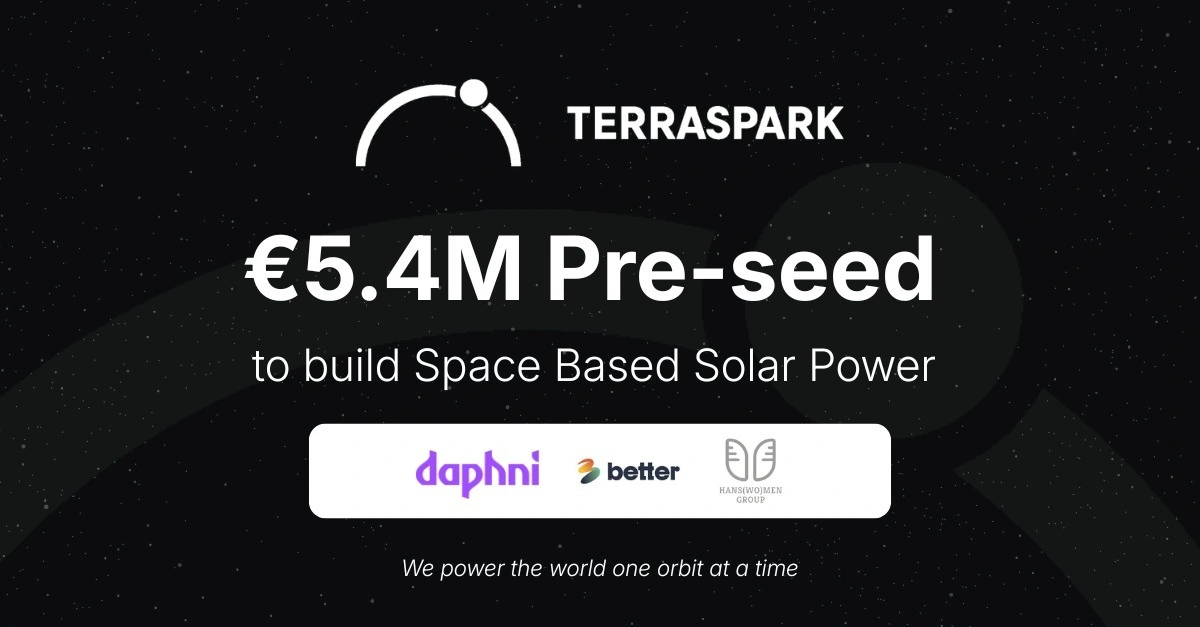
The pre-seed round of more than five million euros was co-led by Paris-based venture capital firm Daphni and technology investor Sake Bosch, with participation from better ventures and the Hans(wo)men Group. The capital is earmarked for three primary purposes: continued development of the wireless power transmission technology, preparation of pilot applications for live testing environments, including the planned wireless power demonstration for a live event, and the engineering groundwork for the 2027 orbital technology demonstrator.
The involvement of Daphni, a firm with a track record in backing ambitious European deep tech ventures, alongside Sake Bosch, whose investment portfolio spans hardware and infrastructure technology, signals that the round was assembled with long-term infrastructure building in mind rather than a near-term exit strategy. Space-based solar power is not a two-year venture. The investors backing TerraSpark understand they are funding a decade-long platform build, and the pre-seed sizing reflects a disciplined approach to capital deployment that matches the phased technical roadmap.
Why does Europe need TerraSpark and why now?
The timing of TerraSpark’s emergence is not coincidental. Europe’s energy infrastructure is under compounding pressure from multiple directions simultaneously. The 2025 Iberian blackout exposed the physical fragility of interconnected transmission grids that were not designed for the energy demands of a continent accelerating both its renewable transition and its digital infrastructure buildout.
The International Energy Agency projects that the energy demand of data centres alone will more than double by 2030, driven primarily by AI workloads. Meanwhile, even where renewable energy is abundant, the inability to transmit it efficiently from generation sites to consumption centres remains a structural bottleneck that more solar panels and wind turbines alone cannot solve.
Space-based solar power addresses both the generation and the transmission problem simultaneously. Energy collected in orbit requires no terrestrial land, generates no intermittency, and can be directed to any point on Earth with a suitable ground receiver, bypassing the transmission grid entirely.
For island nations, remote industrial operations, and the growing category of energy-intensive computing infrastructure that cannot always be co-located with renewable generation, this is not a distant aspiration. It is a practical value proposition that TerraSpark is building toward with a commercial timeline that, for the first time in the history of this technology concept, looks genuinely achievable.
TerraSpark is Luxembourg-based and European in its identity, positioning, and team composition. Its stated ambition, that Europe will lead the future of space-based energy, is not mere branding. It reflects a genuine strategic opportunity: in a world where energy independence has become a geopolitical as well as an environmental imperative, the nation or continent that masters the infrastructure to generate and transmit power from orbit will hold an extraordinary long-term advantage.
TerraSpark is betting that Europe will seize it, and with five million euros, a world-class team, and a commercial roadmap that begins on the ground in 2026, it is taking the first concrete steps to make that happen.