


Why is Trent AI the Critical Guardrail for the Age of Autonomous Agents?
The Shift from Talking to Acting: Why AI Security Just Broke
The past two years have changed how AI is used inside organizations. What began as conversational interfaces has quickly evolved into systems that can take action. AI agents are now writing production code, executing workflows, accessing internal systems, and even initiating financial transactions.
This shift introduces a different category of risk. When AI systems move beyond generating text and begin interacting with real infrastructure, the consequences of failure are no longer theoretical. A flawed output is no longer just incorrect, it can trigger unintended actions across systems.
Traditional security frameworks were not designed for this environment. Tools like static and dynamic testing operate on predictable code paths and human-driven workflows. Autonomous agents operate differently. They make decisions in real time, adapt to inputs, and interact across multiple systems simultaneously. This creates a gap between how software behaves and how it is secured.

The New Threat Landscape: Prompt Injection and Agent Misuse
As organizations deploy agentic systems, new attack vectors are emerging. One of the most critical is prompt injection, where malicious instructions manipulate an AI agent into performing unintended actions. Unlike traditional exploits, these attacks do not require breaking the system. They exploit how the system interprets instructions.
Another challenge is privilege escalation. Agents often operate with access to multiple tools and datasets. If compromised, they can misuse these permissions, exposing sensitive data or executing unauthorized actions. The risk is amplified by the speed and scale at which agents operate.
These threats are difficult to detect using conventional methods. They do not follow static patterns and often occur within the logic of the application itself. This requires a different approach to security, one that operates alongside the agents rather than outside them.

Inside Trent AI: A System Designed to Secure Agents with Agents
Trent AI, a London-based startup, is building its platform around this emerging challenge. Its approach focuses on securing AI-driven systems through continuous, automated oversight rather than periodic checks.
At the core of the platform is a system of specialized AI agents designed to monitor and govern application behavior. These agents operate in a coordinated loop, each with a specific role. The Scan agent identifies potential vulnerabilities and risky behaviors. The Judge agent evaluates their severity and relevance. The Mitigate agent generates fixes, often in the form of automated pull requests. The Evaluate agent ensures that the applied changes resolve the issue without introducing new risks.
This structure creates a self-reinforcing loop where the system continuously improves its own security posture. Instead of waiting for vulnerabilities to be discovered manually, the platform actively searches for and addresses them in real time. The result is a shift from reactive security to continuous governance, where protection evolves alongside the system it is designed to secure.

From Code to Compliance: Securing the Entire AI Lifecycle
Trent AI’s platform extends beyond application security into broader governance and compliance. As organizations deploy AI systems in regulated environments, ensuring adherence to standards such as SOC2 and GDPR becomes critical. The platform provides visibility into how AI agents interact with data, systems, and workflows. This allows organizations to track usage patterns, enforce policies, and demonstrate compliance without relying on manual audits.
Its solutions span multiple layers, including AI security posture management, application security, and specialized protections for tools like Claude Code. By integrating these capabilities into a single system, Trent AI positions itself as an infrastructure layer for AI governance rather than a standalone tool. This approach reflects a growing need for systems that can manage complexity at scale while maintaining accountability.
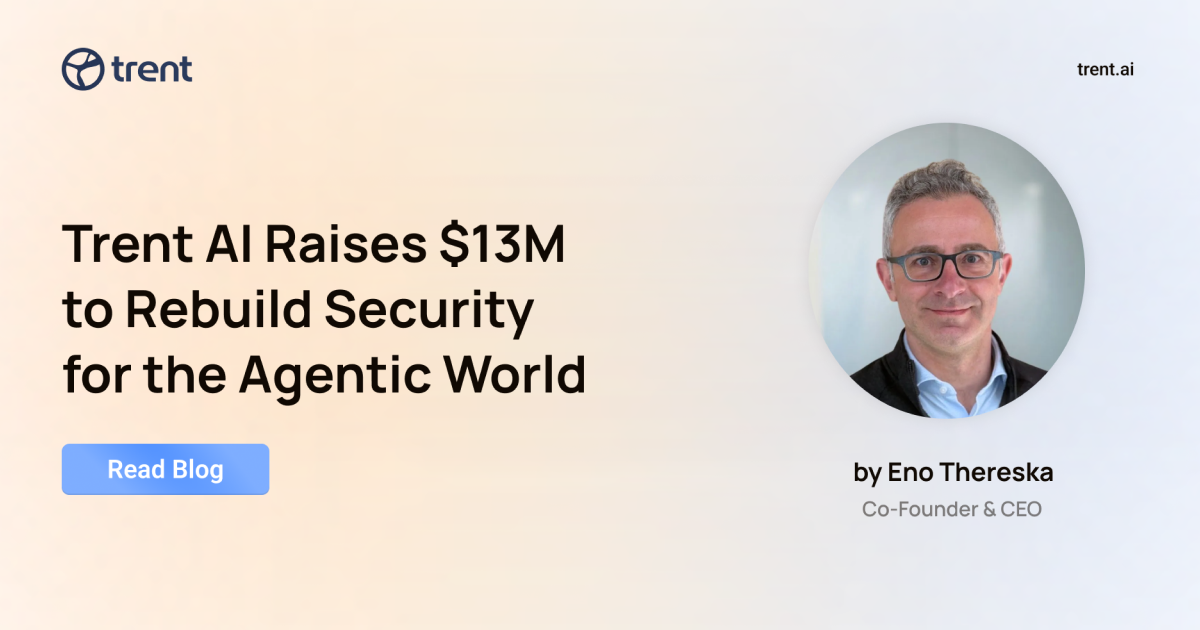
Trent AI Raises $13 Million to Build the Future of Agentic Security
Trent AI recently raised $13 million in a seed funding round backed by investors including leaders from OpenAI and Spotify, along with strategic players like Stripe. The funding supports the company’s efforts to expand its platform and accelerate adoption across enterprise environments.
The investment highlights the importance of security in the next phase of AI adoption. As organizations move toward agent-driven workflows, the need for systems that can govern and secure these environments becomes more urgent. This funding positions Trent AI within a category that is still emerging but rapidly gaining relevance: agentic security.
Why Will Security Define the Next Phase of AI Adoption?
The evolution of AI is moving toward systems that can operate independently, making decisions and executing tasks with minimal human intervention. This shift has the potential to unlock significant efficiency and innovation, but it also introduces new layers of risk. Platforms like Trent AI represent an attempt to address these risks at their source. By embedding security into the operation of AI systems, they aim to create an environment where autonomy can be deployed safely.
As enterprises continue to integrate AI into core workflows, the ability to manage and govern these systems will become a defining factor. Security is no longer a supporting function. It is a prerequisite for scaling AI in real-world environments. Trent AI reflects a necessary evolution in cybersecurity, where protecting autonomous systems requires equally autonomous defenses, shaping how organizations will safely deploy AI at scale.