


TUBR and the Rise of Predictive Analytics for Businesses
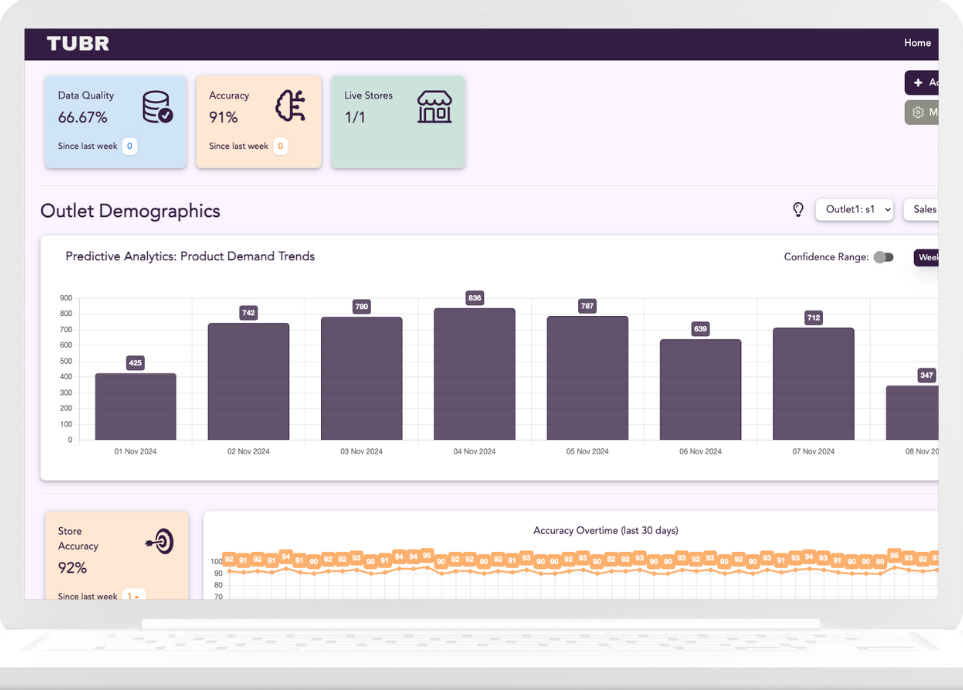
TUBR, a Sheffield-based artificial intelligence startup, has developed a predictive analytics platform designed to help businesses make faster and more accurate decisions using limited and incomplete data. The company focuses on enabling business leaders to turn raw data into actionable insights without relying on large-scale data infrastructure.
Predictive analytics has become an important tool for organizations seeking to anticipate demand, optimize operations, and improve decision-making. However, many traditional analytics systems require significant amounts of structured data and technical expertise, limiting their accessibility for smaller businesses.
TUBR aims to address this gap by providing a platform that can generate insights from smaller datasets, allowing a broader range of organizations to adopt data-driven strategies.
Moving Beyond Big Data with Small Data AI
Conventional artificial intelligence models often depend on large volumes of clean and structured data. For many businesses, particularly small and medium-sized enterprises, collecting and maintaining such datasets can be challenging.
TUBR’s approach focuses on what is often referred to as “small data” AI. Instead of requiring extensive historical data, the platform is designed to work with incomplete or fragmented datasets while still producing meaningful predictions.
This capability is particularly relevant for industries where data may be inconsistent or limited, such as hospitality, retail, and personal care services. By reducing the dependency on large datasets, TUBR enables more organizations to leverage predictive analytics. The shift toward small data AI reflects a broader trend in artificial intelligence, where systems are being designed to operate effectively in real-world conditions rather than ideal data environments.
How TUBR’s Physics-Based Models Work?
A key aspect of TUBR’s technology is its use of physics-based modeling alongside data-driven techniques. Instead of relying solely on statistical machine learning, the platform incorporates environmental and behavioral factors into its predictive models.
This approach allows the system to account for variables such as external conditions, human behavior, and operational constraints. By integrating these factors, the platform aims to produce more accurate and context-aware predictions.
Physics-based models can also adapt more effectively to changing conditions, making them suitable for dynamic environments where patterns may shift over time. By combining these methods with AI, TUBR seeks to provide businesses with insights that are both reliable and adaptable.
Applications Across Hospitality, Retail, and Services
TUBR’s platform is designed to support a range of industries where forecasting and operational planning are critical. In hospitality, for example, businesses can use predictive analytics to anticipate customer demand, optimize staffing levels, and manage inventory more efficiently.
Hotels and booking platforms can use the technology to forecast occupancy rates and adjust pricing strategies. Personal care and salon businesses can benefit from improved scheduling and resource allocation.
Point-of-sale and booking systems can also integrate predictive insights to enhance customer experiences and streamline operations. By targeting industries with complex and variable demand patterns, TUBR addresses practical challenges faced by businesses that operate in dynamic environments.
Real-Time Insights for Faster Decision-Making
One of the key advantages of TUBR’s platform is its focus on delivering real-time insights. Instead of relying solely on historical analysis, the system is designed to provide up-to-date predictions that reflect current conditions.
This allows business leaders to make decisions more quickly and respond to changes as they occur. Real-time analytics can be particularly valuable in industries where demand fluctuates rapidly.
By enabling faster decision-making, predictive analytics platforms can help businesses improve efficiency and reduce uncertainty in their operations.
The Future of Accessible AI for Business Decision-Making
The development of platforms like TUBR highlights a shift toward making artificial intelligence more accessible to a wider range of organizations. As businesses increasingly seek to adopt data-driven strategies, tools that simplify analytics and reduce technical barriers are becoming more important.
The ability to generate insights from small and imperfect datasets may play a key role in expanding the use of AI beyond large enterprises. By focusing on usability and practical applications, such platforms can support a broader adoption of predictive analytics.
TUBR’s approach reflects an evolving landscape in artificial intelligence, where flexibility, accessibility, and real-world applicability are becoming as important as raw computational power.
Platforms that enable businesses to make accurate decisions using limited data could significantly expand the adoption of AI, particularly among small and medium-sized enterprises seeking practical and scalable solutions.