


The AI-First Oil and Gas Company: What 2026 Changes Everything?
For most of its modern history, the oil and gas industry has treated digital technology as a support function, a set of tools that made existing processes faster or cheaper without fundamentally changing how the business operated. That description no longer applies. In 2026, the leading companies in this sector are not deploying AI to assist their operations. They are rebuilding their operations around AI. The distinction is not semantic. It is the difference between a company that uses AI to help engineers write reports faster and one that uses AI agents to autonomously manage production optimization, maintenance scheduling, subsurface modelling, and capex allocation simultaneously, in real time, without waiting for human instruction.
According to BCG’s landmark analysis of the AI-first future of oil and gas companies, companies taking full advantage of AI in their operations will deliver incremental profits reaching as much as 30 to 70 percent of their earnings before interest and taxes over the next five years. That is not an efficiency gain. It is a structural transformation of industry economics.
The question for every operator, service company, and energy investor in 2026 is no longer whether AI matters in oil and gas. The evidence on that is unambiguous. The question is where each organisation sits on the spectrum between AI-enabled, where people are the core drivers and use digital tools incrementally, and integrated AI, where AI agents are the core drivers and humans provide oversight to close gaps.
The companies that have moved decisively toward the latter are already pulling away. Those that have not are watching the gap widen in real time.
The Numbers That Define the Moment
To understand the scale of what is happening, start with the financial picture. BCG’s research, published in its August 2025 Executive Perspectives on AI in oil and gas, identifies AI as having strong value creation potential across the entire oil and gas value chain, from upstream exploration and production through refining, trading, and fuel retail. The 30 to 70 percent EBIT improvement projection is not a theoretical ceiling.
It reflects the aggregated impact of AI deployed systematically across maintenance, production optimisation, exploration accuracy, supply chain efficiency, and commercial operations, compounding over a five-year horizon. It is among the most significant profitability projections made for any technology in any industry in recent years.
The IBM Institute for Business Value’s May 2025 report, “Oil and Gas in the AI Era,” reinforces this picture from a different angle. Its central finding is that oil and gas companies are not just using AI to boost operational efficiencies. The most advanced operators are developing entirely new AI-powered business models that create competitive advantage independent of production volumes or commodity prices.
The ability to generate value from data, intelligence, and automation, regardless of what oil is trading at on any given day, is a fundamentally different economic proposition from the one that has governed this industry for a century.
The global AI in oil and gas market was valued at approximately $3.79 billion in 2025 and is estimated to grow to $7.91 billion by 2031 at a compound annual growth rate of 13 percent. More revealing than the headline number is the composition of that growth: services, reflecting the human expertise required to deploy, customise, and manage AI at scale, currently account for 65.8 percent of market value, while platforms are growing fastest at 13.74 percent CAGR as companies move from consulting engagements to embedded, continuously operating AI infrastructure.

Upstream: AI Is Now the Lead Geoscientist
Upstream oil and gas, the exploration and production segment, accounts for 61 percent of the AI in oil and gas market by operation in 2026, reflecting the extraordinary data intensity of the business of finding and accessing hydrocarbons. Seismic archives at leading operators now exceed 1,500 petabytes. Drilling logs, well test results, petrophysical measurements, and production histories accumulated over decades represent a body of knowledge that no human team, however skilled, can synthesise at the speed and scale that decisions now require.
AI systems built on deep learning and physics-informed neural networks are transforming this reality. According to research published in the journal Applied Sciences, AI-enabled seismic interpretation is lifting drilling-location accuracy by 70 percent compared to manual methods. AspenTech’s subsurface science and engineering suite, deployed across upstream operators globally, enables reservoir engineers to run multiple fracture cluster scenarios in minutes, a process that previously required weeks of manual simulation.
ADNOC’s ENERGYai agentic AI system reduced geological model build times by 75 percent through autonomous seismic analysis, demonstrating at industrial scale what AI-first upstream operations actually look like in practice.
Saudi Aramco, whose approach to AI and big data is documented extensively on its own platform, now analyses approximately 10 billion data points daily across its operations. The company’s Aramco Metabrain AI model, trained on seven trillion data points, enables engineers to query the company’s entire institutional knowledge base in natural language, surfacing insights from decades of technical documentation that would otherwise require weeks of manual search.
Aramco’s AI system at its Fadhili Gas Plant, developed in partnership with Yokogawa, has been permanently adopted and is being extended to additional facilities through 2026, a signal that these deployments have crossed from pilot into core operational infrastructure.
“AI has the potential to transform O&G profitability, with a 30 to 70 percent EBIT increase in the next five years. O&G AI-pioneers invest across all three strategic plays to deliver value and gain competitive edge in their upstream and downstream operations.” BCG Executive Perspectives: AI Reshapes O&G Winners, August 2025
Drilling Smarter: From Human Judgment to Autonomous Decision-Making
The drilling process generates one of the richest real-time data environments in industry: downhole sensors measuring temperature, pressure, weight on bit, vibration, and formation characteristics at millisecond intervals; surface instrumentation tracking mud flow, pit volume, and returns; and geological sampling providing continuous information about what the bit is encountering. The challenge has always been that this data arrives faster than human operators can process it, and that the optimal adjustments to drilling parameters must happen within seconds to be effective.
BCG’s analysis identifies drilling optimisation as one of the highest-value AI levers in upstream, noting that AI is already shrinking processes from months to weeks in exploration and well planning workflows. The mechanism is not simply faster computation. AI systems trained on historical drilling data across thousands of wells can identify patterns in how specific formation types, bit designs, and mud programmes interact, learning from every well drilled globally to recommend parameter adjustments that improve rate of penetration while maintaining wellbore integrity.
Reinforcement learning systems, deployed on drilling rigs by operators including Shell, continuously improve their recommendations as they accumulate operational experience, meaning each well drilled makes the model better for the next one.
The research published in the MDPI journal Applied Sciences further highlights that AI-driven autonomous drilling systems are now trimming crew exposure in deepwater projects, a safety improvement that carries both ethical and commercial weight in an industry where a single deepwater well control incident can cost hundreds of millions of dollars and permanently damage a company’s social licence to operate. Physics-informed models are also yielding faster subsurface insights that sharpen well-placement accuracy, reducing the proportion of capital deployed on wells that underperform expectations.

Predictive Maintenance: The $500,000-Per-Hour Argument
If there is a single AI application that has achieved the most widespread adoption in oil and gas, it is predictive maintenance, which accounted for 37.6 percent of AI market applications in 2026. The economics are straightforward: a single hour of unplanned downtime at a critical facility costs close to $500,000 and this figure has more than doubled in recent years as operational complexity and the cost of emergency response have risen.
According to research referenced in the ScienceDirect study on AI applications in oil and gas, approximately 35 percent of refinery downtime is unplanned, and the majority of those incidents could have been prevented with better data analytics.
AspenTech’s Aspen Mtell machine learning platform, one of the leading tools in this category, monitors continuous streams of sensor data from rotating equipment, heat exchangers, and process vessels to detect the subtle signatures of developing faults weeks before they manifest as failures.
The platform learns the normal behaviour of each individual asset in its specific operating context, making its failure predictions far more accurate than threshold-based alarm systems that cannot distinguish between abnormal readings caused by developing faults and those caused by normal process variability.
The IBM IBV’s oil and gas research confirms that organisations with a well-defined, enterprise-wide AI strategy see materially greater ROI on their AI investments than those deploying AI on individual assets or processes in isolation. This finding reflects a structural reality about predictive maintenance at scale: the value of knowing that a compressor is degrading is multiplied enormously when that information is integrated with maintenance scheduling systems, spare parts inventory management, production planning, and safety management in a unified AI architecture rather than surfaced as an isolated alert that still requires manual triage and response.
The Finance and Strategy Revolution No One Talks About
Most coverage of AI in oil and gas focuses on operations. EY’s analysis, “How AI Is Becoming Central to Oil and Gas Finance Strategy,” makes the case that this framing misses one of the most consequential dimensions of the transformation. AI is now reshaping how oil and gas companies make capital allocation decisions, manage commodity price risk, plan portfolios, and report to investors, functions that collectively determine whether an operator creates or destroys value regardless of what happens in the field.
Specifically, BCG’s framework for the AI-first O&G company identifies AI levers in the general and administrative domain that are as significant as those in operations. GenAI contract review and compliance tools are reducing the legal risk and administrative cost of the hundreds of complex commercial agreements that govern every exploration joint venture, pipeline tariff, offtake agreement, and service contract. Automated processing of billing and invoicing is minimising revenue leakage in midstream and downstream operations.
And AI-based capital deployment optimisation, driven by risk-based project selection algorithms, is improving the quality of capex decisions in an environment where the energy transition makes the long-term economic case for any given asset more uncertain than at any previous point in the industry’s history.
EY’s insight that AI is becoming central to finance strategy, not just a tool for finance teams to use more efficiently, reflects a deeper shift. When AI systems can ingest real-time production data, commodity market signals, weather forecasts, geopolitical risk indicators, and regulatory developments simultaneously, and translate that synthesis into recommendations for portfolio rebalancing, hedging strategy, and asset divestiture, the nature of strategic decision-making in oil and gas changes fundamentally.
The companies building these capabilities in 2026 are not just optimising their current portfolio. They are developing a structural information advantage over competitors who are still relying on quarterly planning cycles and human analysts working with incomplete data.
Agentic AI: The Third Wave That Changes Everything
BCG’s framework for the AI-first O&G company describes three distinct phases through which leading operators are building AI maturity. Understanding these phases is essential for understanding where the industry is in 2026 and where it is heading.
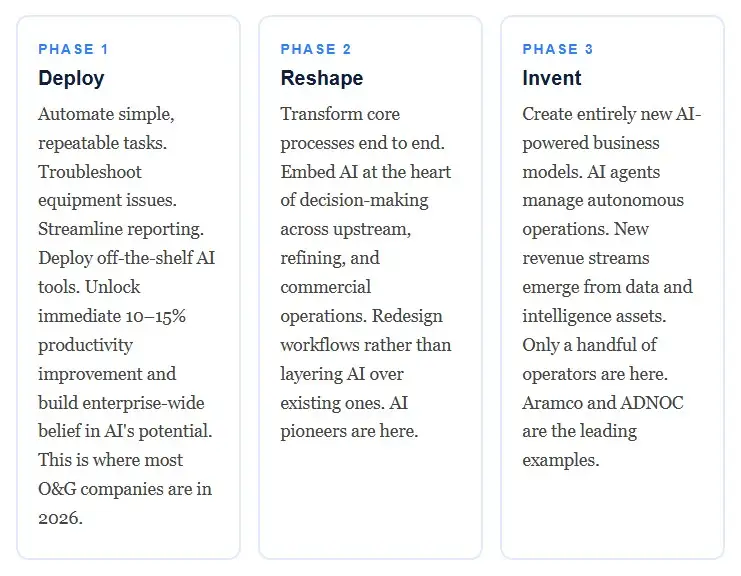
The third wave, agentic AI, is what makes 2026 a genuinely different moment from 2024 or 2025. If predictive AI is the analytical left brain that spots patterns and recommends actions, and generative AI is the creative right brain that synthesises knowledge and generates content, then agentic AI is the executive function that turns analysis into action. Agentic systems observe, plan, and act autonomously. They do not wait to be asked. They learn continuously from their outcomes.
And when embedded across an oil and gas operation, they take on the execution steps that slow organisations down, whether managing maintenance work orders, coordinating drilling parameter adjustments, optimising refinery yield in real time, or monitoring pipeline integrity across thousands of kilometres simultaneously.
BCG’s cross-industry research shows that agentic AI accounted for 17 percent of total AI value in 2025 and is expected to reach 29 percent by 2028. In oil and gas specifically, BCG’s O&G-focused analysis identifies agentic systems as the mechanism through which the operating model shift from AI-enabled to integrated AI will occur. ADNOC and SLB’s jointly launched AI-powered Production System Optimisation platform, which integrates millions of real-time data points from ADNOC’s wells and processing facilities into a unified agentic architecture, is the most prominent current example of what this looks like at industrial scale.
TotalEnergies’ partnership with Mistral AI, announced in June 2025, to build customised large language models for seismic interpretation and operational decision-making, is another. These are not experiments. They are production systems, and they represent the leading edge of the operating model that the rest of the industry will be racing to replicate over the next three to five years.
The Barriers Standing Between Today and the AI-First Future
Despite the momentum, the transformation is not uniform. IBM’s IBV research, the instinctools industry analysis, and the academic literature from ScienceDirect and MDPI all identify a consistent set of barriers that explain why the majority of operators still sit closer to the AI-enabled end of the spectrum than the integrated AI end.
The first and most fundamental barrier is data infrastructure. AI systems require clean, structured, consistently labelled data to learn from, and oil and gas operations generate data across decades of heterogeneous legacy systems, inconsistent sensor standards, and geographically dispersed infrastructure that does not naturally interoperate. Many operators have invested heavily in instrumentation and connectivity without investing proportionally in the data pipelines, governance frameworks, and quality management processes that turn raw operational data into the kind of training material that AI models can learn from effectively.
AspenTech’s industrial data fabric infrastructure, AspenTech Inmation, exists specifically to address this challenge, aggregating and harmonising data from disparate operational sources into a unified architecture that AI applications can consume. But building and maintaining that infrastructure at enterprise scale remains one of the most demanding aspects of the AI-first transition.
The second barrier is the talent gap at the intersection of petroleum engineering and data science. Deploying AI effectively in oil and gas requires people who understand both what the data means physically and how to build models that learn from it correctly. That combination remains rare. BCG’s broader AI research shows that future-built companies invest heavily in upskilling programmes alongside technology deployment, recognising that technology without the human capability to operate it generates far less value than the two together.
The third barrier is cybersecurity. As AI systems are integrated with operational technology, the attack surface of critical energy infrastructure expands. The interconnected nature of AI-enabled operations creates vulnerabilities that require new security architectures, and the oil and gas industry, which has historically operated with significant separation between its information technology and operational technology systems, is still building the governance frameworks to manage this transition safely.
According to research published in Applied Sciences, cybersecurity risk management is now considered a core design requirement for AI deployment in upstream operations, not an afterthought.
The fourth barrier is change management. BCG’s analysis is explicit that the transition to an AI-first operating model is a business transformation, not a technology implementation. It requires executive sponsorship, alignment of AI initiatives with real business challenges owned by operational leaders, and the willingness to redesign workflows end to end rather than inserting AI tools into processes built for a pre-AI world.
The companies that are furthest along the curve share a common characteristic: their AI programmes are driven by business leaders who own the value outcomes, not by technology teams who own the tools.

The Gap Is Widening. The Time to Move Is Now
BCG’s cross-sector AI research, published in September 2025, identifies a stark and widening performance gap between what it terms “future-built” companies, those systematically building AI maturity across strategy, technology, people, and innovation, and the 60 percent of organisations that remain AI laggards generating minimal value from their investments.
Future-built companies achieve 1.7 times the revenue growth, 3.6 times the three-year total shareholder return, and 1.6 times the EBIT margin of laggards. They plan to spend more than twice as much on AI in 2026. And they are pulling further ahead with every passing quarter.
In oil and gas, the stakes of this divergence are particularly high because the industry’s capital intensity means that operational advantages compound over decades. An operator that builds a genuine AI advantage in subsurface modelling, drilling performance, and maintenance management in 2026 is not just outperforming peers this year.
It is building an asset, a continuously improving body of models, data, and institutional learning, that depreciates more slowly than any physical asset in its portfolio and appreciates with use as the models become more accurate and the agents become more capable.
The IBM IBV frames this trajectory plainly: oil and gas companies are no longer just using AI to boost operational efficiencies. The leaders are building AI-powered business models that create competitive advantage independent of production volumes or commodity prices. That is the destination that BCG’s Deploy-Reshape-Invent framework is charting a course toward. And in 2026, for the first time in the history of this technology in this industry, the companies that have moved furthest along that course are not just more efficient than their peers.
They are structurally different businesses, ones that can see more, decide faster, act more precisely, and learn continuously from every barrel produced and every decision made. The gap between those companies and the ones still running AI pilot programmes is no longer a technology gap. It is a business model gap. And it is widening every day.
Source:
- https://www.bcg.com/publications/2025/ai-first-future-of-oil-and-gas-companies
- https://www.sciencedirect.com/science/article/pii/S2590123025036898
- https://www.aspentech.com/en/cp/ai-for-oil-and-gas
- https://www.ey.com/en_in/insights/ai/how-ai-is-becoming-central-to-oil-and-gas-finance-strategy
- https://www.mdpi.com/2076-3417/15/14/7918
- https://www.ibm.com/thought-leadership/institute-business-value/en-us/report/oil-and-gas-in-ai-era
- https://www.aramco.com/en/what-we-do/energy-innovation/digitalization/ai-and-big-data