

The Market for Meaning: Why Taste, Trust, and Timing Are the New Moats
The Market Has Changed Its Terms and the Rules With It
Artificial intelligence is changing the economics of knowledge work, and speed is only the surface. The deeper shift is what speed does to value.
Research can be assembled in minutes. Drafts appear almost instantly. Early concepts can be tested without the cost and delay that once made serious work slow and therefore selective. As execution becomes easier to access, it also becomes harder to use as a durable point of difference. When most teams can produce competent output with similar tools, the market stops rewarding execution and starts rewarding something harder to copy. It starts rewarding judgment.
For years, firms built their edge through access. Better information, better specialists, better tools, faster delivery. That logic shaped strategy, hiring, and status. It also shaped how organizations defined talent. The person who produced more, moved faster, and kept more plates spinning often looked like the most valuable person in the room.
AI dissolves that logic. It spreads capability widely and quickly. Once a large share of the market can execute well enough, the stronger advantage belongs to the people who can decide what is worth pursuing before the work begins. Before the brief is written. Before the first tool is opened. That is why there is a market for meaning. Output is everywhere. Clear direction is still rare.
Why Taste Matters More Than the Word Suggests?
“Taste” is one of those words that arrive carrying the wrong luggage. It sounds aesthetic, even ornamental, when its real history points somewhere more serious. Taste originally meant cultivated judgment. The ability to distinguish what has lasting quality from what merely catches attention in the moment. In business, that distinction has never mattered more.
Taste helps a founder tell the difference between a real market and a fashionable one. It helps an operator separate genuine customer demand from temporary noise. It helps a leader see when an idea deserves more investment, when a message needs restraint, and when a product has crossed the line from compelling to cluttered.
Taste is judgment applied early, before resources, reputation, and speed start amplifying the wrong choice.
This matters now because accelerated intelligence is about to flood every market with polished work. More smart-sounding copy. More attractive prototypes. More convincing decks. More recommendations that look stronger than they are. The volume of credible-looking output will rise faster than most organizations are ready for. Taste sets the standard before software scales the idea. It shapes the brief, sharpens the choices, and gives the work a point of view that can survive competition rather than simply imitate it.
The gap is already forming. Two founders use the same model layer, the same tools, the same launch playbook. One builds from a clear understanding of user pain, buyer behavior, and market timing. The other builds from ambient excitement and recycled category language. Their products may look similar in week one. Their trajectories diverge quickly. The gap begins with judgment long before it shows up in revenue.
The Human Role Is Shifting Toward Alignment Work
The phrase “human in the loop” understates what actually matters now. It sounds procedural. It implies the person arrives near the end to review what the machine has already done, a quality check on the way out the door. The more valuable role starts earlier and carries more weight. It is alignment work.
Alignment work is the human task of connecting AI output to reality. It brings together customer context, domain knowledge, legal exposure, operational constraints, market timing, and the practical cost of getting a decision wrong. It asks whether the machine is solving the right problem, working from the right assumptions, and pointing toward an answer that will hold up once real consequences begin.
This is where human value rises with AI, though it rises unevenly. The people gaining ground are the ones who can improve the quality of a decision before it becomes expensive, public, or irreversible. The healthcare operator who understands regulation and patient trust. The editor who hears the difference between smooth language and persuasive language. The strategist who can tell a passing signal from a structural shift. The founder who knows whether a market is ready to move or still needs education.
These are the people who keep accelerated intelligence pointed toward useful outcomes rather than expensive confusion. One point many AI conversations miss entirely: faster output requires better judgment to be valuable. Speed can hide weak thinking very effectively. A system generates a plausible answer in seconds, and that speed creates the illusion of solidity. Alignment work breaks that illusion. It forces an answer to meet reality before reality punishes the organization for trusting it too quickly.
Why Trust and Timing Now Carry Commercial Weight?
As machine fluency becomes cheaper, trust becomes more valuable. When every company can produce a polished memo, a credible strategy, and a smart-sounding narrative, people pay closer attention to the source of the judgment. They want to know whose reasoning survives pressure. Whose recommendations stay coherent when conditions shift. Whose name beside an idea makes it easier to back. Trust is a selection mechanism in a market full of capable-sounding noise.
Timing carries the same weight. Strong teams still miss markets. They arrive too early, or they enter after the category has flattened into sameness, or they mistake attention for readiness. Accelerated intelligence makes building faster, and the older, harder problem of knowing when a market is prepared to care remains fully intact. Timing still depends on context, patience, and a feel for what buyers are ready to believe, change, or fund.
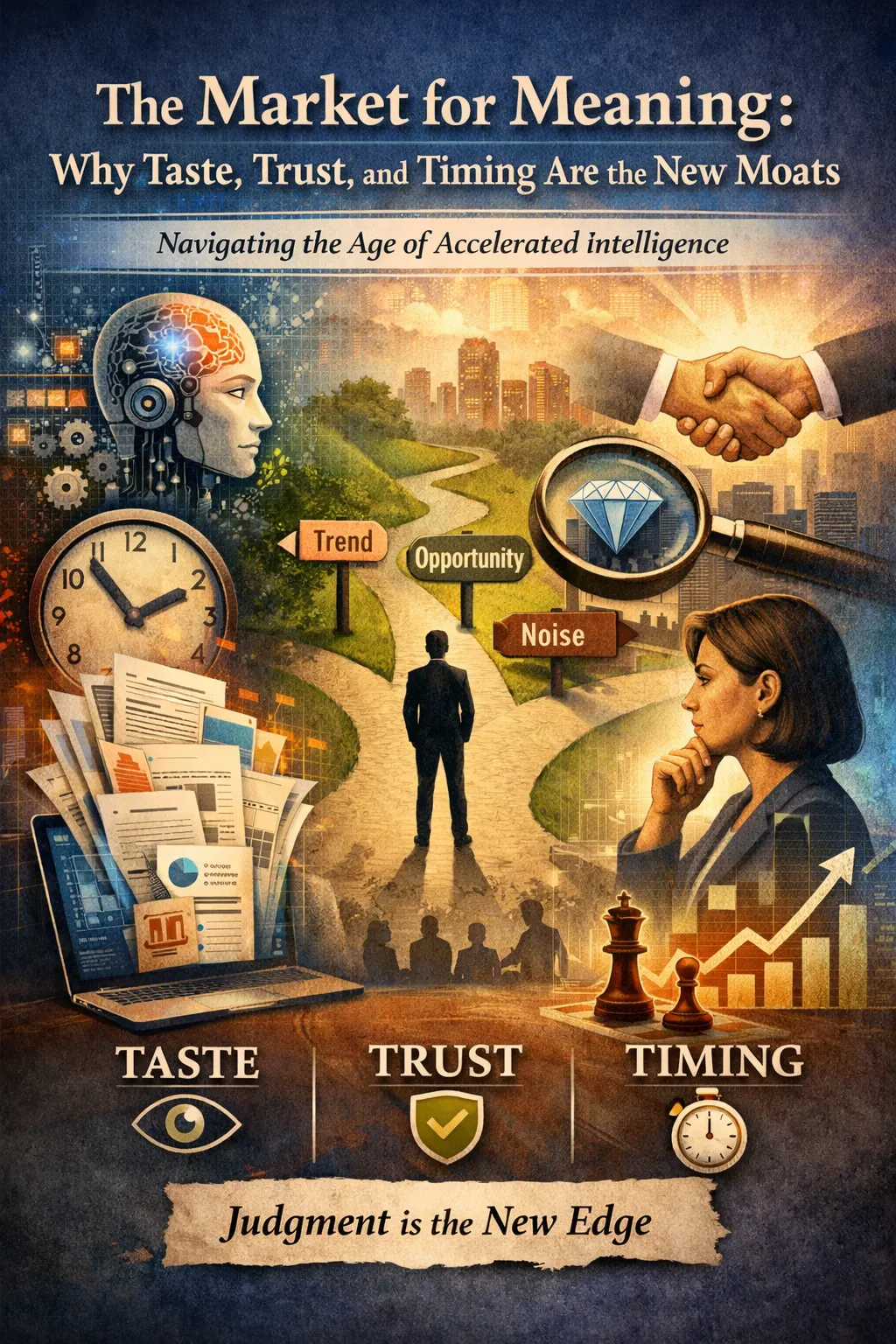
This is where taste, trust, and timing stop sounding like separate virtues and start functioning as one discipline. Taste improves selection. Trust supports belief. Timing gives the decision force. Together, they determine whether AI-driven speed creates something durable or simply adds more material to the pile.
What Founders and Leaders Should Actually Do With This?
The next phase of AI adoption will reward the people who redesign work around judgment. For founders and builders, that means a few things worth taking seriously. Give real authority to people with domain depth. Decision-making roles, close to the judgment that matters. The person who understands the customer, the regulation, or the market dynamic belongs closer to the decision.
Treat alignment work as a core function. The gap between what AI produces and what the market actually needs is where value is created or destroyed. That gap deserves skilled, deliberate attention at every stage of the process. Judge AI systems by the quality of the decisions they improve. Decision quality is the honest metric. Volume is the easy one.
Hire for judgment, explicitly. The strongest companies building right now know who in the organization can frame a problem properly, test the assumptions underneath an answer, and make a call that holds up after the initial excitement fades. In a market where execution is abundant, that capacity is where real scarcity lives.
The more serious question is who on your team can turn that abundance into work that deserves attention, decisions that deserve belief, and products that deserve a place in the market.
That is the real contest in the age of accelerated intelligence. It will be won by people whose judgment can carry weight once speed becomes common.