


eNOugh Raises $2.7M to Build an AI Wearable for Real-Time Personal Safety
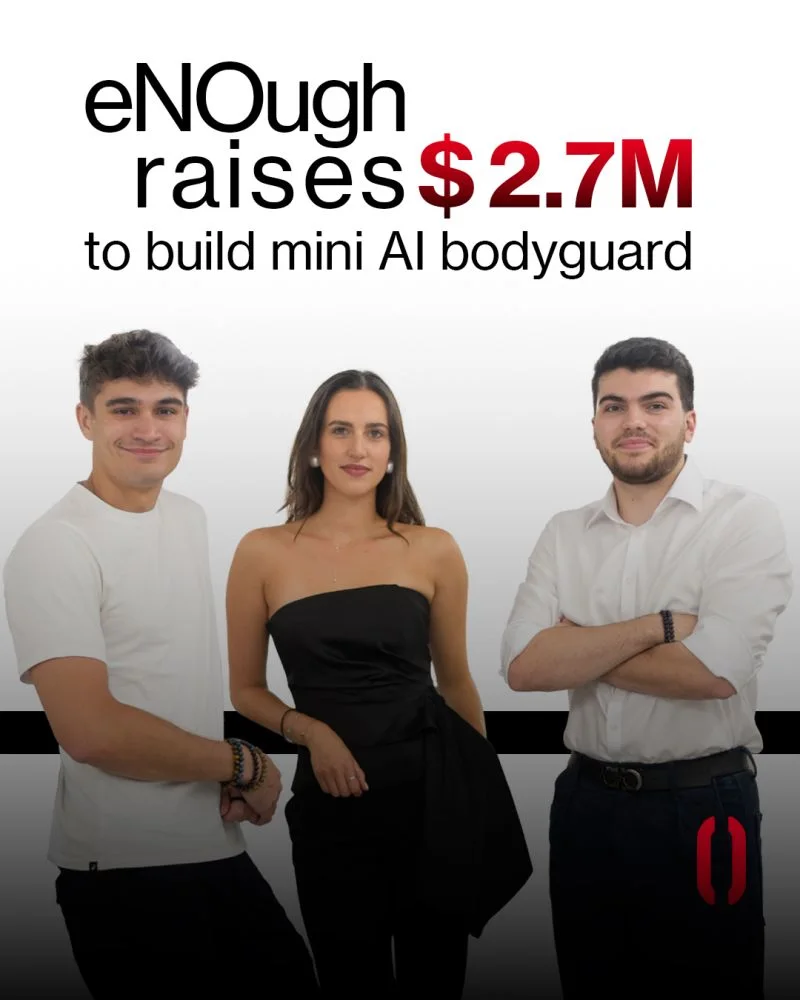
London-based startup eNOugh has raised $2.7 million in funding to develop an AI-powered wearable designed to help people get home safely. The round was led by A*Ventures, with participation from Comma Capital, Karman Ventures, Intuition VC, and a group of angel investors. The funding will support the launch of the company’s first product, the eNO badge, and expand early partnerships across urban institutions.
While consumer technology has transformed communication, navigation, and mobility, personal safety (particularly in cities) has remained stubbornly difficult to address. eNOugh’s funding highlights growing interest in technologies that operate as autonomous, physical systems designed to intervene when safety is at risk.
Why is “Getting Home Safe” Still a Problem ?
It is a fact that for many people, and especially women, walking home alone after dark involves constant risk assessment rather than ease or spontaneity. Studies in the UK show that a significant proportion of women feel unsafe in public spaces at night, and many people modify their behavior (changing routes, avoiding activities, or staying home altogether) because of safety concerns.
These patterns are not unique to London; they reflect a global urban challenge affecting cities from New York to Paris to Mexico City to Delhi. Despite widespread awareness, existing solutions have offered limited relief. Safety apps often require manual activation during moments of panic, while deterrents such as alarms or self-defense tools assume a user can react quickly under stress. eNOugh was founded on the premise that effective safety tools must function even when a person cannot.
Moving Beyond Software-Only Safety Tools
The eNO badge represents a shift away from software-only approaches to personal safety. Designed as a palm-sized wearable, the device uses multimodal AI to detect potential threats in real-world environments. Rather than relying on a panic button or manual input, the badge is built to recognize when a user may be under threat and initiate protective actions autonomously.
When activated, it can record audio and visual evidence, share live location data, and alert emergency operators who can contact authorities or designated contacts. This approach reflects a broader trend in artificial intelligence: moving from passive tools that wait for user commands to systems that can perceive context and act independently when conditions warrant intervention.
Detection and Deterrence as a Combined Strategy
A key element of eNOugh’s design philosophy is combining threat detection with visible deterrence. Traditional safety tools are often discreet, activated only after a situation escalates. The eNO badge is intentionally visible, designed to signal that recording and live streaming may be taking place. While an ordinary passerby may see only a wearable accessory, a potential attacker is confronted with the possibility of evidence capture and immediate escalation.
This emphasis on deterrence reflects research suggesting that visible accountability can reduce opportunistic crime. By shifting safety from reactive response to preventive presence, eNOugh aims to reduce harm before it occurs rather than documenting it after the fact.
Collective Safety and Network Effects
Beyond individual protection, eNOugh’s platform is designed around the idea of collective safety. Each badge contributes anonymized, real-world signals that help improve detection models over time. As more users wear the device, the system becomes better at recognizing patterns associated with risk across different environments and contexts.
This network-based approach reframes personal safety as shared infrastructure rather than a solitary responsibility. The company describes this as a distributed model where participation strengthens protection not only for the wearer, but for others navigating similar spaces. Such an approach aligns with emerging views in urban technology that safety outcomes improve when systems learn from real-world conditions rather than hypothetical scenarios.
From Early Deployment to Broader Urban Use
With the new funding, eNOugh has opened a waitlist for early access to the eNO badge and is preparing initial deployments in London. The company is working with partners across universities, hospitals, and nightlife venues, all the settings where personal safety concerns are especially acute. These early collaborations will help validate the product in diverse real-world environments before expansion to other cities.
While the technology itself is central, eNOugh’s broader ambition is cultural as much as technical: restoring a sense of freedom that has quietly eroded for many people navigating cities after dark. As AI increasingly moves out of digital interfaces and into physical spaces, products like the eNO badge offer a glimpse into how technology may play a more active role in shaping everyday safety.
eNOugh addresses a reality that technology has long struggled to confront: safety cannot depend on perfect user behavior during moments of fear. By embedding AI into a physical, autonomous device, the company is exploring what it means for technology to actively protect people in the environments they move through every day.