

GPT-6 Astra Explained: Features, Capabilities, Benchmarks and What Comes Next
What Is GPT-6 Astra?
GPT-6 Astra is OpenAI’s latest frontier AI model and the company’s most capable broadly deployed system to date. Released in September 2026, Astra combines advances in pre-training, reinforcement learning, and alignment to improve performance across computer use, browsing, software engineering, cybersecurity, science, mathematics, and professional work.
What makes the release particularly significant is that OpenAI is positioning Astra less as a chatbot and more as a system capable of operating across digital environments to complete complex tasks. According to OpenAI, GPT-6 Astra achieved a 98% score on FrontierMath Tier 4, 99.9% on ARC-AGI-3, and 100% on ExploitBench, benchmarks that highlight its progress in mathematical reasoning, abstract problem-solving, and cybersecurity capabilities.
The numbers are impressive, but Astra’s larger significance lies in what they represent: frontier AI models are increasingly being evaluated not only by whether they can generate a good answer, but by whether they can take that answer and turn it into useful action.
What Can GPT-6 Astra Do That Earlier Models Couldn’t?
Earlier generations of AI were often powerful but passive. A user could ask a model to explain how to build a website, analyze a spreadsheet, research a market, or fix a software bug, but a human usually had to carry out much of the actual work. GPT-6 Astra pushes further toward agentic behavior by combining reasoning with computer use, browsing, coding, and tool interaction.
OpenAI says the model can handle demanding professional tasks across software environments with greater speed, accuracy, and judgment, allowing it to perform longer sequences of work without requiring constant human intervention. This is also why Astra’s cybersecurity capabilities have attracted so much attention. OpenAI classified it at the Critical level of cybersecurity capability under its Preparedness Framework, saying the model can, with appropriate tools and access, identify previously unknown vulnerabilities and develop ways to exploit them without a person directing every step. That capability demonstrates both Astra’s potential and the challenge ahead.
The same AI that can independently investigate a software problem, automate business workflows, or accelerate scientific research can also create new security risks. Astra therefore represents a broader transition in AI: from systems that primarily generate information to systems increasingly capable of navigating digital environments and acting upon that information.
Does GPT-6 Astra Mean AGI Has Arrived?
The launch of GPT-6 Astra has reignited one of the biggest debates in artificial intelligence: has AGI finally arrived? NVIDIA CEO Jensen Huang has publicly declared that “AGI has arrived,” while OpenAI President Greg Brockman has described Astra as the beginning of the AGI era.
However, the answer depends heavily on how AGI is defined. There is still no universally accepted benchmark that determines when an AI system becomes generally intelligent. Astra is extraordinarily capable across a growing range of tasks, but that does not necessarily mean it possesses human-like understanding or can independently perform every intellectual activity a person can. Critics have argued that declaring AGI based on benchmark performance remains premature, particularly because frontier models can still make mistakes, depend on tools and infrastructure, and lack the independent goals and broad real-world adaptability associated with some definitions of general intelligence.
Perhaps the more important question is not whether Astra officially qualifies as AGI, but whether the distinction will matter economically. If AI can perform a significant percentage of software, research, analytical, and administrative work with minimal supervision, businesses may experience an AGI-like transformation long before scientists agree on whether the technology has crossed a philosophical threshold.
What Does GPT-6 Astra Mean for Jobs?
The biggest impact of GPT-6 Astra may be on the nature of work rather than on any individual profession. AI has already automated parts of writing, coding, customer service, research, and analysis, but systems capable of using software and completing multi-step tasks could automate larger portions of entire workflows. That does not necessarily mean every job disappears.
Instead, the first major change may be a reduction in the amount of routine digital work required within existing jobs. An analyst could spend less time gathering information, a programmer could spend less time debugging routine problems, and a business team could automate tasks that previously required several employees moving information between applications. The potential consequence is that companies may increasingly redesign roles around supervising, directing, and verifying AI agents. The transition could nevertheless be disruptive.
Jobs built largely around repetitive computer-based processes may face the greatest pressure, while people who can combine domain expertise with AI systems could become significantly more productive. GPT-6 Astra therefore strengthens an emerging divide in the workplace: the question may increasingly become not whether AI replaces humans, but whether AI-enabled workers and organizations can outperform those that continue operating without autonomous systems.
GPT-6 Astra vs. Claude Fable 5.1
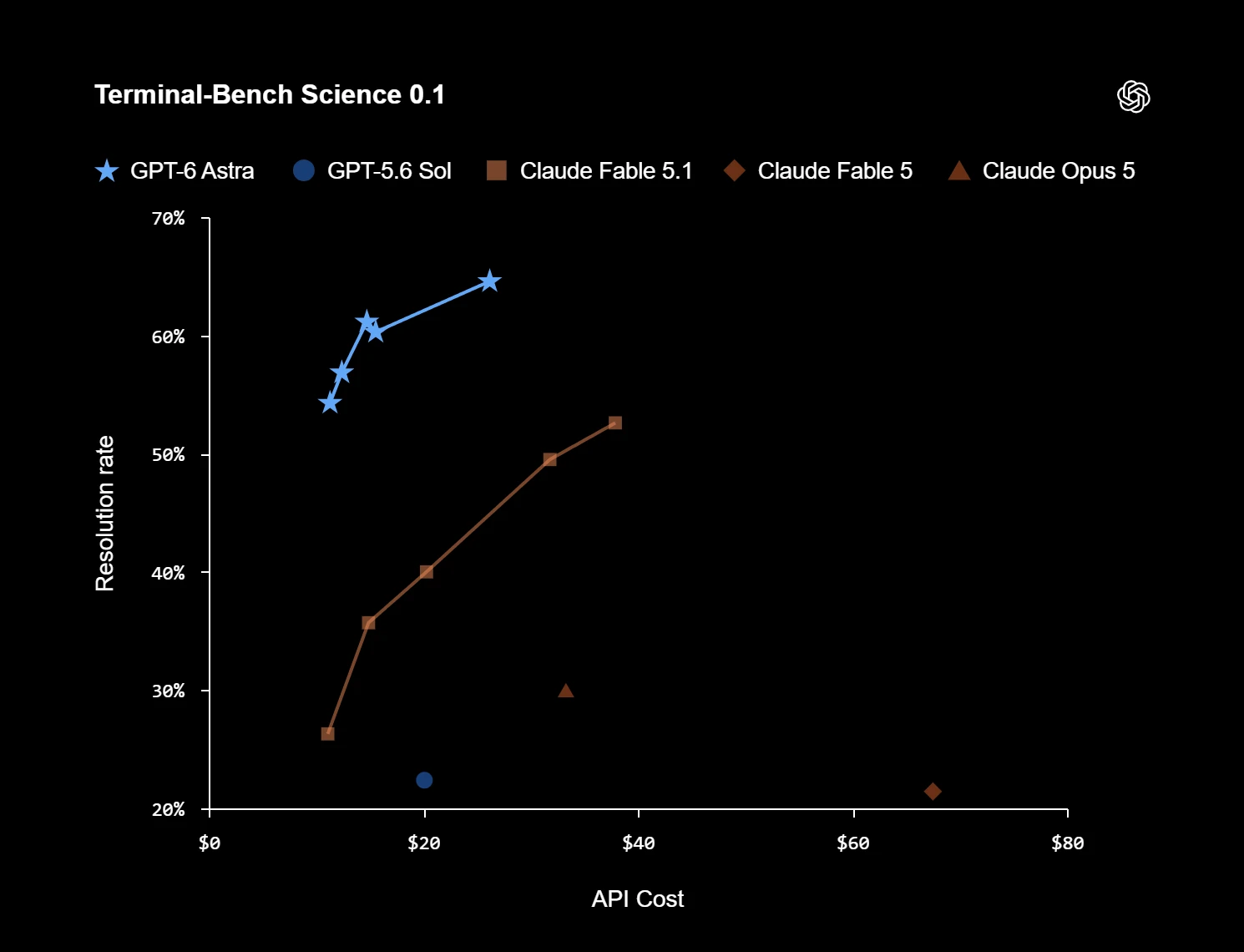
GPT-6 Astra and Anthropic’s Claude Fable 5.1 represent two of the most capable AI systems currently competing for the future of agentic work, but the benchmark picture is more complicated than simply declaring one model the winner. OpenAI’s published results place Astra ahead in areas including computer use, mathematics, cybersecurity, automation, and scientific software tasks, while Fable 5.1 has shown stronger results on some broader reasoning evaluations, including Humanity’s Last Exam with tools and the Artificial Analysis Intelligence Index.
Claude Fable 5.1 has also focused heavily on coding, research, and agentic workflows, with Anthropic emphasizing improved efficiency and lower costs for complex agent operations. Astra, meanwhile, appears particularly strong in computer interaction and high-stakes technical domains, which may make it attractive for organizations looking to deploy AI that can actively operate across software systems. The competition is ultimately good news for users because the future of AI is unlikely to be controlled by a single benchmark or capability.
Some models may become better at autonomous computer use, others at deep reasoning, coding, research, creativity, or long-running enterprise workflows. GPT-6 Astra’s arrival makes the race more important. AI is increasingly moving beyond answering questions and toward performing work, and the companies building the most capable agents may soon compete not simply to create the smartest chatbot, but to define the digital workforce of the future.