

SearchScore AI Reveals the Brutal Truth About Your Brand in AI Search
For more than two decades, digital visibility was largely defined by search engines built around links, rankings, and keyword optimization. Brands competed for positions on search result pages because visibility inside Google Search often determined traffic, conversions, and online relevance. Entire industries emerged around search engine optimization, analytics, and advertising systems designed to help companies appear more prominently across the web.
There is a question that every brand manager, CMO, and SEO professional should be asking in 2026, and most of them are not asking it with any precision: when someone types your category into ChatGPT, Gemini, or Perplexity, does your brand appear? Not rank. Not show up in a blue link. Appear. By name. Described accurately. Positioned favourably. Recommended rather than merely acknowledged. The answer to that question is now a material business issue, and for most brands, the answer is unknown because the tools to measure it have either not existed or have not been accessible enough to become part of a standard marketing workflow.
DareAISearch has launched SearchScore AI to change that. It delivers an AI search visibility score for any brand, in under 55 seconds, across the platforms where the most consequential brand discoveries of 2026 are happening.
SearchScore AI Helps Brands Measure Visibility in AI-Powered Search Engines
The problem SearchScore AI is solving did not exist at scale two years ago. It is entirely a product of the speed at which AI answer engines have become the primary discovery layer for information, products, and services. ChatGPT holds approximately 79 percent of global generative AI web traffic as of January 2026. Gemini grew 157 percent between April and September 2025, reaching 1.1 billion monthly visits. Perplexity reached 170 million monthly visits, and Claude reached 157 million. These are not niche platforms used by early adopters. They are the search interfaces of a generation that has decided it would rather ask a question and receive an answer than scroll a list of links and make its own determination.
And the brands that appear consistently and favourably in those answers are building a form of digital authority that traditional search engine optimization was never designed to create or measure.
The visibility challenge is compounded by the fact that AI search is not one system. Not all AI models think the same way when it comes to sourcing and citations for the answers they generate. ChatGPT rewards broad distribution and consistency across sources. Perplexity rewards specialisation, leaning into industry-specific directories. Gemini leans brand-heavy in its citation patterns. A brand that appears strongly in ChatGPT may be entirely absent from Perplexity’s recommendations, and vice versa. Without a tool that queries all of the major platforms simultaneously and aggregates the results into a unified visibility picture, any brand attempting to manage its AI search presence is flying blind across most of the airspace that matters.
The New Way to Track Brand Visibility in AI Search
SearchScore AI’s core proposition is disarmingly simple and surprisingly rare in the martech landscape. Enter your brand name, wait under 55 seconds, and receive a scored assessment of how visible your brand is across ChatGPT, Gemini, Perplexity, and Google AI. The score is a composite measurement drawn from real-time queries across each platform, with results analyzed for brand presence, frequency of mention, accuracy, sentiment tone, and competitive positioning. The output is a number that did not previously exist for most brands, a quantified answer to the question every marketing team has been asking in qualitative terms since AI search started to matter.
What makes SearchScore AI worth understanding as a product rather than simply as a marketing dashboard is the nature of what it is actually measuring. AI search visibility is not the same as keyword ranking. When a user asks ChatGPT “what is the best project management software for a remote team?” the platform does not return a ranked list with your brand at position seven. It synthesises a response, drawing on whatever training data and retrieval-augmented information it has access to, and presents a narrative.
Your brand either appears in that narrative or it does not. If it appears, it is described in a particular way, with a particular tone, compared to particular competitors, in a position within the response that reflects how the model has weighted its knowledge of your category. All of these dimensions, presence, sentiment, accuracy, competitive positioning, and consistency across platforms, are what SearchScore AI is designed to surface.
Do AI Search Engines Actually Recognise Your Brand?
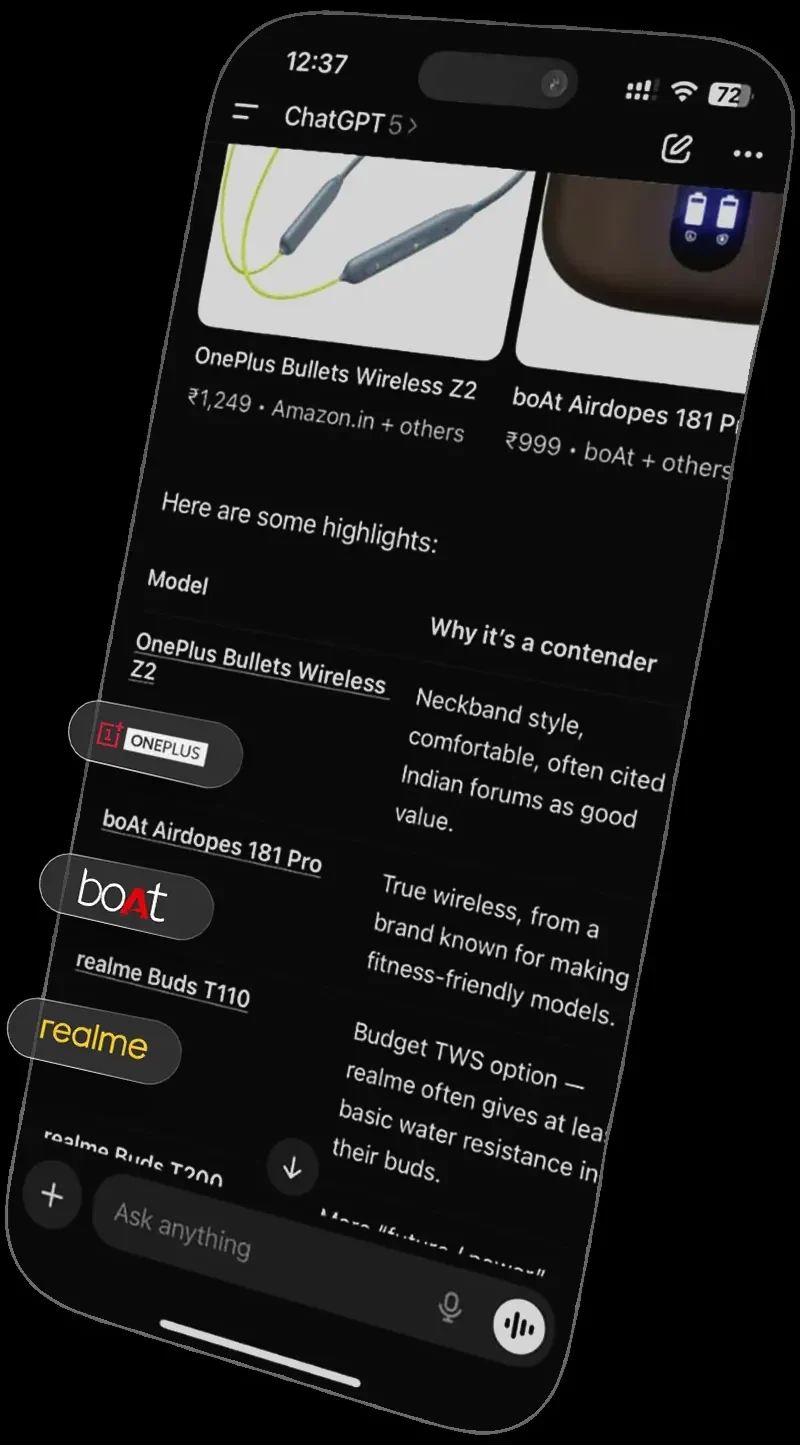
The question of whether AI search engines have a coherent, accurate model of what your brand is, what it does, who it serves, and where it sits in its competitive category is a prerequisite for everything else. A brand that AI platforms do not recognise cannot be recommended. A brand that AI platforms recognise inaccurately will be described in ways that may actively mislead potential customers. And a brand that AI platforms recognise but associate primarily with negative sentiment will be cited in the wrong contexts, positioned against rather than for the purchasing decisions it is trying to influence.
What we have observed is that the recognition problem has an additional dimension that SearchScore AI’s platform addresses and that is hallucination. Large language models occasionally generate confident, fluent, and entirely incorrect descriptions of brands, including wrong founding dates, misattributed product features, incorrect market positioning, and invented customer testimonials.
These hallucinations are not detectable through traditional brand monitoring tools, because they do not appear in social media mentions, news articles, or review sites. They exist only in the outputs of AI search platforms, and they are only discoverable through the kind of systematic, real-time AI querying that SearchScore AI conducts.
Score Breakdown, Brand Sentiment, Competitive Benchmarking: The Four Pillars
SearchScore AI is organised around four core product capabilities, each addressing a distinct dimension of the AI search visibility problem.
- AI Search Playground: An interactive environment where users can test how their brand appears across AI search platforms in real time, experimenting with different query formulations, competitive angles, and category framings to understand which prompts trigger mentions and which leave the brand invisible. The Playground gives marketing teams a hands-on tool for understanding the AI search landscape around their brand rather than receiving a static report.
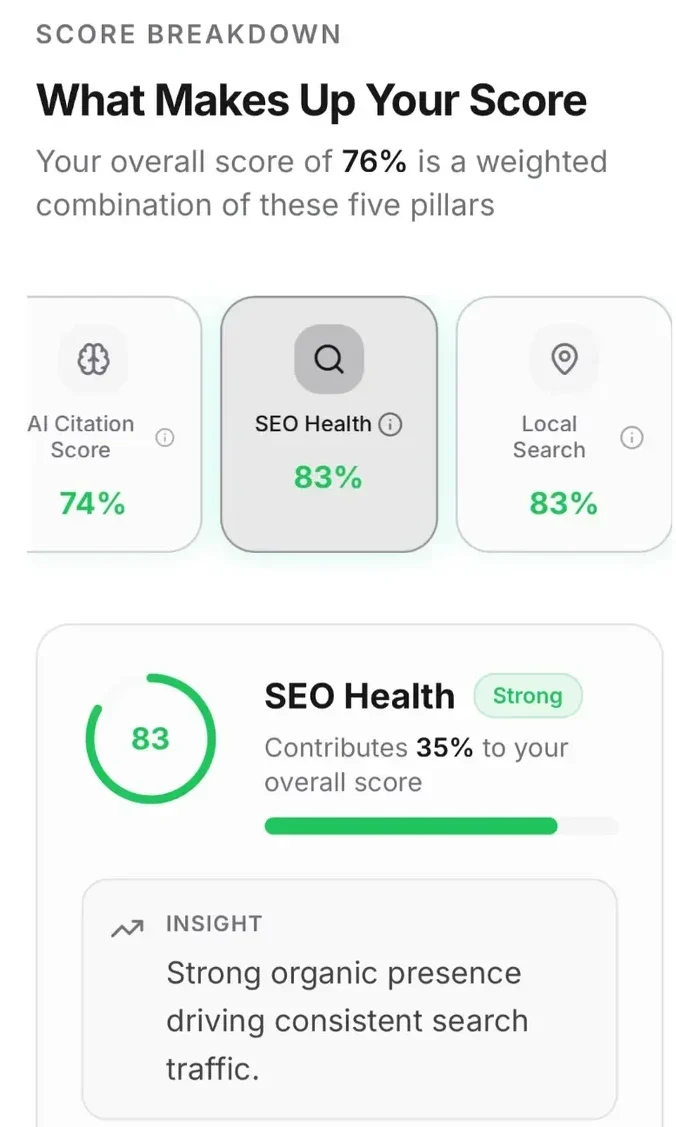
- Score Breakdown: A detailed decomposition of the composite SearchScore, revealing how visibility varies by platform, by query type, by category framing, and over time. The breakdown transforms the top-line number into actionable diagnostic data, identifying specifically where a brand is visible, where it is absent, and where the gap between its intended positioning and its AI-represented positioning is widest.
- Brand Sentiment Analysis: Measurement of the tone and framing that AI platforms use when mentioning a brand. Not whether the brand appears, but how it is described: as a leader, as an alternative, as a legacy player, as a challenger, as a risk, or as a recommendation. According to Gartner, 73 percent of B2B buyers trust AI product recommendations over traditional ads. The language of those recommendations is what sentiment analysis is measuring.
- Competitive Benchmarking: A side-by-side comparison of a brand’s AI search visibility against named competitors, revealing which brands in a category win mentions, which are systematically absent, and which carry the strongest or weakest sentiment profiles. Competitive benchmarking turns AI search visibility from a self-referential metric into a strategic tool for understanding where the competitive battle for category ownership in AI answers is actually being won and lost.
Could SearchScore AI Become the Google Analytics of AI Search?
When Google Analytics launched in 2005, it gave marketers a systematic, data-driven way to understand something they had previously only been able to estimate: who was visiting their websites, where those visitors came from, what they did once they arrived, and how that behaviour translated into business outcomes. It created a measurement layer for web traffic that became foundational to modern digital marketing over the following two decades.
AI search visibility may now be approaching a similar inflection point. The traffic is already flowing through conversational interfaces. Product discovery, purchasing decisions, and brand comparisons increasingly happen inside AI-generated responses rather than through traditional search result pages. Platforms such as ChatGPT, Gemini, and Perplexity are beginning to shape perception before users ever reach a company’s website directly.
Traditional SEO was built around rankings, clicks, backlinks, and traffic flows. AI search changes the object being measured. In conversational systems, visibility is no longer defined only by whether a website appears in search results, but by whether a brand is included inside the generated answer itself, how it is described, and which competitors appear alongside it. That creates a measurement problem that most existing analytics infrastructure was never designed to solve.
Platforms like SearchScore AI are emerging in response to that gap. Rather than focusing exclusively on search rankings, they attempt to measure how AI systems represent, prioritize, and contextualize brands across conversational interfaces. The broader significance of these tools is the creation of a new visibility layer for an internet increasingly mediated by AI-generated answers rather than traditional web navigation.
Why SearchScore AI Could Become Essential for AI Search Visibility?
The argument for SearchScore AI’s strategic necessity rests on a simple arithmetic of modern discovery. If 93 percent of AI Mode sessions end without a click, then for the majority of AI-mediated information queries, the AI response is not a gateway to your brand’s website. It is the only impression your brand gets. There is often no second chance in the form of an organic listing below the AI overview. There is no ad placement alongside the AI-generated answer that catches the user who was not swayed by the main response. SearchScore AI is not measuring where your brand ranks. It is measuring whether your brand exists in the conversation that is increasingly replacing search.
The New Visibility Layer Emerging Around AI Search
SearchScore AI is best understood as part of a new measurement layer emerging around AI-mediated discovery. Search rankings, social listening, and advertising analytics were built for an internet where users navigated websites directly. Conversational AI changes that dynamic by compressing discovery, recommendation, and comparison into generated responses that users increasingly trust without leaving the interface itself.
This creates a visibility problem that did not previously exist in the same form. Brands are no longer competing only for clicks or rankings, but for inclusion inside AI-generated narratives that shape perception before direct engagement occurs. As AI systems become more deeply integrated into search, browsers, and enterprise workflows, understanding how those systems represent brands may become an increasingly important part of digital strategy.
SearchScore AI Helps Brands Compete for Visibility Inside AI Answers
The entry-level diagnostic requires no integration, no API key, or technical setup. Users can enter a brand name, optionally select competitors, and receive a composite score based on real-time queries across major AI platforms within 55 seconds. The score breakdown then reveals where the brand is visible and where it is not, what sentiment the AI platforms are attaching to it, and how that positions it relative to the competitors winning the AI search narrative in its category.
For brands that have been building their digital presence with traditional SEO and paid media as the primary levers, the SearchScore AI diagnostic reveals a visibility picture that is radically different from what their existing analytics suggest. That gap is the opportunity. SearchScore AI exists to make it legible.