

From CERN to Cycles: Dr. Magda Armbruster on the Science, Privacy, and Future of Natural Cycles
There are not many people in the world who can claim to have contributed to a Nobel Prize in Physics and then pivoted to leading product development of a contraceptive app that cleared the FDA. Dr. Magda Armbruster is one of them. As VP of Product at Natural Cycles, she sits at the centre of one of the most technically complex and ethically loaded intersections in modern technology: the point where clinical algorithms, reproductive biology, wearable hardware, AI, and personal privacy all converge.
Natural Cycles is not simply a health app. It is a regulated medical device, the first software-as-a-medical-device to receive FDA clearance as a contraceptive method. The product that millions of women use to manage their fertility was built on clinical data from over 22,000 participants, underpinned by probabilistic modelling that has more in common with particle physics than with a wellness startup, and governed by regulatory standards that most technology companies have never been asked to meet.
In collaboration with Gallium Ventures, we had the opportunity to interview Dr. Magda Armbruster
What follows is her full, unedited response to each, framed by editorial context that helps situate the answers in the broader landscape of femtech, AI, and the future of reproductive health technology in 2026.
The Science Behind the Algorithm
Your journey from searching for the Higgs boson at CERN to Vice President of the product team at Natural Cycles is uniquely impressive. Technically speaking, how does managing billions of particle collisions compare to the algorithmic complexity of predicting biological cycles?
In many ways, the Higgs boson was easier because the laws of physics are universal. At CERN, we worked with massive data volumes, but the “rules” of a subatomic particle don’t change based on whether it’s stressed or whether it had a glass of wine.
Biological cycles are much noisier. The complexity comes from individual variability. At CERN, I used statistical models like Bayesian methods to find a needle in a haystack. At Natural Cycles, we use similar probabilistic modeling, but instead of particles, we’re interpreting personal signals, like whether a temperature rise is a true thermal shift or just noise. The key difference is that the “physics” of the body is personal, not universal.
Natural Cycles was the first FDA-cleared software-as-a-medical-device (SaMD). What was the biggest technical or regulatory hurdle in proving that an algorithm could be as effective as physical contraception?
The biggest hurdle was shifting the mindset of regulators who were used to evaluating physical barriers or chemicals. We had to prove that an algorithm could be a contraceptive.
Our clinical study of over 22,000 women was the cornerstone. We needed to demonstrate both a “Typical Use” effectiveness of 93% and a “Perfect Use” effectiveness of 98%. That meant showing the algorithm is conservative. It will not give a “Green Day” or non-fertile day unless it is statistically very confident it’s a non-fertile day.

Basal body temperature can be affected by alcohol, lack of sleep, or illness. How does your algorithm technically filter out “noisy” data points to ensure the user’s “Green Day” status remains medically accurate?
Users can log factors that might affect their temperature, like illness or alcohol, but we can’t rely on that alone.
So the algorithm identifies anomalies,data points that deviate significantly from a user’s baseline and treats them as unreliable. These are effectively filtered out, and we may add a buffer “Red Days” to stay on the safe side.
This is where the strength of the algorithm comes in, balancing personalization with a conservative approach to safety.
*The anomaly detection described here mirrors the signal-noise filtering techniques used in high-energy physics data pipelines. At CERN, outlier readings from particle detectors are flagged and removed before statistical analysis. Dr. Armbruster is applying the same rigour to a dataset where the stakes are not experimental, they are personal.
Wearables, Data, and the Connected Health Era
With recent Apple Watch and Oura Ring integrations, the app has moved from manual entry to passive data collection. How has this shift improved the algorithm’s predictive power or “Green Day” accuracy?
In simple terms, the effectiveness of the Natural Cycles app does not depend on the device you use to measure temperature. Whether it’s a thermometer, Oura Ring, Apple Watch, or Garmin Watch, the algorithm delivers the same level of contraceptive effectiveness. That really speaks to the strength of the algorithm itself.
What has changed with wearables is the user experience. Passive data collection and automatic syncing make it much easier to record data consistently, and that has a big impact on engagement and retention.
The more consistent the data, the better the algorithm can learn an individual’s cycle. Our research shows that this can lead to more “Green Days,” simply because the algorithm has a clearer understanding of your patterns.
So while the effectiveness remains the same, the experience becomes more seamless, and in many cases, more empowering for the user.
As “Connected Health” becomes the standard, how do you see Natural Cycles interacting with other AI health assistants (like Apple Health or Google Fit) while maintaining its status as a regulated medical device?
The key is distinguishing between general health tools and regulated medical devices.
AI health assistants can process data, but they are not validated to interpret it in a way that provides medical or contraceptive advice. That’s why they are not regulated for it.
What differentiates Natural Cycles is our medical device classification, which reflects both the regulatory standards we meet and the level of scientific validation behind the product.
Privacy, Security, and the Weight of Sensitive Data
How do you address the unique cybersecurity challenges of handling highly sensitive reproductive data in an era of increasing digital vulnerability?
At Natural Cycles, we understand this data is deeply personal, and trust is foundational for us.
We have a strong data protection program, NC° Secure, in place, and we also created a Go Anonymous mode, which allows users to go fully anonymous. This means their identity is completely separated from their fertility data, so no one, including us, can link the data back to them.
It’s also important to highlight that Natural Cycles is a subscription-based app, so we don’t need to monetize your personal health data. This allows us to design the product with privacy and security at the core, and provide a more secure and trustworthy experience for our users.

With the rise of privacy-first tech, is Natural Cycles looking into processing more data on-device (at the edge) to minimise the transmission of sensitive biometric data to the cloud?
The sensitive data we collect is a critical input to the clinical algorithms that we run behind the scenes. At this stage, it’s not really feasible to run these algorithms fully on-device, due to factors like performance, scalability, and the size and complexity of the data.
It’s also important to note that, as a regulated medical device, we are required to collect and monitor this data as part of ensuring and reporting on contraceptive effectiveness.
That said, privacy remains central to how we design the product, so while not all processing happens on-device, the system is built with both clinical rigour and data privacy in mind.
*The tension Dr. Armbruster describes between on-device processing and clinical data requirements is one of the defining regulatory challenges for health wearables in 2026. As a regulated SaMD, Natural Cycles is required to maintain audit trails that most consumer apps are not subject to, a constraint that actually works in users’ favour, creating accountability that purely consumer-facing health apps do not bear.
Big Data, AI, and the 28-Day Myth
You now have one of the largest datasets on female reproductive health in existence. How are you using Big Data to challenge long-standing medical assumptions about the “average” 28-day cycle?
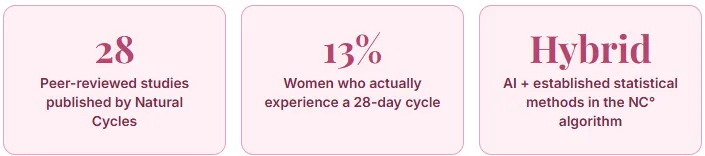
Our research shows that the “standard” 28-day cycle is actually not the norm — only around 13% of women experience it.
Beyond generating data, we focus on education. We want women to understand their own cycles and be able to bring that data into conversations with healthcare providers. It’s a way of helping women advocate for themselves, while also challenging outdated assumptions.
Femtech is often underfunded. From a “futurist” perspective, how can advancements in AI and data equity help close the gender gap in clinical research?
As a woman and a former physicist, I find it quite absurd that women were historically excluded from research because hormonal cycles were seen as too “complex.” In physics, you learn to account for variables. That’s the whole point.
AI and data equity will be key to closing this gap. At Natural Cycles, we’re contributing in three important ways. First, by building one of the largest datasets in women’s health. Second, by using that data to evolve our technology.
Because we’ve analysed so many cycles, we’ve been able to train AI models and incorporate them into our algorithm. Today, we use a hybrid approach, combining established statistical methods with AI, while maintaining the same level of clinical effectiveness.
And third, we’re actively investing in women’s health research. We collaborate with leading researchers and institutions around the world, and have published 28 peer-reviewed studies to date. This is a critical part of closing the research gap and advancing scientific understanding in this space.
Once this kind of data exists at scale, it not only improves the technology itself, but also makes it much easier to demonstrate the need for greater investment in femtech and women’s health overall.
Most medical AI is trained on data that lacks gender diversity. As VP of Product, is your team ensuring that your predictive models are inclusive of different ethnicities and lifestyles globally?
The NC° algorithm is fully personalised. It learns from each individual user rather than comparing them to others.
At the same time, our global dataset allows us to study how different factors influence reproductive health more broadly.
Our R&D team continuously refines the algorithm and expands our research, so we can keep improving both accuracy and inclusivity.
AI, Diagnostics, and What Natural Cycles Becomes Next
As AI evolves, do you see Natural Cycles moving toward generative or diagnostic capabilities, perhaps identifying hormonal imbalances or early signs of perimenopause before a user even notices symptoms?
With our different modes: Birth Control, Plan Pregnancy, Follow Pregnancy, Postpartum, and Perimenopause, we’ve already moved toward more predictive capabilities.
For example, NC° Perimenopause helps users better understand whether they may be entering perimenopause, and at which stage, based on their data and our new NC° Menopause Algorithm.
We’re excited about how much further we can take this, especially as the dataset continues to grow and we continue to expand how we incorporate AI into our work.
Natural Cycles currently offers five distinct modes, each addressing a different life stage:
- Birth Control
- Plan Pregnancy
- Follow Pregnancy
- Postpartum
- Perimenopause
Natural Cycles was a pioneer in the SaMD (Software as a Medical Device) space. What advice do you have for tech leaders trying to navigate the friction between “move fast and break things” and the strict safety requirements of the FDA?
Coming from CERN, I’m used to a culture where peer review and validation are everything. In a “move fast and break things” environment, that can feel like a constraint, but in healthcare, breaking things has real consequences.
For us, trust comes first. That’s why we invested years in clinical trials to achieve FDA clearance and CE marking.
Being a medical device means we move carefully, but it also means that when we do innovate, it’s been rigorously tested. That’s ultimately what builds long-term credibility.
BONUS READ: What Makes Natural Cycles a Leading Fertility Tracking and Hormone-Free Birth Control App?
About the People and Organisations Behind This Interview
About Dr. Magda Armbruster, VP of Product, Natural Cycles
Dr. Magda Armbruster is a physicist and product leader with a background in particle physics research at CERN, where she contributed to work associated with the Higgs boson discovery. Today, she leads product development at Natural Cycles, bringing a data-driven and scientific approach to reproductive health technology. Combining analytical rigor with a strong focus on user experience, she works at the intersection of science, technology, and women’s health to build products grounded in both research and real-world impact.
About Natural Cycles
Founded in Stockholm and serving users globally, Natural Cycles is the first FDA-cleared birth control app and a pioneer in digital reproductive health. Its algorithm combines basal body temperature data with cycle tracking to provide personalized daily fertility insights with clinically validated effectiveness. Today, the platform supports women across multiple stages of reproductive health, including birth control, conception planning, pregnancy, postpartum recovery, and perimenopause. Backed by extensive clinical research and peer-reviewed studies, Natural Cycles has helped define the emerging category of software-driven reproductive healthcare.
About Gallium Ventures
Gallium Ventures is an award-winning global PR and strategic communications agency that helps technology, consumer, and high-growth brands build visibility, shape reputation, and expand internationally. Founded by communications leader Heather Delaney, the agency combines strategic storytelling, media relations, creative campaigns, and brand consultancy to support companies ranging from startups to global enterprises. With expertise spanning sectors such as femtech, fintech, healthtech, consumer technology, and entertainment, Gallium Ventures positions itself as an extension of its clients’ teams, focused on delivering measurable impact through modern, globally minded communications.
About The Futurism Today
The Futurism Today is an independent tech media platform focused on covering emerging technologies, startups, and innovation-driven trends. It publishes commentary, analysis, and opinion-driven content exploring developments across the tech ecosystem, with a focus on new products, companies, and industry shifts. It also highlights early-stage innovation and breakthrough ideas shaping the next generation of technology. Through interviews, features, and analysis, it aims to make complex tech developments more accessible to a broader audience.