


RadixArk Wants to Democratize AI Infrastructure with Open-Source Systems
The Growing Divide in AI Infrastructure
The rapid rise of large language models and frontier AI systems has transformed artificial intelligence from a research discipline into a full-scale infrastructure race. Since 2023 the conversation around AI has increasingly shifted away from models alone and toward the systems required to train, deploy, optimize, and scale them. Advanced AI development now depends on massive computational infrastructure, distributed training systems, inference engines, reinforcement learning frameworks, and hardware orchestration layers capable of operating across increasingly complex environments. While breakthroughs in generative AI receive most public attention, the underlying infrastructure stack has quietly become one of the most strategically important layers in the technology industry.
At the same time, this infrastructure has become increasingly concentrated inside a small group of well-funded labs and hyperscale technology companies. Frontier AI systems often require access to proprietary tooling, specialized deployment pipelines, and large-scale compute environments that remain inaccessible to most startups, researchers, and independent developers. This concentration creates a structural divide where only organizations with significant financial resources can fully participate in developing next-generation AI systems.
RadixArk is entering this environment with a different approach. Rather than building closed AI products, the company is focused on open-source infrastructure systems designed to support the training, inference, and deployment of large AI models across multiple hardware platforms. Its broader goal is to reduce the dependency on proprietary infrastructure ecosystems by making advanced AI tooling more accessible and interoperable.
The company’s positioning reflects a growing movement inside the AI ecosystem where infrastructure itself is becoming a competitive domain. Open-source frameworks have historically played a foundational role in AI development, but frontier-scale infrastructure has increasingly shifted toward closed internal systems controlled by major labs. RadixArk is attempting to reverse part of this trend by building infrastructure layers intended to remain open and broadly usable across the industry.
Why Open Infrastructure Matters in Frontier AI
The importance of open infrastructure in AI extends beyond ideology or developer preference. At the frontier level, infrastructure decisions directly influence who can participate in model development, how quickly research progresses, and whether innovation remains concentrated within a handful of companies. Many of the most powerful AI systems today depend on highly optimized internal stacks that combine training orchestration, inference optimization, reinforcement learning workflows, and hardware-level acceleration techniques unavailable outside a small number of organizations.
This creates several challenges for the broader AI ecosystem. Researchers and startups often struggle to reproduce or scale advanced systems because infrastructure complexity has become a barrier in itself. Proprietary environments can also limit interoperability, forcing developers into tightly controlled ecosystems tied to specific vendors or hardware architectures. As AI systems become larger and more computationally demanding, these infrastructure constraints are becoming increasingly significant.
RadixArk’s strategy is built around the idea that frontier AI infrastructure should function more like open computing infrastructure rather than isolated internal tooling. The company is developing systems capable of operating across a wide range of hardware environments, including NVIDIA GPUs, AMD accelerators, Intel CPUs, and Google TPUs. This hardware flexibility is strategically important because it reduces dependency on single-vendor ecosystems at a time when GPU supply constraints and infrastructure costs continue to affect the broader AI market.
The company’s close connection to open-source projects such as SGLang and the reinforcement learning framework Miles also highlights the growing importance of community-driven infrastructure development. SGLang focuses on large language model inference optimization, while Miles supports reinforcement learning workflows tied to advanced model training. Together, these systems reflect an effort to create modular infrastructure layers capable of supporting multiple stages of AI development rather than isolated use cases.
The broader significance of this approach lies in its attempt to decentralize advanced AI infrastructure capabilities. If successful, open infrastructure systems could allow smaller organizations to experiment with more advanced models without relying entirely on proprietary cloud ecosystems or closed tooling environments.

Building Infrastructure for Training, Inference, and Scale
Modern AI systems require infrastructure that extends far beyond raw compute power. Training large models involves coordinating distributed workloads across thousands of accelerators, managing memory efficiency, optimizing data pipelines, and maintaining system reliability during long-duration training runs. Inference introduces a different set of challenges involving latency optimization, cost efficiency, and serving models across production environments at scale.
RadixArk is positioning itself across this broader infrastructure stack rather than focusing on a single operational layer. Its systems are intended to support both training and inference environments, enabling organizations to move models from development into deployment without rebuilding core infrastructure components for each stage.
One of the more important aspects of the company’s strategy is interoperability across hardware ecosystems. AI infrastructure has become increasingly fragmented due to the rapid growth of specialized accelerators and compute architectures. Different hardware platforms often require different optimization techniques, creating operational complexity for organizations deploying large models across heterogeneous environments.
By supporting multiple hardware backends, RadixArk aims to reduce this fragmentation while improving portability and flexibility. This could become increasingly important as enterprises and research organizations look for alternatives to highly centralized infrastructure ecosystems dominated by a small number of providers.
The company’s infrastructure focus also reflects a broader industry transition toward operational efficiency. Early AI development emphasized model scale above all else, often prioritizing larger parameter counts regardless of infrastructure cost. As AI systems move toward commercialization, however, efficiency in training and inference has become increasingly important. Infrastructure companies capable of reducing deployment costs and improving hardware utilization may therefore occupy a critical position within the next phase of AI development.
The $100M Seed Round and the Push for Open AI Systems
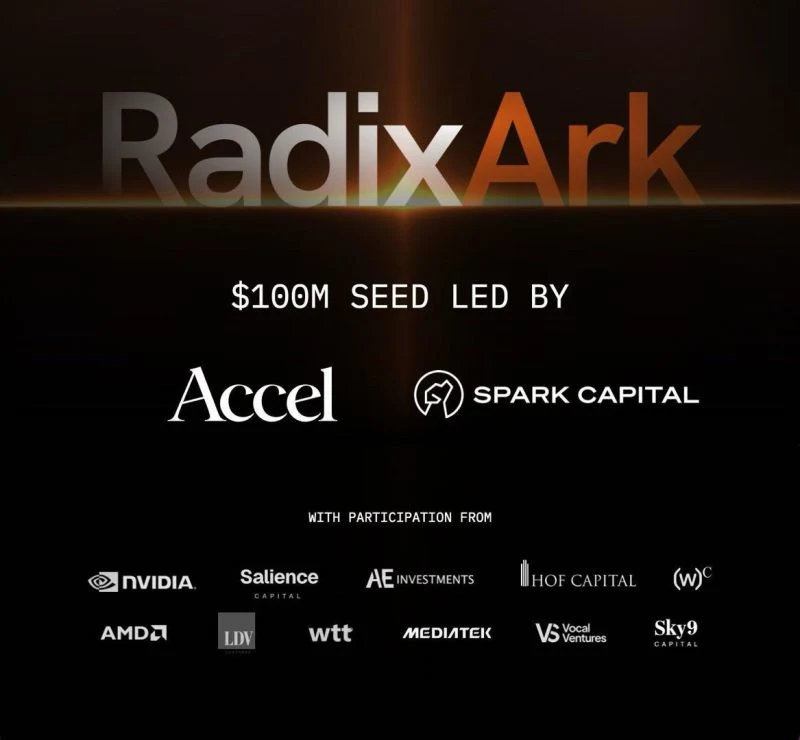
RadixArk’s $100 million seed funding round, led by Accel and Spark Capital, reflects the growing strategic importance of AI infrastructure startups within the broader technology market. The scale of the investment is particularly notable given the company’s early stage, signaling strong investor confidence in the long-term relevance of infrastructure-focused AI companies.
The funding also highlights how investor attention is increasingly shifting toward foundational infrastructure rather than purely application-layer AI products. While generative AI applications continue to dominate public discussion, the systems enabling training, deployment, and scaling are becoming equally important competitive layers. Companies building these infrastructure foundations may ultimately influence the broader direction of the AI ecosystem itself.
RadixArk’s reported valuation of approximately $400 million further underscores the market’s perception of frontier AI infrastructure as a strategic domain rather than simply a technical niche. The company’s founding team includes engineers with backgrounds at organizations such as xAI and NVIDIA, bringing expertise tied directly to large-scale AI system development. This operational experience is particularly important in infrastructure environments where scalability, optimization, and hardware coordination become defining technical challenges.
What Comes Next for Open AI Infrastructure?
The future of AI infrastructure will likely be shaped by tensions between openness, scalability, cost, and competitive control. Major AI labs continue investing heavily in vertically integrated systems where hardware, models, and infrastructure are tightly connected. At the same time, open-source communities and independent infrastructure companies are attempting to build alternative ecosystems capable of supporting advanced AI development without requiring full dependence on proprietary environments.
RadixArk’s emergence reflects this broader shift toward infrastructure pluralism. The company is effectively arguing that frontier AI should not remain operationally restricted to a small number of organizations with exclusive access to internal tooling. Instead, advanced infrastructure capabilities should become more modular, portable, and accessible across the ecosystem.
The long-term significance of this debate extends beyond developer convenience. Infrastructure accessibility influences research diversity, startup formation, academic participation, and the pace of experimentation across the AI industry. If frontier AI infrastructure remains highly centralized, innovation may increasingly concentrate within a limited set of dominant organizations. More open infrastructure systems could help distribute experimentation more broadly across the ecosystem.
However, building open infrastructure at frontier scale is extraordinarily difficult. AI systems are becoming increasingly resource-intensive, requiring continuous optimization across hardware, networking, orchestration, and model architecture layers simultaneously. Open-source infrastructure must therefore compete not only on accessibility but also on performance, reliability, and operational efficiency.
RadixArk’s success will ultimately depend on whether it can build infrastructure systems capable of meeting these demands while maintaining openness and interoperability. The company is entering one of the most strategically important layers of the AI industry at a time when infrastructure decisions may shape who controls the future direction of frontier AI development itself.
RadixArk is targeting one of the most strategically important gaps in AI today by focusing on open infrastructure rather than closed applications. The company’s long-term relevance will depend on whether open systems can remain competitive against increasingly vertically integrated AI ecosystems dominated by hyperscale labs and infrastructure providers.