


How Quantum Motion Plans to Scale Quantum Computing Through Silicon?
Quantum Computing Still Faces a Scalability Problem
Quantum computing has spent years moving from theoretical research toward practical engineering, yet one challenge continues to dominate the industry: scalability. While multiple companies have demonstrated functioning qubits and early-stage quantum processors, building systems large enough to solve commercially valuable problems remains extraordinarily difficult. Many current architectures require highly specialized fabrication methods, complex control systems, and environments that are difficult to scale economically. As the number of qubits increases, maintaining stability, reducing noise, and managing error correction become increasingly complex engineering problems.
Quantum Motion is approaching this challenge from a semiconductor perspective. Instead of treating quantum computing as an entirely separate manufacturing ecosystem, the company is developing silicon-based quantum systems compatible with CMOS fabrication processes. This approach reflects a broader effort to connect quantum hardware development with the mature infrastructure of the semiconductor industry. The idea is not simply to build isolated qubits, but to create a scalable pathway for manufacturing large arrays of qubits using technologies already foundational to modern electronics.
The significance of this strategy lies in its focus on manufacturability rather than purely experimental performance. Quantum computing has historically been dominated by research milestones tied to isolated systems. Quantum Motion is instead emphasizing how quantum hardware could eventually move into scalable production environments capable of supporting large-scale deployment.

Why Silicon Matters in the Race for Quantum Computing?
Silicon has shaped the modern computing industry for decades because of its compatibility with scalable manufacturing. The semiconductor ecosystem built around CMOS technology enables billions of transistors to be fabricated reliably and efficiently at scale. Quantum Motion’s strategy attempts to leverage this existing infrastructure rather than building an entirely separate manufacturing framework for quantum processors.
This is strategically important because scalability in computing has historically depended not only on performance breakthroughs but also on manufacturing capability. Early computing systems remained niche technologies until semiconductor fabrication enabled large-scale production. Quantum Motion’s focus on silicon-based qubits reflects an attempt to apply a similar principle to quantum hardware development.
The company’s approach also introduces potential advantages in integration and miniaturization. Silicon-based architectures can theoretically support denser qubit arrays while benefiting from decades of advancements in semiconductor engineering. By aligning quantum hardware with established CMOS processes, Quantum Motion aims to reduce some of the barriers associated with scaling exotic quantum systems.
However, integrating quantum behavior into silicon-based manufacturing environments is far from straightforward. Quantum systems are extremely sensitive to environmental interference, and maintaining coherent quantum states inside scalable architectures remains one of the industry’s largest technical challenges. The company’s work therefore exists at the intersection of quantum physics and semiconductor engineering, requiring advances in both domains simultaneously.

Building More Than a Single Qubit
One of the defining aspects of Quantum Motion’s positioning is its emphasis on qubit arrays rather than isolated qubit demonstrations. In quantum computing, individual qubits are important milestones, but commercially meaningful systems require thousands or potentially millions of interconnected qubits operating reliably together. The engineering challenge therefore shifts from proving that a qubit works to proving that large numbers of qubits can function cohesively within scalable architectures.
Quantum Motion’s platform is designed around this systems-level perspective. Instead of focusing solely on isolated performance metrics, the company is building infrastructure intended to support large-scale integration. This includes control electronics, error management systems, and manufacturing approaches compatible with semiconductor production methods.
The broader implication of this strategy is that scalability becomes part of the architecture from the beginning rather than an afterthought. Many early-stage quantum systems achieve promising experimental results but encounter significant obstacles when expanded beyond limited qubit counts. By focusing on manufacturable arrays and integrated control systems, Quantum Motion is attempting to address scalability constraints earlier in the development cycle.
This systems-oriented approach also reflects a shift occurring across the quantum computing industry. As the field matures, companies are increasingly evaluated not just on theoretical breakthroughs but on their ability to build complete architectures capable of long-term commercial deployment.
The “Transistor Moment” Comparison
Quantum Motion describes its vision as delivering quantum computing’s “transistor moment,” a comparison that carries substantial historical significance. The invention of the transistor fundamentally transformed computing by replacing bulky vacuum tubes with scalable semiconductor devices. More importantly, it enabled the miniaturization and mass production necessary for modern electronics.
By invoking this comparison, Quantum Motion is positioning its technology around a similar transition point for quantum computing. The implication is that current quantum systems resemble early experimental computing hardware, while scalable silicon-based quantum architectures could create the foundation for broader commercial adoption.
This analogy also highlights the importance of manufacturability in technological transitions. The success of the transistor was not solely based on performance improvements but on the ability to scale production economically and reliably. Quantum Motion’s emphasis on CMOS compatibility reflects an attempt to align quantum development with these same industrial principles.
At the same time, quantum computing introduces challenges far beyond those faced during the semiconductor revolution. Quantum systems require extreme precision, cryogenic environments, and sophisticated error correction methods. Delivering a true “transistor moment” for quantum computing therefore depends not only on hardware miniaturization but also on solving fundamental stability and control problems that remain active research areas across the industry.
Why the Semiconductor Industry Could Shape Quantum’s Future?
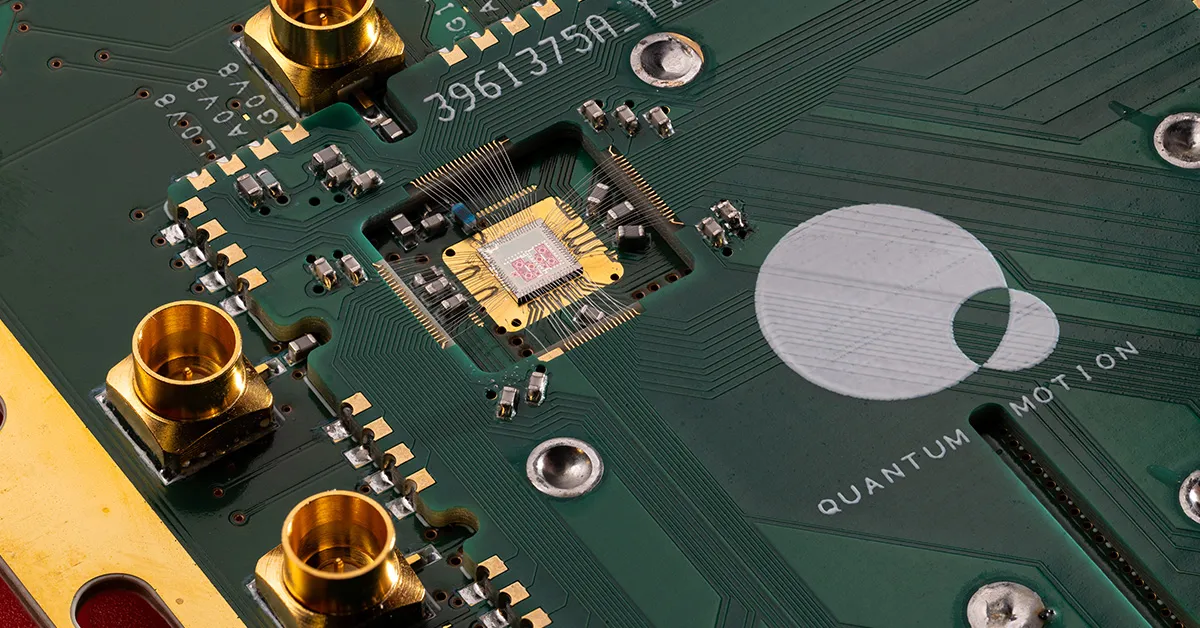
The relationship between quantum computing and semiconductor manufacturing is becoming increasingly important as the industry moves toward commercialization. Semiconductor fabrication facilities represent some of the most advanced manufacturing environments ever created, capable of producing components at nanometer scales with extraordinary consistency. Integrating quantum hardware development into this ecosystem could significantly accelerate scalability and production readiness.
Quantum Motion’s alignment with CMOS processes positions it within this broader convergence between quantum technologies and semiconductor infrastructure. Instead of building entirely new manufacturing pipelines, the company is attempting to leverage existing industrial capabilities developed over decades by the semiconductor sector.
This convergence also has geopolitical and economic implications. Semiconductor manufacturing already plays a central role in global technology supply chains, and quantum computing is increasingly viewed as a strategic technology with implications for cybersecurity, scientific research, and national competitiveness. Companies capable of bridging these industries may therefore occupy an important position within future technology ecosystems.
However, integration with semiconductor infrastructure does not automatically solve quantum computing’s core challenges. Scalability requires not only manufacturable qubits but also advances in software, control systems, and error correction. The long-term success of silicon-based quantum architectures will depend on how effectively these multiple layers evolve together.
What Scalable Quantum Systems Could Enable?
If scalable quantum computing becomes commercially viable, the implications could extend across multiple industries. Quantum systems have the potential to solve certain computational problems far more efficiently than classical computers, particularly in areas involving optimization, material science, molecular simulation, and cryptography.
For example, quantum simulations could accelerate drug discovery by modeling molecular interactions with greater precision than current systems allow. Optimization problems tied to logistics, finance, and manufacturing could potentially be solved more efficiently using large-scale quantum processors. Advances in materials science could also emerge from the ability to model complex atomic structures more accurately.
The importance of scalability lies in the fact that many of these applications require far more qubits than current experimental systems can reliably support. Small-scale quantum processors are valuable research tools, but large-scale commercial applications depend on architectures capable of operating with significantly higher qubit counts and lower error rates.
Quantum Motion’s focus on scalable silicon infrastructure therefore reflects a recognition that the future of quantum computing depends not only on scientific breakthroughs but on engineering systems capable of supporting practical deployment at meaningful scales.

Funding, Expansion, and the Push Toward Commercialization
Quantum Motion’s recent $160 million Series C funding round highlights growing investor confidence in scalable quantum hardware development. The funding provides the company with resources to expand its engineering capabilities, accelerate product development, and continue refining its silicon-based quantum architecture.
More significantly, the scale of the investment reflects broader industry momentum around quantum commercialization. Investors are increasingly shifting attention from theoretical research toward companies building manufacturable systems capable of long-term deployment. Quantum Motion’s focus on CMOS compatibility aligns with this trend by emphasizing industrial scalability alongside quantum performance.
The funding also reinforces the strategic importance of quantum computing within the global technology landscape. Governments, research institutions, and private investors are all increasing investments in quantum infrastructure due to its potential implications across cybersecurity, scientific computing, and industrial innovation.
For Quantum Motion, the challenge ahead lies in translating architectural ambition into reliable large-scale systems. Building manufacturable qubit arrays is only one part of the equation. Long-term success will depend on achieving stable performance, scalable error correction, and integration across the broader quantum computing stack.
Quantum Motion is approaching quantum computing from a manufacturing and scalability perspective rather than focusing solely on isolated research milestones. The CMOS-based strategy is compelling because it aligns quantum development with existing semiconductor infrastructure, but the company’s long-term relevance will depend on whether scalable silicon architectures can overcome the stability and error-correction challenges that continue to define the industry.