


How Corvera AI Is Automating Supply Chain Operations for Consumer Brands?
What Is Corvera AI?
Modern consumer brands operate in an environment where supply chains have become increasingly complex, fragmented, and difficult to manage manually. Fast-growing retail and consumer packaged goods companies must coordinate inventory, purchase orders, demand forecasting, fulfillment, and supplier communication across multiple systems and sales channels. As businesses scale, these operational tasks often create bottlenecks that slow decision-making and increase operational costs.
Corvera positions itself as an AI-driven operational layer built specifically for consumer brands facing these challenges. The company is developing what it describes as an agentic operating system for retail and CPG businesses, using AI agents to automate routine operational workflows that traditionally require extensive human coordination. Rather than functioning as a single-purpose analytics tool, Corvera aims to act as an operational workforce that continuously manages day-to-day supply chain processes in the background.
The company’s focus reflects a broader shift in enterprise software where businesses are increasingly looking beyond dashboards and reporting tools toward systems capable of autonomous execution. Instead of simply presenting operational data, platforms like Corvera are designed to interpret that data, make decisions, and trigger actions automatically. This represents a transition from software as a passive interface to software as an active operational participant.
How Corvera AI Automates Supply Chain Operations
Corvera’s platform focuses on automating core operational workflows that typically consume significant time inside retail organizations. These include inventory monitoring, purchase order management, demand forecasting, and end-to-end order processing. Traditionally, these workflows involve multiple teams coordinating across spreadsheets, ERP systems, supplier portals, and communication channels, creating inefficiencies that become more pronounced as order volumes increase.
The platform’s automation layer is designed to reduce this operational friction by allowing AI systems to manage repetitive and process-heavy tasks continuously. For example, inventory levels can be monitored in real time, while purchase orders are automatically generated based on projected demand and stock availability. Orders can also be processed without requiring manual intervention at every stage, enabling companies to handle larger transaction volumes without proportionally increasing operational headcount.
One of the more significant aspects of this approach is the continuous nature of the automation. Traditional supply chain workflows often operate in cycles, where decisions are made at fixed intervals based on historical data. Corvera’s system instead functions continuously, updating forecasts and operational actions dynamically as new information becomes available. This allows consumer brands to respond more quickly to fluctuations in demand, supplier delays, or inventory risks.
The AI Agents Powering Corvera’s Platform
At the center of Corvera’s infrastructure are AI agents designed to handle specialized operational functions across the supply chain. These agents are not positioned as general-purpose assistants but as systems trained to execute domain-specific workflows tied to retail operations. Each agent operates within a defined context, handling tasks such as monitoring stock levels, forecasting demand, or processing purchase orders.
This agent-based structure reflects an emerging trend in enterprise AI where automation is distributed across multiple specialized systems rather than centralized within a single interface. By dividing operational responsibilities between agents, the platform can manage multiple workflows simultaneously while adapting to changing business conditions.
The effectiveness of these agents depends heavily on access to accurate and integrated operational data. Supply chain environments generate large volumes of information across inventory systems, e-commerce platforms, logistics providers, and ERP software. Corvera’s platform aggregates this data and allows AI agents to interpret it continuously. This enables the system to identify inefficiencies, anticipate shortages, and trigger operational actions before problems escalate.
The broader significance of this model lies in how it changes the role of operational teams. Instead of manually executing repetitive workflows, teams can focus more on strategic decisions and exception management while AI systems handle ongoing operational coordination.

Why Fast-Growing Consumer Brands Need AI-Driven Supply Chains
The operational challenges faced by consumer brands increase significantly during periods of rapid growth. Expanding sales channels, rising order volumes, and more complex supplier relationships create environments where manual coordination becomes increasingly difficult to sustain. Small inefficiencies that may be manageable at an early stage can compound rapidly as businesses scale.
One of the major risks for growing retail brands is inventory imbalance. Overstocking ties up capital and increases storage costs, while stockouts can damage customer relationships and reduce revenue. Managing this balance requires accurate forecasting and rapid operational response, both of which become harder as the number of SKUs, suppliers, and marketplaces increases.
AI-driven supply chain systems attempt to address this challenge by operating with greater speed and consistency than manual workflows allow. Continuous forecasting models can respond to changing sales patterns more quickly, while automated operational processes reduce delays caused by fragmented coordination. For consumer brands operating across platforms such as Shopify and Amazon, this level of responsiveness can directly influence profitability and customer retention.
The broader appeal of AI-driven operations also lies in scalability. Instead of increasing operational teams proportionally with growth, businesses can use automation to absorb increasing complexity without dramatically expanding internal overhead.
Corvera AI’s Integrations With Shopify, Amazon, and ERP Systems
A critical aspect of Corvera’s platform is its integration with existing commerce infrastructure. Retail operations rarely function within a single system. Most brands operate across e-commerce platforms, marketplaces, warehouse systems, and ERP software, each generating its own datasets and workflows. This fragmentation creates visibility challenges and slows operational coordination.
Corvera addresses this by integrating with platforms such as Shopify, Amazon, and enterprise resource planning systems, enabling AI agents to access operational data across multiple environments simultaneously. These integrations allow the platform to function as a centralized operational layer rather than requiring businesses to replace their existing systems entirely.
This approach is strategically important because enterprise adoption often depends on compatibility with existing workflows. Companies are generally reluctant to overhaul infrastructure that is already operational, even if it is inefficient. By positioning itself as an overlay that enhances current systems, Corvera reduces implementation friction while still centralizing operational intelligence.
The integration layer also enables broader operational visibility. AI agents can analyze inventory movements, order flows, and supplier activity across platforms in real time, creating a more unified understanding of the business. This consolidated view is essential for enabling autonomous operational decision-making at scale.
Corvera AI’s Vision for Autonomous Retail Operations
Corvera’s broader vision extends beyond workflow automation toward autonomous retail operations. The company is building toward a model where AI systems can continuously coordinate operational processes with minimal human intervention. This includes not only identifying problems but also initiating corrective actions automatically.
The concept of autonomous operations reflects a larger transformation occurring across enterprise software. Businesses are increasingly moving away from systems that merely surface insights toward platforms capable of acting on those insights independently. In retail and supply chain environments, this could eventually include dynamic purchasing decisions, automated inventory balancing, and predictive operational planning.
The long-term significance of this shift lies in operational speed and adaptability. Traditional supply chain management often involves delays caused by approvals, communication gaps, and fragmented systems. Autonomous operational layers aim to reduce these delays by allowing AI systems to execute routine decisions continuously and at scale.
However, the adoption of autonomous operational systems also introduces new challenges. Businesses must establish clear controls around decision-making authority, data reliability, and operational accountability. The balance between automation and human oversight will likely remain a defining factor as these systems evolve.
Founders, Funding, and Y Combinator Backing
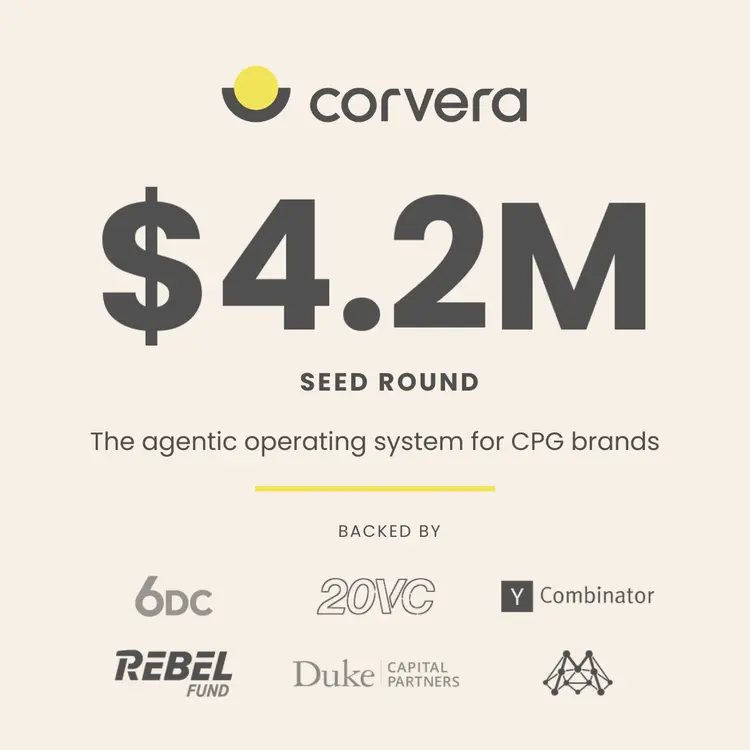
Corvera’s recent $4.2 million funding round highlights growing investor interest in AI-driven operational infrastructure for consumer brands. The company is also part of Y Combinator’s Winter 2026 batch, positioning it within a broader ecosystem of emerging AI-native startups focused on enterprise automation.
The funding supports Corvera’s efforts to expand its platform capabilities, refine its AI agents, and scale integrations across retail infrastructure systems. More importantly, it reflects increasing recognition that operational automation is becoming a strategic priority for brands operating in highly competitive commerce environments.
Investors are not simply backing another supply chain dashboard. They are supporting the development of operational systems capable of executing workflows autonomously across complex retail ecosystems. This represents a shift in how enterprise software is being positioned, moving from passive analytics toward active operational execution.
For Corvera, the challenge going forward will be demonstrating that AI agents can operate reliably across diverse operational scenarios while maintaining trust and transparency for enterprise customers. Supply chains involve high-stakes decisions tied to revenue, customer satisfaction, and logistics performance, making consistency and accuracy critical factors in adoption.
Corvera is targeting a real operational bottleneck for fast-growing consumer brands by focusing on autonomous execution rather than analytics alone. The platform’s long-term relevance will depend on how reliably its AI agents can manage operational complexity without creating new layers of risk or dependency inside supply chain environments.