


How Lithosquare Is Using AI to Accelerate Critical Mineral Discovery
The World Is Facing a Growing Critical Metals Gap
The global transition toward electrification and renewable energy is placing unprecedented pressure on the supply of critical minerals such as lithium, copper, and rare earth elements. These materials are essential for batteries, electric vehicles, grid infrastructure, and a wide range of emerging technologies. Demand projections continue to rise sharply, with forecasts indicating that current supply pipelines may not be sufficient to meet future needs. At the same time, traditional mineral exploration processes remain slow, capital-intensive, and uncertain. Discovering viable deposits can take years, often involving extensive fieldwork, drilling, and analysis with no guarantee of success.
Lithosquare is positioning itself within this challenge by focusing on accelerating the discovery phase. Instead of relying solely on conventional exploration methods, the company is integrating artificial intelligence with geological expertise to identify potential deposits more efficiently. The goal is not just to increase the number of discoveries but to reduce the time and cost associated with finding them. This approach reflects a broader shift in how resource exploration is being approached in an era where demand is outpacing traditional supply mechanisms.
Why Traditional Exploration Struggles to Keep Up?
Conventional mineral exploration is inherently complex and uncertain. It involves analyzing geological formations, interpreting historical data, and conducting physical surveys across vast and often remote areas. The process is iterative and time-consuming, with each stage requiring significant investment. Even with advanced tools, the probability of identifying economically viable deposits remains relatively low.
One of the key limitations of traditional exploration is the fragmentation of data. Geological information is often scattered across different sources, formats, and time periods, making it difficult to build a comprehensive understanding of potential sites. This fragmentation slows down analysis and limits the ability to identify patterns that could indicate the presence of valuable resources.
Additionally, exploration decisions are heavily dependent on human expertise. While geologists bring deep knowledge and experience, the scale of data involved in modern exploration exceeds what can be effectively processed manually. This creates a bottleneck where valuable insights may remain hidden within large datasets. As demand for critical minerals increases, these limitations become more pronounced, highlighting the need for new approaches that can operate at greater speed and scale.
Lithosquare’s Approach: Combining AI With Geological Expertise
Lithosquare’s model is built on the integration of artificial intelligence with domain-specific geological knowledge. Rather than replacing human expertise, the company uses AI to augment it, enabling more comprehensive analysis of geological data. The platform processes large volumes of information, including historical exploration records, geophysical data, and satellite imagery, to identify patterns that may indicate the presence of mineral deposits.
This approach allows for a more systematic evaluation of potential sites. By analyzing data at scale, the system can highlight areas that warrant further investigation, reducing the reliance on trial-and-error methods. Geologists can then focus their efforts on high-probability targets, improving the efficiency of the exploration process.
The combination of AI and geology also enables continuous refinement. As new data is collected and analyzed, the system can update its models, improving accuracy over time. This iterative process creates a feedback loop where each discovery contributes to the overall effectiveness of the platform. The result is a more dynamic approach to exploration, where insights evolve alongside the data.

How AI Is Changing the Speed and Accuracy of Discovery?
One of the most significant impacts of AI in mineral exploration is the ability to process and interpret data at a scale that was previously unattainable. Lithosquare’s platform leverages this capability to accelerate the identification of potential deposits. By analyzing multiple data sources simultaneously, the system can identify correlations and patterns that may not be apparent through manual analysis.
This has direct implications for both speed and accuracy. Faster identification of promising sites reduces the time required to move from initial exploration to active development. At the same time, improved accuracy increases the likelihood that identified sites will yield viable deposits, reducing wasted investment.
The ability to operate at scale also allows for broader exploration coverage. Instead of focusing on a limited number of regions, the platform can evaluate multiple areas concurrently, expanding the search for critical minerals. This is particularly important in a global context where supply chains depend on diverse sources. By increasing both the speed and scope of exploration, AI-driven approaches have the potential to reshape how resources are discovered and developed.
$25M Seed Funding Reflects Urgency Around Mineral Supply
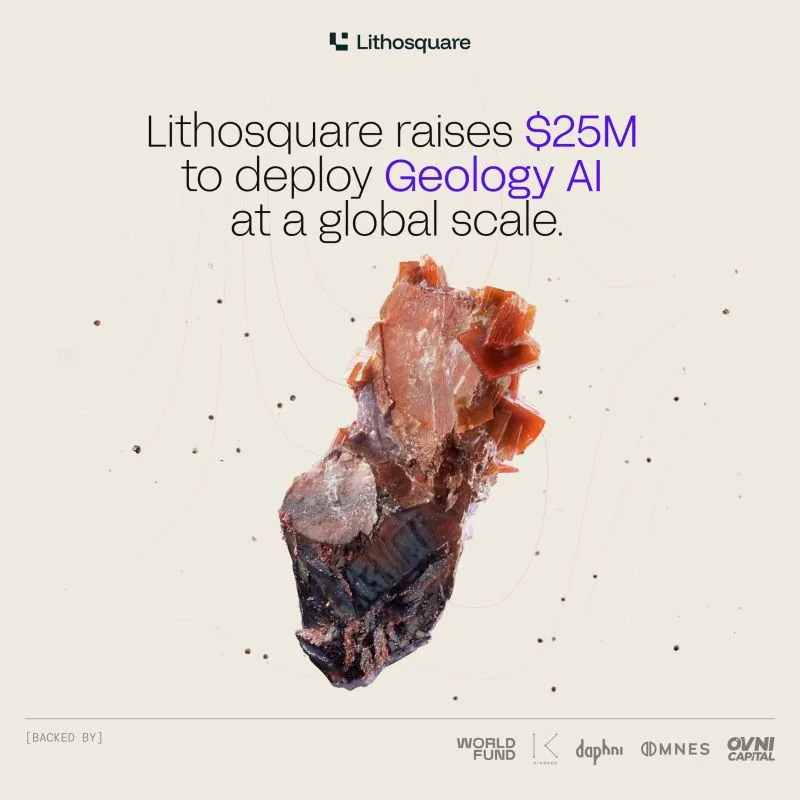
Lithosquare’s $25 million seed funding round highlights growing investor interest in solutions that address the critical metals supply challenge. As demand for these materials continues to rise, there is increasing recognition that traditional exploration methods may not be sufficient to meet future needs. Investors are backing technologies that can accelerate discovery and improve the efficiency of resource development.
The funding provides Lithosquare with the resources to expand its platform and deploy its technology across a wider range of exploration projects. It also supports the development of its AI models, enabling the company to refine its approach and improve performance. Beyond the immediate financial impact, the investment signals confidence in the role of AI in transforming mineral exploration.
This interest is not limited to the technology itself but extends to the broader implications for global supply chains. Securing access to critical minerals is becoming a strategic priority for governments and industries alike. By enabling faster and more reliable discovery, platforms like Lithosquare’s could play a key role in addressing these challenges.
From Exploration to Supply Chain Impact
The implications of accelerated mineral discovery extend beyond the exploration phase. Identifying new deposits is only the first step in a broader process that includes extraction, processing, and integration into supply chains. By reducing the time required to discover viable resources, Lithosquare’s approach can influence the entire lifecycle of mineral production.
Faster discovery can lead to earlier development, increasing the availability of critical materials and supporting the growth of industries that depend on them. This is particularly relevant for sectors such as electric vehicles and renewable energy, where supply constraints can limit expansion. By improving the efficiency of exploration, AI-driven platforms can contribute to more stable and resilient supply chains.
At the same time, the integration of AI into exploration raises questions about how the industry will evolve. Companies will need to adapt to new tools and methodologies, while maintaining the expertise required to interpret and act on the insights generated. The balance between technology and human judgment will remain a key factor in determining the success of these approaches.
What This Means for the Future of Resource Discovery?
Lithosquare’s approach reflects a broader shift toward data-driven exploration, where decisions are informed by large-scale analysis rather than limited datasets. This shift has the potential to transform how resources are discovered, reducing uncertainty and improving efficiency. As AI continues to evolve, its role in exploration is likely to expand, enabling new methods of identifying and evaluating potential deposits.
The future of resource discovery will depend on the ability to integrate technology with domain expertise. While AI can process data at scale, the interpretation of results and the development of exploration strategies will continue to rely on human knowledge. The most effective approaches will be those that combine these elements, leveraging the strengths of both.
Lithosquare’s work suggests that the industry is moving toward a model where exploration is faster, more precise, and more adaptable. This has implications not only for the availability of critical minerals but also for how the industry approaches sustainability and efficiency. By enabling more targeted exploration, AI-driven systems can reduce unnecessary activity and focus resources on areas with the highest potential.
Lithosquare is addressing a clear bottleneck in the global supply of critical minerals by focusing on the discovery phase. The approach is timely, but its long-term impact will depend on how effectively AI insights translate into real-world exploration success and how quickly the industry adopts these methods at scale.