

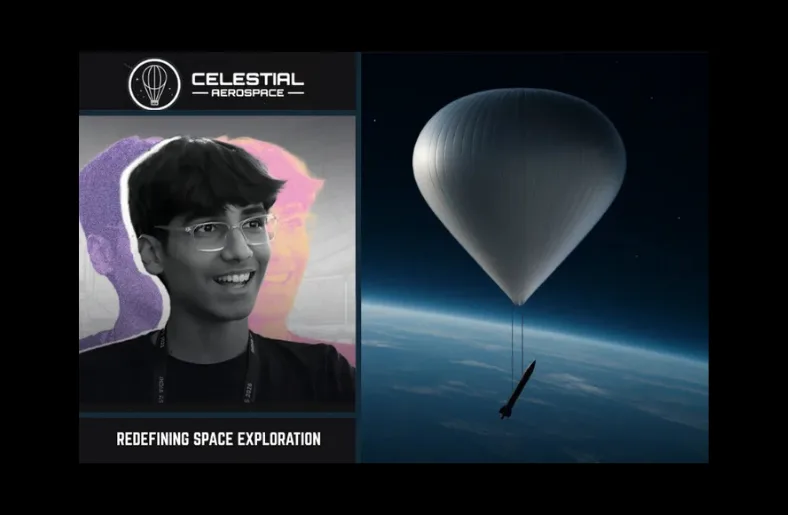
Shreyans Jain’s Balloon-Assisted Rocket Vision Could Transform India’s Space Startup Ecosystem
The Futurism Today Desk
In the fast-paced hustle of Gurgaon, India’s bustling IT hub, where ambitions often get lost in the daily grind, a young scientist Shreyans Jain is reaching for the cosmos. Along with his team that comprises many IIT graduates, he works day and night. Through his venture, Celestial Aerospace, this young innovator has developed a groundbreaking concept: launching rockets with the help of high-altitude balloons, an idea that blends simplicity, efficiency, and bold imagination.
Inside the Balloon-Powered Launch Concept
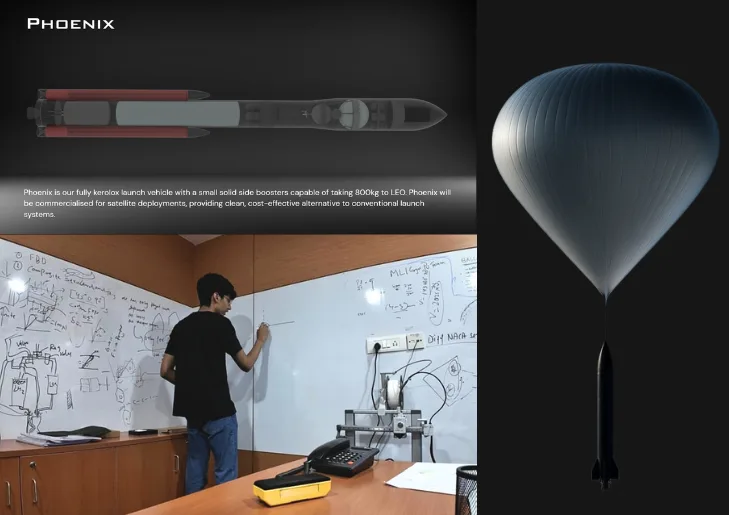
The system is elegantly straightforward. A large, high-altitude balloon lifts the rocket to the upper atmosphere, where the air is dramatically thinner. Once at altitude, the rocket ignites its engines and continues its journey into space. By starting its powered flight far above the densest layers of the atmosphere, the vehicle avoids much of the drag and gravitational penalty that plagues traditional ground launches.

A More Efficient Path to Space
Conventional rockets burn enormous amounts of fuel just to punch through the thick lower atmosphere. Shreyans’ approach changes that equation. By offloading the initial ascent to a balloon, the rocket can save significant fuel,potentially carrying 2–3 times more payload for the same launch mass.
For future interplanetary missions, Celestial Aerospace is exploring high-pressure inflatable structures powered by hot gases. When combined with advanced propulsion like nuclear thermal systems, this could dramatically shorten travel times across the solar system. As Shreyans puts it, “At higher altitudes, there is less air resistance, so the rocket operates far more efficiently.”
From Childhood Passion to Serious Venture
Shreyans’ fascination with rockets began early. He spent years building and launching model rockets, constantly questioning why the fundamental architecture of space launch had barely changed in decades. While giants like SpaceX focus on orbital refuelling to manage mass constraints, Celestial Aerospace aims to avoid the problem altogether by launching more efficiently from the start.
“The basic launch method has remained the same for decades,” Shreyans says. “We want to make it easier, cheaper, and more scalable.”
The Road to a 2026 Prototype
What started as solo research for months has grown into a professional team that includes IIT graduates. The company is now preparing wind tunnel tests and small-scale experiments, with an ambitious target to launch a prototype by the end of 2026. They have filed patents in India and internationally, and the long-term goal is full orbital capability.
As the son of a chartered accountant couple, Shreyans credits his family’s unwavering support for helping him reach this stage. Funding remains the biggest hurdle for any young founder, but the team is actively raising resources to accelerate development. It goes without saying that funding is an issue for the likes of Jain. It is high time that the government supports their cause.
Celestial Aerospace: The Role of Technology in Space Science
Modern technology forms the very foundation of Celestial Aerospace’s innovative approach and is revolutionizing space science as a whole. Breakthroughs in materials science have produced ultra-lightweight, high-strength composites and advanced polymers that enable durable high-altitude balloons capable of withstanding extreme cold, UV radiation, and pressure variations at 25–35 km altitude.
Cutting-edge electronics, including miniaturized sensors, high-precision GPS, inertial measurement units, and AI-driven autonomous flight control systems, allow real-time monitoring, predictive path correction, and safe rocket separation. Computational tools such as advanced simulation software, computational fluid dynamics (CFD), finite element analysis, and machine learning algorithms empower rapid design iteration, performance prediction, and risk reduction without expensive physical prototypes.
Shreyans’ team has also developed kerolox engines specifically optimized for low-pressure environments, paired with smart propulsion management systems. These technologies collectively shift the paradigm in space science from brute-force engineering to intelligent, efficient systems. In broader space exploration, similar advancements in reusable rockets, satellite constellations, in-orbit manufacturing, and quantum communication are driving down costs, increasing accessibility, and accelerating humanity’s expansion into the final frontier. For India’s growing space economy, such tech integration is vital to compete globally and achieve sustainable, scalable space missions.
Fundamentals of Rocket Launches: What Makes This Approach Unique!
Unlike most launch providers who pursue incremental gains through larger engines, more stages, or heavier infrastructure, Celestial Aerospace simplifies the problem at the system level. By removing inefficiencies early in the ascent, the architecture delivers significantly higher performance from existing propulsion technologies. The supporting balloon lift system is also designed for reduced operational and structural complexity, making the entire process more practical and scalable.
Impact on Society, Environment, and Industry: Lower Costs, Lower Emissions, Greater Access
This technology promises to make orbital access more efficient and less resource-intensive. By slashing fuel consumption during the most wasteful phase of launch, it reduces emissions and environmental impact while enabling more frequent and affordable missions for satellites, Earth observation, and space infrastructure. Over time, the same principles can extend to interplanetary transport, making deep-space exploration more sustainable and scalable.
A Message To Inspiration for Young Dreamers
Shreyans’ message to fellow students is clear: “Understand systems deeply, think outside the box. Lack of age or resources cannot stop you. Great achievements come from consistent hard work and confidence.”
In a country where space innovation is surging, young minds like Shreyans Jain prove that the journey from Gurgaon to the stars is not just possible-it’s already underway. His balloon-assisted vision could help elevate India’s space ambitions to entirely new heights. The sky is no longer the limit; it’s just the beginning.