


Building an Iron Man Suit in 2026: What Is Real, What Is Close, and What Is Still Science Fiction
Let’s be clear about what we’re actually asking. Not: “could a billionaire build a cool-looking suit of armour?” That question is boring and the answer is obviously yes. The real question is whether you could build a functional Iron Man suit in 2026, one that flies, augments strength, survives incoming kinetic rounds, powers all of its systems simultaneously, and is controlled by an AI that processes the environment in real time and advises the pilot accordingly. That is a very different engineering problem, and it breaks down into six distinct subsystems, each of which is at a radically different level of technological maturity. Let’s tear it down properly.
The Six Subsystems and Their 2026 Status
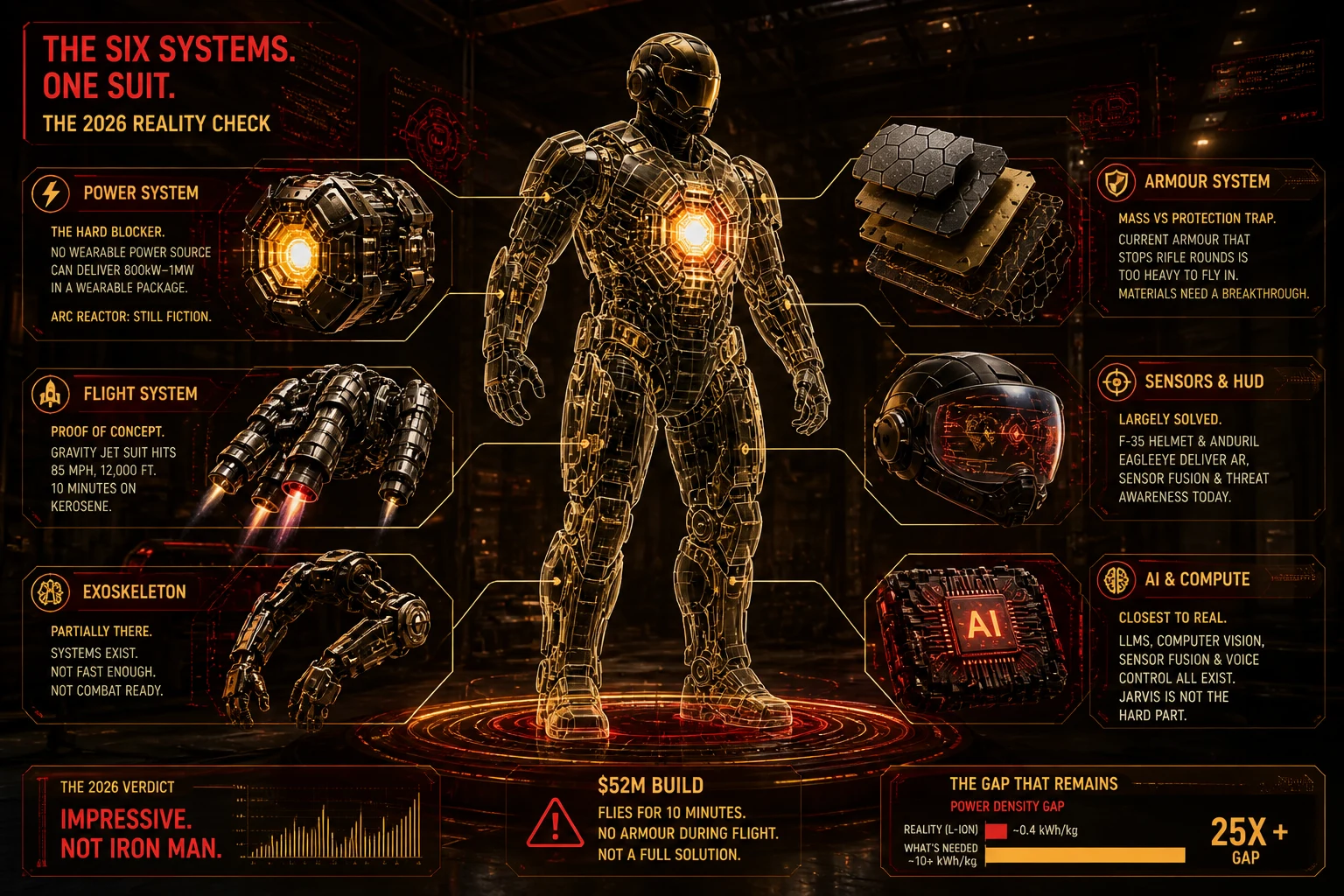
A functional Iron Man suit requires six things to work simultaneously: a power source capable of delivering megawatts in a package small enough to wear, a flight system capable of sustained controlled flight with a human payload, a structural exoskeleton that amplifies strength and absorbs damage, armour rated against kinetic and thermal threats, a sensor and HUD system that overlays actionable intelligence on the pilot’s vision in real time, and an AI capable of processing all of this and making useful decisions fast enough to matter. Each one of these is a hard engineering problem. The suit is all six of them running at the same time without any of them failing.
- AI / JARVIS (Closest to Real): Large language models, computer vision, real-time sensor fusion, and voice command execution all exist at production quality. JARVIS is not the hard part.
- HUD / Sensors (Largely Solved): Anduril’s EagleEye and the Army’s IVAS 1.2 demonstrate AR battlefield overlays. The F-35 helmet costs $400K and does most of what Stark’s visor does.
- Exoskeleton (Partially There): Sarcos Guardian XO, Lockheed ONYX, and HULC all exist. None are combat-ready or fast enough. US Special Ops said soldiers don’t feel comfortable wearing them into combat.
- Flight (Proof of Concept Only): Gravity Industries’ jet suit hits 85 mph and 12,000 ft. Flight time: 10 minutes on a full tank of kerosene. It is the most honest version of a real Iron Man flight system alive today.
- Power Source (The Hard Blocker): No compact, wearable power source comes close to what a flying exoskeleton requires. This is the single subsystem that makes the whole thing impossible today.
- Armour (Mass vs Protection Trap): Titanium-ceramic composites and shear-thickening fluids exist. The problem is weight. Suit-grade ballistic protection at flight weight is not achievable with current materials.
The Power Problem: Why the Arc Reactor Is the Only Part That Cannot Be Faked?
Every other subsystem in the Iron Man suit has a real-world analogue that is either already built or is clearly on a development trajectory that will get there. The arc reactor is unique: there is no analogue, there is no near-term trajectory, and without it, the rest of the suit is either stationary or has a ten-minute runtime. Let’s do the physics!
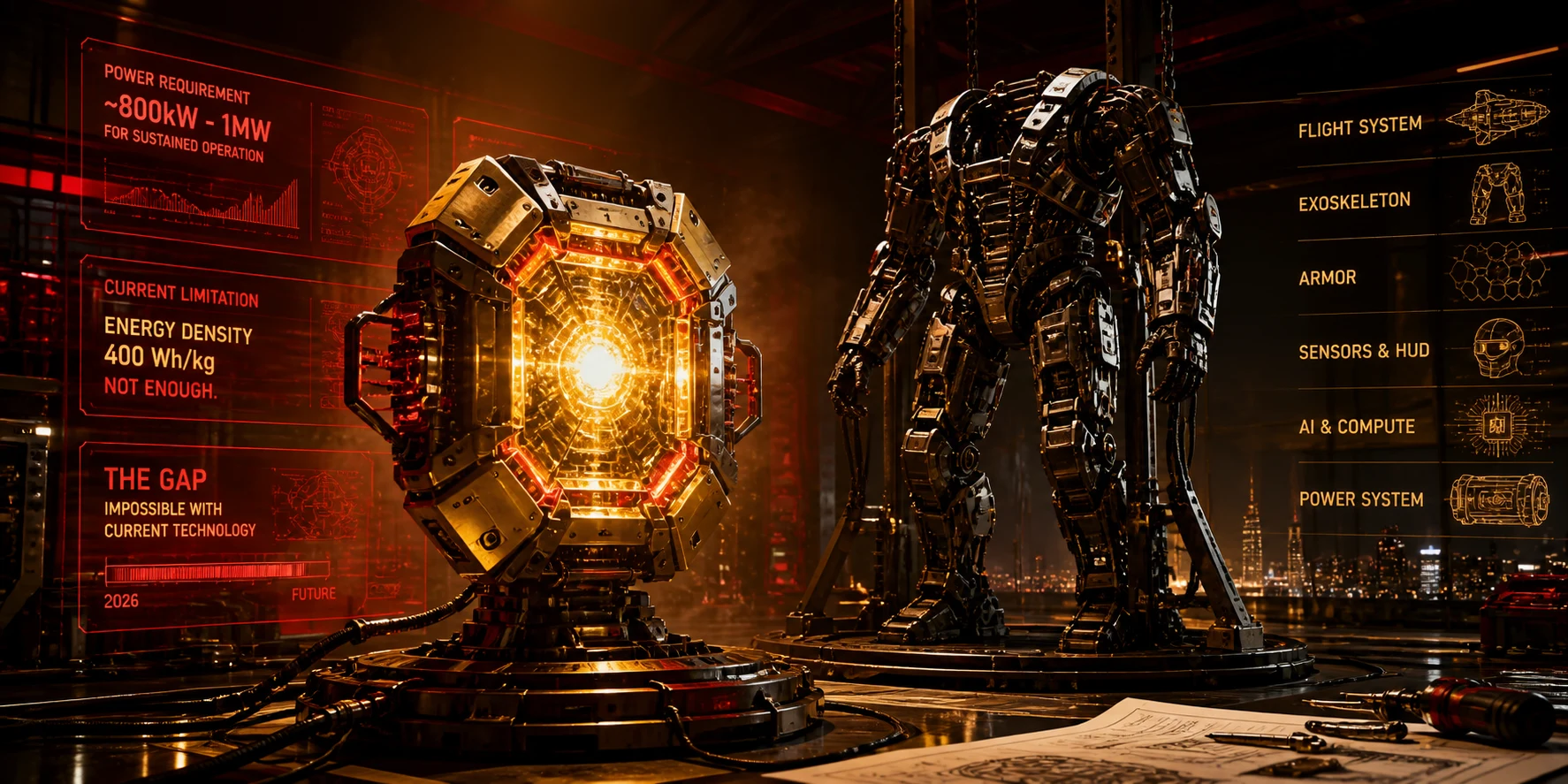
A functional Iron Man flight system running five kerosene jet engines, similar to Gravity Industries’ configuration, requires roughly 1,000 horsepower, or approximately 750 kilowatts of continuous power output. Add the exoskeleton actuators, which in the Sarcos Guardian XO draw around 1.5 kilowatts at light load, the sensor array, the AI compute, the heating and life support, and you are looking at a sustained power requirement in the range of 800 kilowatts to 1 megawatt for a fully operational suit.
The best lithium-ion battery packs available in 2026 achieve approximately 400 watt-hours per kilogram. To store enough energy for a 20-minute flight at one megawatt continuous draw, you would need 333 kilowatt-hours of battery capacity, which at 400 Wh/kg weighs 832 kilograms. A suit that requires 832 kilograms of battery to fly for 20 minutes is not a wearable suit. It is a small car.
The Numbers That End the Conversation
Power required for sustained flight: ~750 kW. Best current battery energy density: 400 Wh/kg. For 20 minutes of flight: 250 kWh needed. At 400 Wh/kg: 625 kg of battery. Total suit weight budget for flight: approximately 120-150 kg including pilot. The gap between 625 kg and 150 kg is the arc reactor problem. Until you close it, the suit does not fly for more than 10 minutes.
This is why the arc reactor is not a throwaway plot device. It is the single engineering insight that makes the entire suit coherent. A compact fusion reactor producing hundreds of megawatts in a chest-sized package would solve every power problem simultaneously. The best real-world compact fusion effort right now is Commonwealth Fusion Systems’ SPARC tokamak, which aims to demonstrate net energy gain and has a major radius of 1.85 metres.
The smallest fusion concept that might eventually be power-plant scale occupies a room. A chest-worn version producing gigawatt-level output is not a 2026 problem or a 2036 problem. It is a physics problem that humanity does not yet know how to solve at that scale. Everything else about the Iron Man suit is engineering. The arc reactor is science.
Flight: The Part That Actually Exists
Richard Browning founded Gravity Industries in 2016 after leaving the Royal Marines, and by 2017 he was flying at the TED conference in Vancouver. The current Gravity Jet Suit straps two miniature jet engines to each forearm and one larger unit to the back, generating 1,050 horsepower total, which is more than a Bugatti Veyron.
It has set a Guinness World Record at 85.06 mph (136.89 km/h), has climbed to 12,000 feet, has been used in NATO mountain warfare rescue exercises in Slovenia, and has been evaluated by the Indian Army under a procurement tender for 48 units. It costs $440,000 per suit. It runs on kerosene at approximately 4 litres per minute, giving it a flight endurance of about 10 minutes on a full load. It is controlled entirely by body movement: the hands steer, the body controls altitude. There is no onboard AI, no HUD, and no exoskeleton. It is a pure flight system.
What Browning has built is genuinely remarkable. It is also a vivid illustration of the power problem. One thousand and fifty horsepower running on kerosene, an energy-dense liquid fuel that a battery cannot match, and you get ten minutes of flight. Switch to batteries at current energy density and you get less than two minutes. The Gravity Jet Suit is as close as humanity has come to the flight component of a real Iron Man suit, and its biggest limitation is not the flight technology. It is the fuel.
The Exoskeleton: Real, But Not What You Think
The powered exoskeleton is probably the most advanced of the six subsystems in terms of operational deployment. Multiple systems are in field testing or limited production. Lockheed Martin’s ONYX lower-body exoskeleton reduces the metabolic cost of carrying heavy loads. The HULC (Human Universal Load Carrier) can carry 90 kg loads for extended periods. Sarcos’s Guardian XO, a full-body industrial exoskeleton, can operate for eight hours per battery charge, lift 90 kg loads, and has been delivered to US Special Operations Command for evaluation. It weighs about 24 kg itself, which is a load the exoskeleton must carry in addition to the human pilot and whatever they are carrying.
The critical limitation is not strength. These systems can amplify human strength meaningfully. The limitation is speed, responsiveness, and combat readiness. SOCOM evaluated the Guardian XO and found that operators do not feel comfortable wearing powered exoskeletons into close combat. The systems are too slow, too bulky, and too unreliable under dynamic conditions.
The TALOS programme, which was explicitly the US military’s attempt to build an Iron Man suit, was officially cancelled in 2019 after determining that the core technologies were not feasible with current or near-term capability. Fifty-six corporations, 16 government agencies, 13 universities, and 10 national laboratories worked on it and concluded it was not achievable. That is the honest state of play.
The HUD and AI: Ironically, the Easiest Parts
JARVIS is the character that makes Iron Man compelling, and JARVIS is also the component that 2026 is most capable of producing. Large language models can process natural language commands, generate situational analysis, and execute multi-step actions in real time. Computer vision systems can identify targets, classify threats, and track objects in three-dimensional space. Sensor fusion can combine radar, thermal, optical, and acoustic data into a coherent environmental picture.
Voice-activated AI that can simultaneously manage flight systems, weapons targeting, communications, and navigation while providing spoken analysis of the combat environment is, more than any other component of the suit, already here in prototype form. The hard part is integrating it into a helmet that weighs under two kilograms.
On the HUD side, Anduril’s EagleEye system, which took over from Microsoft’s troubled IVAS programme in 2025, delivers AR battlefield overlays, real-time sensor imagery, threat tracking, and networked situational awareness through a helmet-mounted display. Its development is backed by a $22 billion framework contract and a $159 million prototyping award in 2025.
The F-35 fighter pilot’s helmet, at $400,000 per unit custom-built, already delivers night vision, weapons targeting, 360-degree situational awareness, and HMD symbology in a combat-proven package. The Iron Man visor, stripped of the fiction and reduced to its functional specification, is a solved engineering problem. The question is miniaturisation, weight, and power draw, all of which are serious but tractable engineering challenges rather than physics barriers.
Armour: The Mass Trap
Titanium alloys, carbon fibre composites, shear-thickening fluids (a material that becomes rigid on impact, used in flexible ballistic protection), and ultra-high-molecular-weight polyethylene all exist and are used in real armour systems. The problem is that armour capable of protecting against rifle fire weighs approximately 10 to 15 kilograms per square metre of coverage. A full-body suit covering the torso, arms, legs, and helmet to rifle-round protection standards would weigh roughly 30 to 40 kilograms before you add any powered systems.
Now add the exoskeleton (24 kg for the Guardian XO), the jet engines (the Gravity suit’s propulsion package weighs approximately 30 kg), the batteries or fuel, the sensor suite, and the AI compute module. The total system weight before any meaningful flight propulsion is already exceeding the weight budget that flight physics allows.
The Mk L nanoparticle suit from the MCU films that assembles itself from a single suitcase is the most dishonest component of the entire franchise. No material science roadmap in existence suggests that a structural material capable of stopping kinetic rounds can also flow as a liquid and reassemble into a rigid structure on demand. Magnetorheological fluids that stiffen under magnetic fields exist, but their ballistic protection at practical densities is negligible. This is one area where the films require pure handwaving.
What Exists (closest) Today to Build a Fully Functional Iron Man Suit?
- Flight (Gravity Industries Jet Suit): 85 mph, 12,000 ft, 10 min endurance. 1,050 hp from five kerosene jet engines. $440,000. The most honest real-world Iron Man flight analogue in existence.
- Exoskeleton (Sarcos Guardian XO): Full-body. 8-hour runtime. 90 kg lift capacity. Delivered to SOCOM for evaluation. Not combat-ready. Too slow for dynamic environments.
- HUD / Sensors (Anduril EagleEye / F-35 Helmet): AR battlefield overlay, sensor fusion, threat tracking. The F-35 helmet is $400K per unit and delivers near-complete HMD capability in combat conditions.
- AI / JARVIS (GPT-class LLMs + Computer Vision): Real-time voice command, threat classification, sensor fusion analysis, and decision support. The functional JARVIS specification is achievable with 2026 AI.
- Armour (Ti-6Al-4V + UHMWPE + STF): Titanium alloy, polyethylene composite, shear-thickening fluid inserts. Exists. Works. Too heavy to fly in. No known material solves the mass-protection tradeoff.
- Power Source (Nothing. Literally Nothing.): Best compact fusion: room-sized. Best batteries: 400 Wh/kg, insufficient by two orders of magnitude for sustained flight. The arc reactor has no real-world analogue.
What Would It Cost to Build an Iron Man Suit in 2026?
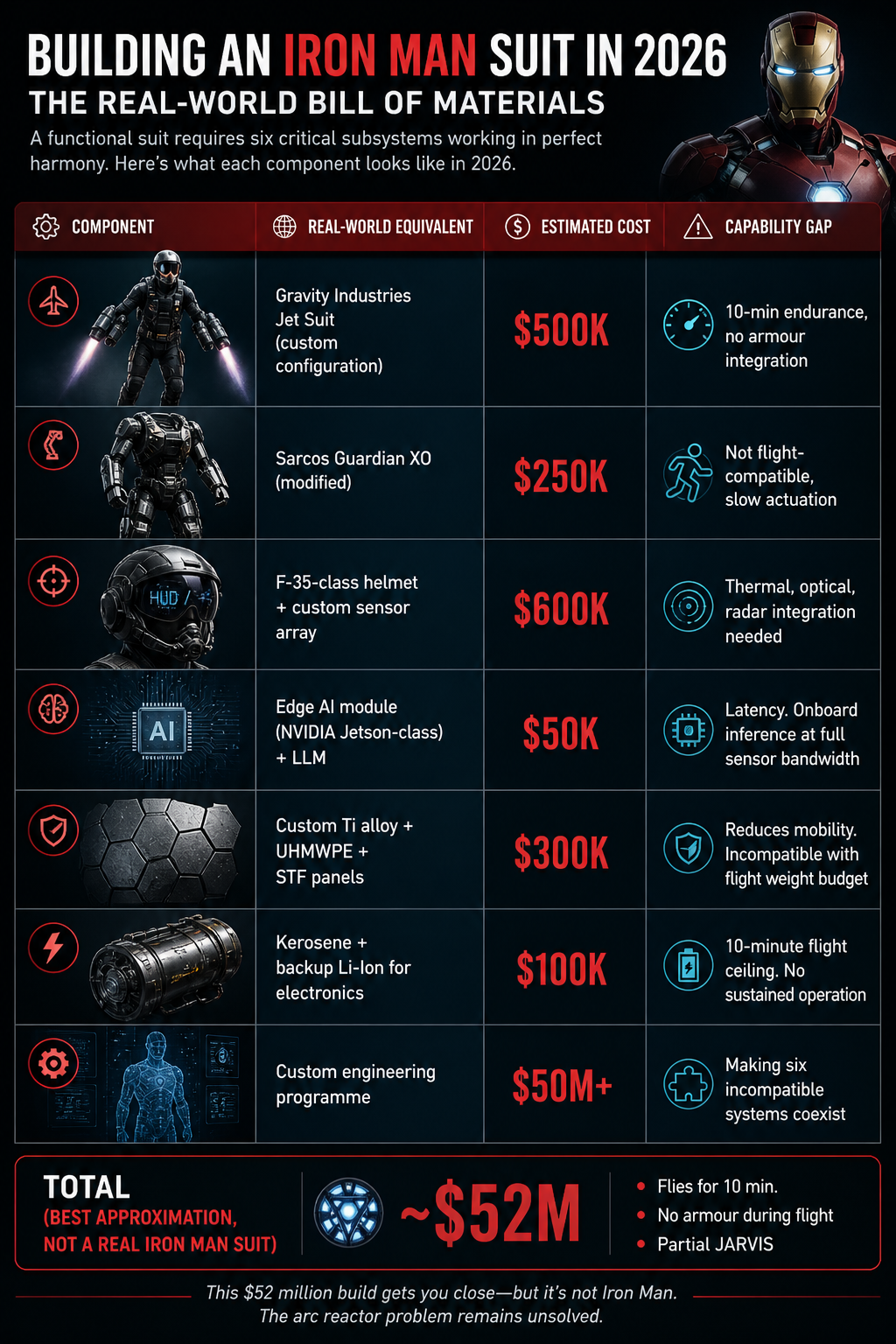
That $52 million buys you a flying exoskeleton with a heads-up display and a voice-activated AI, that cannot be armoured during flight, cannot fly for more than ten minutes, and cannot recharge itself. It is genuinely impressive and genuinely not Iron Man. The gap between the two is almost entirely explained by the arc reactor.
The Honest Timeline to build an Iron Man Suit
- NOW: You can build a partial suit today. Flight (10 min), basic exoskeleton, F-35-class HUD, GPT-class AI, partial armour. Cost: ~$52M. It does not integrate cleanly and it cannot do all six things simultaneously.
- 2030: Solid-state batteries may hit 800-1000 Wh/kg, doubling flight endurance to ~20 minutes. Exoskeleton responsiveness will improve. AI integration will be seamless. Still no solution to the power-at-scale problem.
- 2035: Commonwealth Fusion Systems’ ARC plant is projected to deliver power to the grid. Still room-sized. The gap between grid-scale fusion and chest-worn fusion remains essentially infinite.
- 2040+: Directed energy weapons (laser, microwave) will likely be integrated into military suits before kinetic armour is solved. A suit that deflects rather than absorbs might be more achievable than one that stops bullets.
- Unknown: The arc reactor. There is no credible timeline for a wearable fusion device producing megawatts. This is not a pessimistic assessment. It is a reflection of where plasma physics and materials science currently sit.
The gap between a real Iron Man suit and the best thing we can build in 2026 is not intelligence. It is not a flight. It is not sensors, or armour, or strength. It is a sphere of glowing energy the size of a dinner plate that outputs the equivalent power of a small nuclear power plant. We do not know how to build that. We may not know how to build that for a very long time.
The Part Nobody Talks About: JARVIS Is Not the Hard Part
The cultural narrative around AI and Iron Man focuses on JARVIS as the magical component, the impossibly advanced intelligence that makes the suit work. In 2026, this framing is completely backwards. JARVIS is the most achievable part of the entire system. A multimodal AI with voice command execution, real-time computer vision, sensor fusion, and decision support that can advise a pilot on threat assessment, route planning, weapon selection, and structural integrity monitoring is a software engineering problem. It is a hard software engineering problem, but it is nowhere near the frontier.
The frontier is the arc reactor. Everything else, including JARVIS, is just very good engineering on technologies that exist.
Iron Man in 2026: A Partial Build for $52M That Flies for 10 Minutes
You can build something that looks like Iron Man, flies like Iron Man (briefly), augments strength like Iron Man, sees like Iron Man, and even talks back like Iron Man. You cannot build something that performs like Iron Man, because the performance is predicated on a power source that does not exist and a mass-to-protection ratio that current materials cannot achieve.
The good news is that five of the six subsystems are on credible improvement trajectories. Batteries are getting denser. Exoskeletons are getting faster. AI is getting better at essentially everything. Sensor fusion is already at extraordinary capability. Armour materials science is advancing. The trajectory on all five of those converges toward a genuinely functional near-Iron Man suit somewhere in the 2030s.
The bad news is that the sixth subsystem, power, is not on a credible trajectory toward a wearable megawatt-class source. And without it, the other five subsystems can be as advanced as you like. They still cannot run simultaneously for more than ten minutes. Tony Stark’s real genius was not the suit. It was solving the energy problem. In 2026, that problem remains unsolved.