


How Exergy3 Converts Renewable Electricity Into 1300°C Industrial Heat?
The Hardest Problem in the Energy Transition: Industrial Heat
Decarbonising electricity has seen measurable progress over the past decade, with solar and wind reaching scale and cost competitiveness in many parts of the world, but industrial heat remains one of the most difficult challenges in the energy transition, largely because it operates under entirely different constraints that are not easily addressed by electrification alone. Heavy industries such as steel, cement, chemicals, and manufacturing rely on extremely high temperatures, often exceeding 1000°C, to power their processes, and these temperatures have traditionally been generated using fossil fuels because they provide the consistency, intensity, and controllability required for industrial operations.
While electrification is often presented as a universal solution, the reality is that directly replacing fossil fuel-based heat with electricity introduces inefficiencies, infrastructure challenges, and cost barriers that make it impractical at scale in many industrial contexts, particularly when renewable energy supply is intermittent and not always aligned with demand. This creates a structural gap in the energy transition, where clean electricity is abundant at certain times but cannot be effectively stored or converted into the form of energy that heavy industries actually need, leaving a critical part of global emissions largely unaddressed.

Exergy3’s Core Idea: Storing Energy as High-Temperature Heat
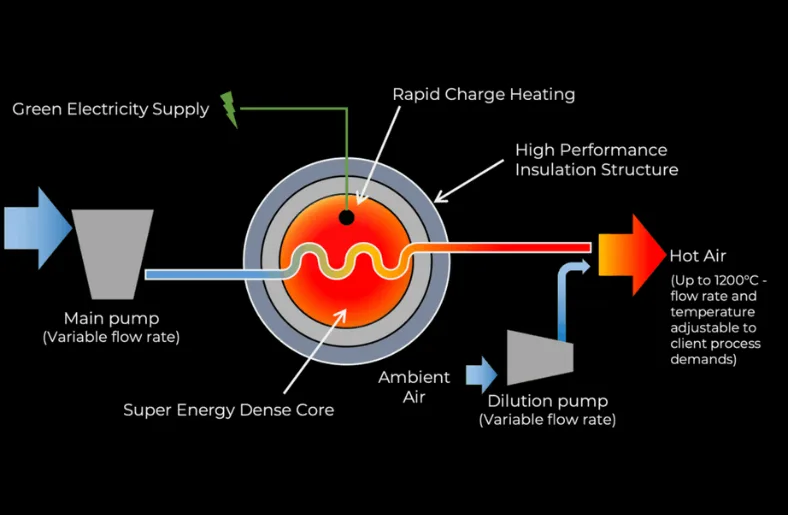
Exergy3 is built around a simple but powerful idea, that renewable electricity can be converted into ultra-high temperature heat and stored in a way that allows it to be used on demand, effectively bridging the gap between intermittent energy generation and continuous industrial requirements. As a spinout from the University of Edinburgh, the company has developed a proprietary energy storage technology capable of reaching temperatures up to 1300°C, which is significantly higher than most conventional thermal storage systems and makes it suitable for a wide range of industrial applications.
Instead of storing energy in batteries, which are often expensive and limited in duration for large-scale industrial use, Exergy3 stores energy in the form of heat, which is both more efficient for certain applications and better aligned with how energy is consumed in heavy industry. This approach allows excess renewable electricity to be captured when it is available, converted into high-temperature heat, and then deployed when needed, providing a consistent and reliable energy source that can replace fossil fuels in industrial processes without requiring fundamental changes to existing infrastructure.
From Grid Imbalance to Industrial Opportunity
One of the less visible but increasingly important challenges in modern energy systems is grid imbalance, where the supply of renewable electricity does not match demand, leading to periods of surplus energy that cannot be fully utilized and must either be curtailed or sold at very low prices. Exergy3’s technology addresses this issue by creating a mechanism for absorbing excess energy and converting it into a form that can be stored and used later, effectively turning a problem into an opportunity.
By acting as a bridge between the electricity grid and industrial demand, the system not only supports decarbonisation but also contributes to grid stability, enabling a more efficient use of renewable energy resources. This dual role is particularly significant in regions where renewable penetration is high and grid constraints are becoming a limiting factor, as it allows energy systems to operate more flexibly while providing industries with a reliable alternative to fossil fuels.

Exergy3 Raises £10M to Scale Industrial Heat Decarbonisation
Exergy3’s recent £10 million seed funding round represents a critical step in moving its technology from development to deployment, with the capital aimed at scaling its proprietary systems and accelerating commercial adoption across key industries. The funding highlights the growing recognition that industrial heat is one of the most important frontiers in decarbonisation, and that solutions capable of addressing it at scale will play a central role in achieving climate targets.
Beyond financial validation, the investment also positions Exergy3 to expand its partnerships, advance its engineering capabilities, and demonstrate its technology in real-world environments, which is essential for building confidence among industrial customers who require proven reliability and performance before adopting new energy systems. As the company moves into this next phase, its ability to translate technical innovation into operational solutions will be a key factor in determining its long-term impact.

Applications Across Industry, Heating, and Power Systems
The versatility of Exergy3’s technology is reflected in its range of applications, which extend beyond individual industrial processes to include district heating systems and combined heat and power configurations, creating a broader impact across the energy ecosystem. In industrial settings, the ability to deliver high-temperature heat directly addresses one of the most challenging aspects of decarbonisation, enabling companies to reduce emissions without compromising on performance.
In district heating, the technology provides a way to integrate renewable energy into heating networks, supporting the transition away from fossil fuel-based systems in urban environments. In combined heat and power systems, it offers a more efficient way to utilize energy by capturing and redistributing heat that would otherwise be wasted. This multi-application approach enhances the value proposition of the technology, as it can be deployed across different sectors and adapted to a variety of use cases, increasing its potential for widespread adoption.

The Future of Energy: Converting Power Into Usable Heat
What Exergy3 represents is a broader shift in how energy systems are conceptualized, moving away from a model where electricity and heat are treated as separate domains toward one where they are interconnected and can be converted and stored in ways that optimize efficiency and sustainability. The ability to transform renewable electricity into high-temperature heat at scale has implications not only for industrial decarbonisation but also for energy security and system resilience, as it reduces dependence on fossil fuels and enables more flexible use of renewable resources.
As the energy transition progresses, the importance of such technologies is likely to increase, particularly in regions where industrial activity is a major contributor to emissions and where the need for reliable, low-carbon energy solutions is most urgent. Exergy3’s approach highlights the potential of combining academic research with commercial application to address complex challenges, and while the path to large-scale deployment will require continued innovation, investment, and collaboration, it offers a compelling vision of how renewable energy can be transformed into the forms that industries actually need.