


What Is Lua AI? Inside the Rise of Enterprise AI Agent Builders
The Shift from Tools to Agents in Enterprise Software
Enterprise software is undergoing a structural transition, one that goes beyond incremental automation and begins to change how work itself is executed, moving from static tools that assist humans to dynamic systems where software agents actively participate in workflows, make decisions, and execute tasks across systems. For years, businesses have layered SaaS tools on top of each other, building complex stacks that require constant human coordination to function effectively, but the emergence of AI agents introduces a different model, one where intelligence is not confined to individual applications but operates across them, orchestrating workflows in a way that reduces manual intervention.
This shift is not simply about efficiency but about redefining the relationship between humans and software, where the role of the user evolves from operator to supervisor, and the software begins to take on responsibilities that were previously considered inherently human.
Lua’s Core Idea: Building an Agent Layer for the Enterprise
Lua positions itself at the center of this transition by offering a platform that allows organizations to build and deploy their own AI agent layer, effectively creating a system that sits above existing tools and connects them into a unified, intelligent workflow. The company’s approach is based on abstraction, removing the complexity traditionally associated with building enterprise-grade AI systems and replacing it with a framework that enables teams to create agents that are deeply integrated, measurable, and aligned with specific business outcomes.
Rather than requiring large budgets, external consultants, or extended implementation cycles, Lua is designed to enable rapid deployment, allowing organizations to move from concept to execution in days, which is a critical factor in environments where speed and adaptability are increasingly important. This focus on accessibility does not come at the expense of capability, as the platform supports a wide range of use cases across industries, from healthcare and financial services to retail, manufacturing, and professional services, demonstrating its flexibility as a foundational layer for enterprise operations.
From Experimentation to Execution: Making AI Agents Work in the Real World
One of the challenges that has defined the early phase of enterprise AI adoption is the gap between experimentation and execution, where companies have been able to build prototypes and run pilot projects but have struggled to translate these into systems that deliver consistent, measurable value in production environments. Lua addresses this gap by focusing on the operational aspects of AI deployment, providing tools that ensure agents are not only functional but also reliable, observable, and aligned with business processes.
The platform’s visual builder, developer tools, and pre-built templates enable teams to design workflows that integrate seamlessly with existing systems, while its emphasis on measurability ensures that the performance of these agents can be tracked and optimized over time. This approach reflects a broader shift in the AI landscape, where the focus is moving from building models to building systems that can operate effectively within the complexity of real-world business environments.
Lua Raises $5.8M to Build the Operating System for Human-Agent Collaboration
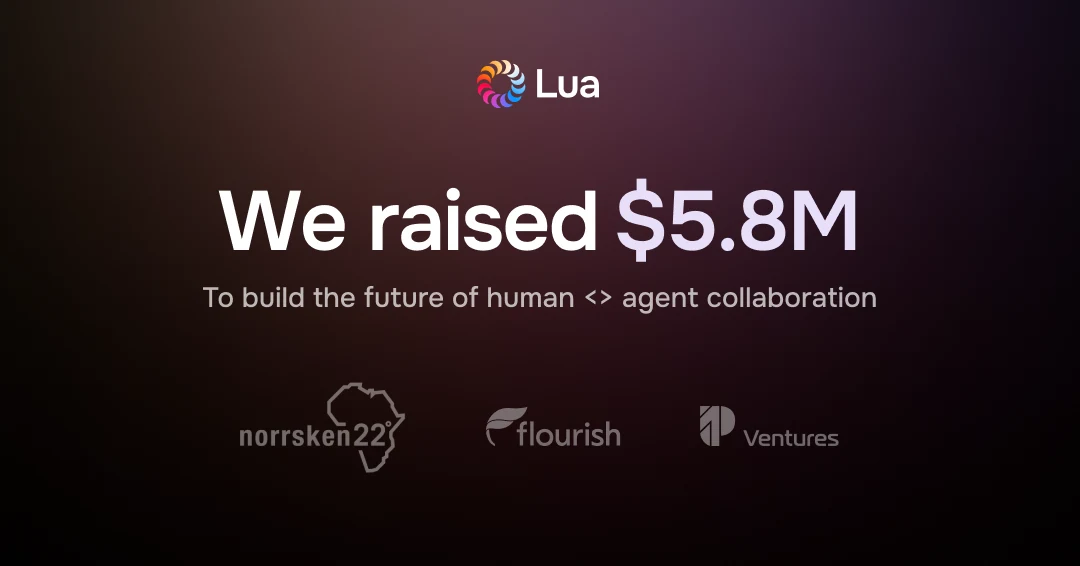
Lua’s recent $5.8 million funding round marks an important milestone in its development, signaling investor confidence in the idea that the next layer of enterprise software will be defined by agent-based systems rather than traditional applications. The funding is intended to support the expansion of the platform, further development of its capabilities, and the scaling of its go-to-market efforts as it seeks to position itself as a core infrastructure layer for businesses adopting AI. This investment also reflects a broader trend in the market, where capital is increasingly flowing toward companies that are building the frameworks and tools necessary to operationalize AI at scale, rather than those focused solely on model development.
By positioning itself as an operating system for human-agent collaboration, Lua is aligning with this trend, aiming to provide the infrastructure that enables organizations to move beyond isolated use cases and integrate AI into the core of their operations.
The Emergence of Agent Platforms as the New Enterprise Stack
The rise of platforms like Lua suggests that the enterprise software stack is evolving toward a model where agents become the primary interface through which work is executed, replacing or augmenting traditional applications in a way that changes how systems are designed and used. In this model, the value of a platform is not determined solely by its individual features but by its ability to coordinate and optimize workflows across multiple systems, creating a layer of intelligence that sits above the existing infrastructure. This has significant implications for how businesses approach technology adoption, as it shifts the focus from selecting individual tools to building cohesive systems that can adapt and evolve over time.
Lua’s emphasis on integration, control, and scalability reflects this shift, positioning it as part of a new category of enterprise platforms that are designed to operate in an environment where AI is not an add-on but a core component of how work is performed.
The Open Questions Around AI Agents in the Enterprise
Despite the momentum behind AI agents, their adoption raises important questions about control, accountability, and the long-term impact on organizational structures, particularly as systems become more autonomous and begin to take on tasks that have traditionally required human judgment. While platforms like Lua provide the tools to build and manage these systems, the responsibility for how they are used ultimately rests with the organizations that deploy them, creating a need for clear governance frameworks and oversight mechanisms to ensure that automation does not lead to unintended consequences.
Additionally, as the complexity of these systems increases, so does the challenge of maintaining transparency and understanding how decisions are made, which is critical in industries where accountability and compliance are paramount. These questions do not diminish the potential of AI agents but highlight the need for a thoughtful approach to their implementation, one that balances innovation with responsibility.

Toward a Future of Collaborative Intelligence
What Lua represents is not just another step in the evolution of enterprise software but a broader shift toward a model of collaborative intelligence, where humans and AI systems work together in ways that amplify the strengths of both. By providing a platform that enables organizations to build and deploy their own agent layers, Lua is contributing to a future where the boundaries between human and machine work are increasingly fluid, and where the focus shifts from managing tools to orchestrating systems that can adapt to changing conditions and requirements.
Whether this vision becomes the dominant paradigm for enterprise operations will depend on how effectively these systems can deliver value at scale, but the direction is clear: the future of work will be shaped not by individual tools, but by the systems that connect and coordinate them.