


How UK-based Rivan Industries Plans to Make Fossil Fuels Obsolete?
There is a category of problem in climate science that does not lend itself to optimism. The roughly 12 gigatonnes of CO₂ emitted annually by heavy industry, covering steel production, cement manufacture, chemical processing, and aviation, are what researchers and policymakers describe as hard to abate. Not because the science of reducing them is unclear, but because electrification, the tool that is steadily decarbonising personal transport and residential heating, cannot reach them. Steel furnaces, cement kilns, and jet engines do not run on batteries. They require physical molecules: fuels with high energy density, feedstocks that become the product itself.
For these industries, the only credible decarbonisation pathway is not electrification but substitution: replacing the fossil molecules they currently combust with chemically identical synthetic ones produced without the carbon cost. Rivan Industries, a London-based startup that has spent the past two and a half years building the machines to do exactly this, believes it has found the formula. Not just the chemistry, which is well-understood, but the cost structure and the manufacturing model that makes synthetic fuel economically competitive with the fossil alternative it is designed to replace.
The Problem With Every Other Decarbonisation Solution
Rivan’s founding argument, set out in unusual detail in its public manifesto, begins not with technology but with economics. The company is explicit that the decarbonisation strategies that have dominated policy conversations for the past decade contain a structural flaw: they require either reducing energy consumption, which is incompatible with economic growth, or deploying solutions that are more expensive than the fossil fuels they replace, which is incompatible with the mechanics of capitalism. A solution that costs more than the problem it replaces will not scale. It will require subsidies, mandates, and sustained political will of a kind that has historically proven unreliable across economic cycles and election cycles alike.
Rivan’s proposition is that synthetic fuel produced at prices competitive with fossil gas is the only decarbonisation pathway with a self-sustaining, profit-driven adoption mechanism built into it. When synthetic fuel is cheaper than fossil fuel, every heavy industrial operator in Europe has a financial incentive to switch without any external pressure. That is the threshold Rivan is engineering toward, and its entire hardware design philosophy is shaped by the conviction that it is achievable within the next two to three years.
The building blocks of synthetic natural gas are not exotic. Methane, the primary component of natural gas, is formed by combining carbon dioxide and hydrogen in the Sabatier reaction: CO₂ plus four molecules of H₂ produces methane plus water. Both feedstocks are abundant. CO₂ exists in the atmosphere at concentrations that, while alarming from a climate perspective, represent an essentially unlimited supply. Green hydrogen can be produced by splitting water using electricity via electrolysis.
The bottleneck has always been cost: the energy required to run electrolysis and direct air capture of CO₂ has historically been too expensive to produce synthetic gas at prices that could challenge fossil natural gas. Rivan’s core technical insight is that this bottleneck is dissolving. Solar electricity, which has fallen in cost by 95 percent over the past decade and which Rivan’s own April 2026 update notes has already reached below 0.5 pence per kilowatt-hour in some markets, is continuing to decline along the trajectory described by Wright’s Law. As solar costs fall, the operating economics of synthetic fuel production improve continuously, and the company’s machines are designed specifically to benefit from this dynamic rather than be insulated from it.
The Rivan Machine: Designed Around Cheap Energy, Not High Efficiency
The counterintuitive core of Rivan’s engineering philosophy is its deliberate rejection of the high-efficiency, high-capex approach that has characterised most attempts at industrial-scale carbon capture and hydrogen production. The company makes this argument with specificity: the cost of a machine falls faster than the efficiency falls as you move away from peak performance.
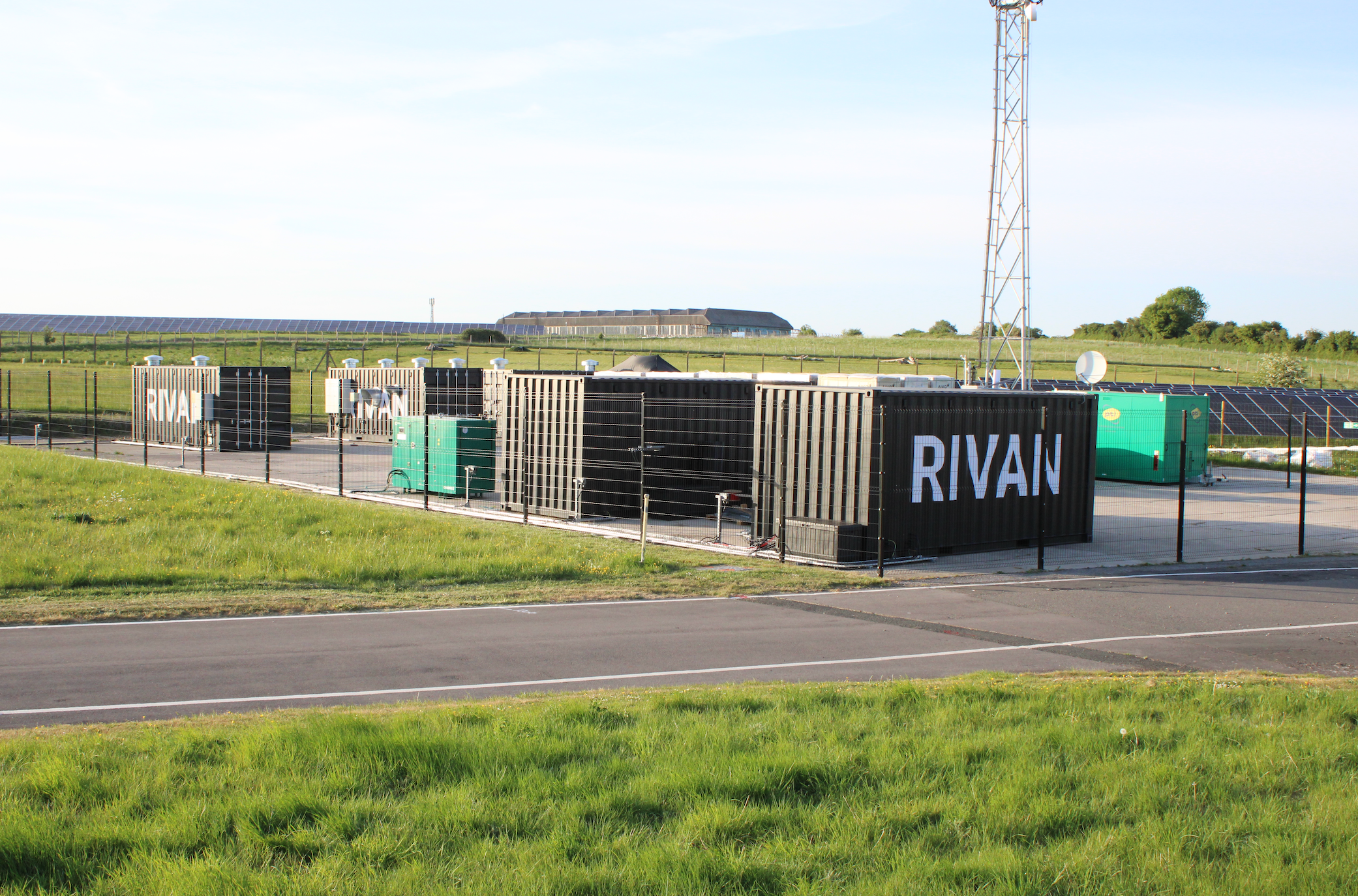
A machine that operates at 50 percent of the efficiency of the state-of-the-art equivalent costs roughly one-fifth the price, not half the price. This super-linear relationship between efficiency and cost means that building cheaper, lower-efficiency machines funded by abundant cheap solar is a more viable path to mass deployment than building expensive, high-efficiency machines that cannot achieve the capital payback cycles necessary to scale. The Rivan SNG system is organised around three modules, each designed for simplicity and mass manufacturability rather than peak performance.
- Module One (Alkaline Electrolysis): Green hydrogen production from water splitting. No rare-earth metals. No high temperatures or pressures. Designed around the core electrochemical elements only, stripped of cost complexity. Connected directly to utility-scale solar via DC power, eliminating inversion and transformation equipment.
- Module Two (Direct Air Capture): CO₂ extraction from the atmosphere using calcium oxide looping rather than expensive amine-based absorbents or zeolites. Thermodynamic unfavourability becomes an advantage under energy abundance conditions. Designed for large surface area and airflow, not laboratory efficiency.
- Module Three (Sabatier Reactor): CH₄ synthesis from the CO₂ and H₂ produced by modules one and two. Designed to run at lower pressures and flow rates, with 90 percent turndown capability to follow the solar energy gradient across the day. Output: 99 percent pure methane, ready for grid injection.
The business model that flows from this hardware design is equally distinctive. Because the machines are built for low capex and high opex, their capital cost can be recovered in approximately two to three years from the start of operation rather than the 20-plus-year payback periods associated with conventional LNG infrastructure. This fast amortisation cycle means cash flow from operating machines can be reinvested in manufacturing additional machines rapidly, creating a compounding deployment dynamic that mirrors the unit economics of the solar industry itself.
The entire system is also back-compatible with existing gas infrastructure: Rivan’s synthetic methane is chemically identical to fossil natural gas, meaning it can enter Europe’s existing pipeline network without any modifications to the machinery of the industrial customers it serves. A steel mill or cement plant can switch to synthetic natural gas overnight with no capital expenditure on their end, once pricing parity is reached.
£25 Million to Build the Largest Synthetic Gas Plant in Europe
On April 20, 2026, Rivan announced a £25 million fundraise led by IQ Capital with participation from Plural, the venture firm that also backed its earlier £10 million seed round alongside Patrick and John Collison and other investors. The new capital brings total funding above £35 million and will be deployed across three concurrent priorities: commissioning Project Starwell, opening Production Base 1, and accelerating R&D across all four major technical areas of the platform.
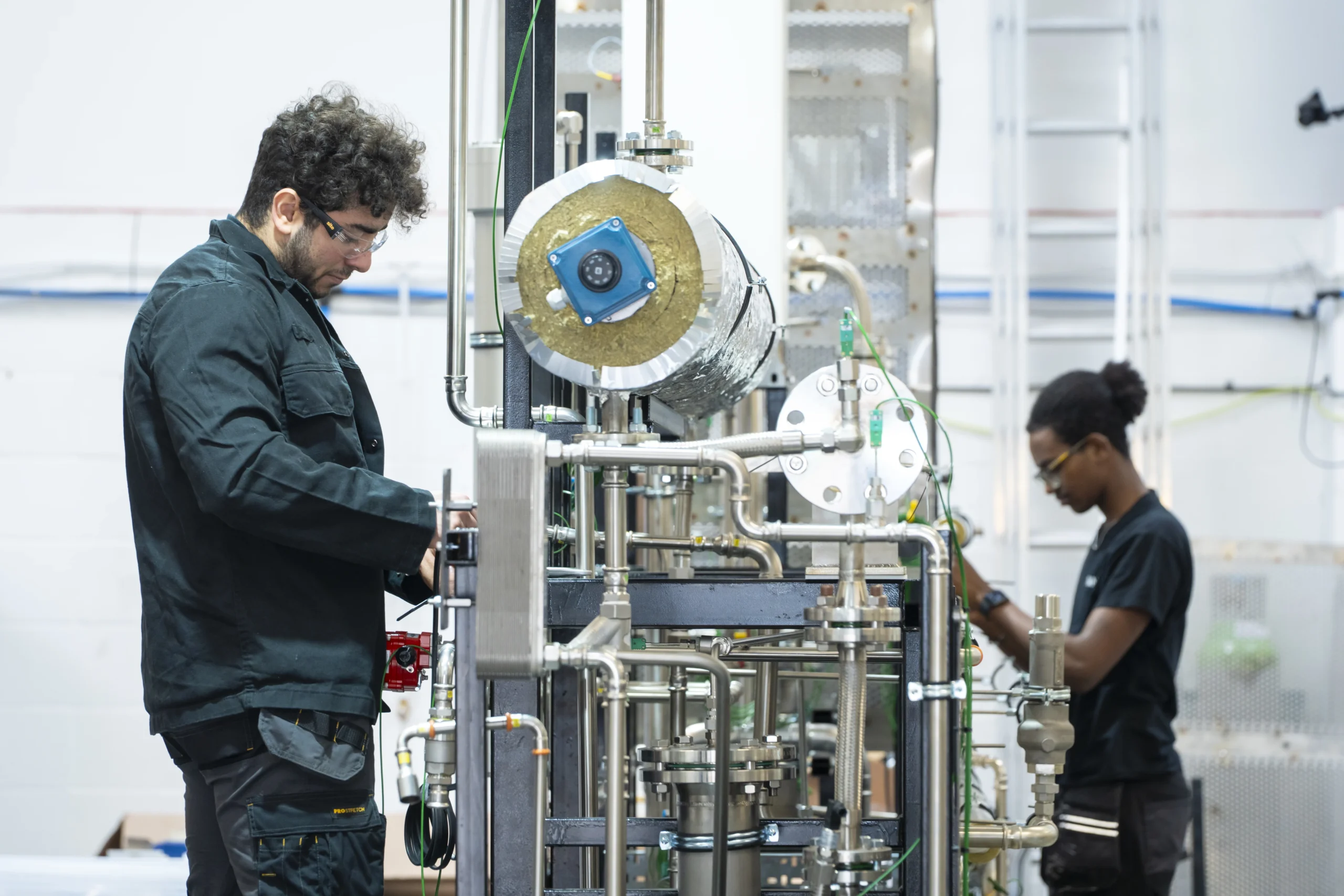
Project Starwell will deliver 15 megawatts of plant capacity, making it the largest synthetic natural gas (SNG) facility in Europe. At the same time, Production Base 1, a 50,000 square foot manufacturing site in South London, will serve as Rivan Industries’ first dedicated production hub, with a targeted hardware output of 50 megawatts per year. Notably, the company has already secured customer contracts covering all planned production through 2029, which highlights strong early demand for its technology.
Project Starwell is Rivan’s most immediately significant deployment: a 15-megawatt synthetic natural gas plant in Wiltshire that, when commissioned, will represent the largest SNG facility in Europe and mark the first time synthetic gas has ever been injected into the UK national gas grid. It is a milestone that carries both technical and regulatory significance, establishing a precedent for grid injection of synthetic methane that will be required to unlock the full distribution reach of the technology.
Rivan’s existing pipeline distribution strategy deliberately exploits the fact that Europe already has an enormous gas grid: by producing synthetic methane that is grid-compatible, the company can reach industrial customers across multiple countries without building any new distribution infrastructure. Production Base 1, the 50,000 square foot manufacturing facility leased in South London, is the industrial foundation for this expansion: the facility is designed to produce up to 50 megawatts per year of Rivan hardware, enabling the kind of deployment velocity that the company’s cash-flow model depends on.
The energy security dimension of Rivan’s pitch to investors and customers is not incidental. Approximately 60 percent of Europe’s total energy is currently imported, a structural dependence that was forcefully exposed when conflict in the Middle East caused wholesale gas prices to double, pushing the UK, France, Germany, and Spain into energy emergency conditions. Rivan’s synthetic natural gas is produced domestically from air, water, and solar radiation: three inputs with no geopolitical chokepoints, no shipping routes, and no OPEC.
The company specifically targets arid and unproductive land not sought by conventional solar developers for its installations, avoiding both grid connection queues and conflicts with agricultural land use. Because its machines run on direct current from solar panels without requiring AC inversion or voltage transformation equipment, installation costs are lower than conventional solar-to-grid projects.
The Roadmap to Fossil-Fuel Pricing Parity
Rivan’s £25 million will fund three specific near-term objectives that it describes as the platform from which price parity with fossil gas becomes achievable within two to three years.
- Next 12 Months: Commission Project Starwell at 15MW in Wiltshire, becoming Europe’s largest SNG plant and achieving first-ever synthetic gas injection into the UK national grid. Hire 35 new engineers, operators, and permitting specialists.
- Manufacturing Scale: Ramp Production Base 1 to produce up to 50MW per year of Rivan hardware. Establish the manufacturing throughput required to compound deployment across the UK, Spain, and France at country-scale industrial demand.
- R&D Investment: Accelerate across four technical domains, direct air capture, electrolysis, Sabatier reactor, and solar integration, targeting the cost reductions required to challenge fossil fuel pricing within 2-3 years, ahead of schedule.
The milestones Rivan has already cleared before this raise are an important part of the credibility case. At the £10 million seed stage, the company committed to proving its technology at scale, cost, and performance, and to building the customer demand necessary to support rapid manufacturing growth. It has since commissioned the UK’s largest operating synthetic natural gas plant, tripled its customer contracts, and sold its entire planned production through to 2029. A team of more than 30 engineers and operators is based at the South London headquarters, with 35 additional roles currently open.
The speed of this progression, from engineering hypothesis to Europe’s largest SNG plant in approximately two and a half years, reflects both the relative simplicity of Rivan’s low-capex hardware approach and the urgency with which it is prosecuting deployment. Rivan’s culture page describes speed explicitly as the company’s primary defensive strategy, reasoning that in a market where the technology is well understood and the primary question is who can manufacture and deploy at sufficient scale and low enough cost first, time is the only moat that compounds.
Europe’s energy future, and the credibility of its industrial decarbonisation commitments, depends in large part on whether technologies like Rivan’s can cross from engineering proof to industrial scale within the window that matters. The company is making a specific, falsifiable bet: that cheap solar will keep falling in cost, that its low-capex machines will compound their deployment through rapid cash flow cycles, and that within two to three years its synthetic natural gas will be genuinely cheaper to produce than its fossil equivalent. If that bet is right, the market mechanism does the rest.
Every heavy industrial operator in Europe that has been unable to decarbonise because electrification does not reach them, and because low-carbon alternatives have always cost more than what they are replacing, will have a financially rational reason to switch. That is not a story about climate altruism. It is a story about price.