

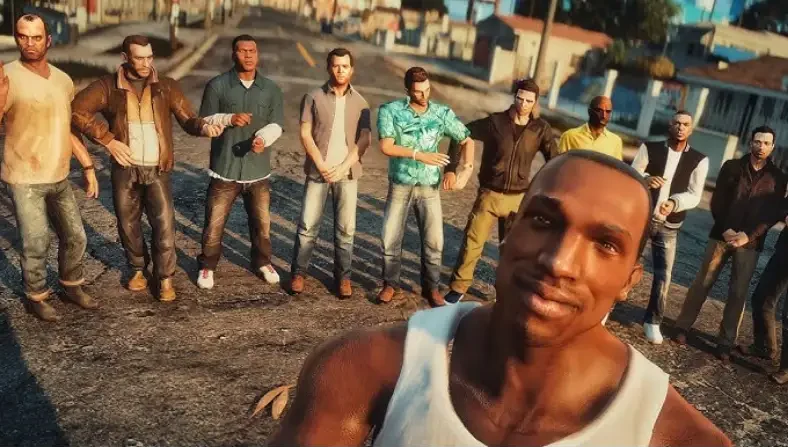
Why GTA (Grand Theft Auto) Is One of the Greatest Software Engineering Projects Ever Built
Grand Theft Auto was born from a bug. In the mid-1990s, a small Scottish studio called DMA Design was prototyping a top-down racing game in which players chased criminals through city streets. During testing, the police car AI glitched and began careening wildly through traffic, smashing pedestrians, causing chaos at every intersection. The developers watched the bug unfold and made a decision that changed gaming history: being the criminal was more fun than being the cop. They threw out the original concept, flipped the premise, and built a game around the feeling of escaping a city that was trying to kill you.
That accidental discovery is now a franchise worth billions, spanning seven mainline entries across thirty years, due to arrive in its most technically ambitious form on November 19, 2026. What connects the sprite-based original to the sun-drenched Leonida of GTA VI is not just a name or a logo. It is a relentless obsession with using whatever hardware exists to simulate a more convincing, more chaotic, more alive version of the world.
- 1997: Year GTA 1 launched on late-1990s PC hardware
- 30+ Years of continuous franchise development across seven mainline entries
- $8B+ GTA V estimated lifetime revenue across all platforms and generations
- Nov 2026, GTA VI confirmed release, PS5 and Xbox Series X/S only at launch
Greatness of Grand Theft Auto: A 30-Year Timeline of Computing Progress
The history of Grand Theft Auto maps almost perfectly onto the history of consumer computing. Each mainline entry arrived at a moment when hardware was powerful enough to do something that felt impossible the generation before, and Rockstar consistently used that new headroom to simulate something more complex, more detailed, and more responsive than anything that had come before. GTA 1 fit three cities, a traffic system, pedestrian AI, radio stations, a police response mechanic, and a full mission scripting engine onto machines with as little as 8 megabytes of RAM.
GTA VI ships on consoles with 16 gigabytes of unified memory and solid-state storage that loads assets hundreds of times faster than the optical drives of the PlayStation 2 era. That is not a linear progression in degree. That is a different universe of hardware, and Rockstar has expanded to fill every cubic inch of it every single time.
What makes this remarkable as a software engineering achievement is that the franchise never simply used new hardware to make the same game look better. Every generation brought a fundamental rethinking of what a Grand Theft Auto game was trying to simulate. The 2D era was about simulating a city as a system. The 3D era was about simulating a city as a space.
The HD era was about simulating a city as a society. And GTA VI, arriving thirty years after the original, appears to be about simulating a world as a living, breathing, socially networked, economically interconnected reality in which the chaos Rockstar has always loved is emergent rather than scripted. The technical ambition has never been about resolution or polygon counts. It has always been about interconnected systems running simultaneously without the seams showing.
Rockstar Games was founded in 1998 when Take-Two Interactive acquired BMG Interactive and rebranded DMA Design’s publishing arrangement. The company understood almost immediately that the future of gaming was three-dimensional open worlds. Every studio decision from that point forward, every technology investment, every engine rebuild, every expansion of the team from dozens of developers to thousands, has been in service of that original conviction.
What makes the Grand Theft Auto franchise a case study in software engineering rather than simply a series of popular games is that Rockstar has been right about where computing was going every single time, and has positioned its technology to meet each new generation before competitors understood what that generation would make possible.
The 2D Era: How GTA 1 and GTA 2 Built an Open World on Late-1990s Hardware
To understand what GTA 1 actually accomplished, you need to understand the constraints it operated under. Personal computers in 1997 typically ran at processor speeds between 133 and 300 megahertz. Available RAM was measured in single-digit megabytes for most users. Storage was slow and graphics hardware was rudimentary.
Into this environment, DMA Design dropped a game that simultaneously simulated traffic flowing through city streets, pedestrians walking and reacting to the player, a dynamic police response system that escalated through wanted levels based on the severity of what the player had done, multiple radio stations playing different music depending on which stolen car you happened to be driving, and a complete mission structure across three distinct cities.
The wanted level system, that five-star cascade that brings in regular cops, then FBI sedans, then the military with tanks, was not a set of scripted sequences. It was a reactive simulation that checked your criminal behaviour against a set of escalating thresholds in real time and deployed resources accordingly. In 1997, on 8 megabytes of RAM, that was genuinely sophisticated systems design.
All of this was achieved using sprite-based 2D graphics viewed from above, which was not purely an aesthetic choice. 3D rendering at urban scale was simply beyond what the machines of the era could manage. The genius of the 2D GTA era was in recognising that a living city could be simulated through rules and systems rather than through visual fidelity. Players who found the right car would hear a specific radio station. Pedestrians would scatter when you fired a weapon. Gang members in certain areas would attack on sight. The city felt alive because its underlying logic was consistent and responsive, even when rendered in pixels barely larger than thumbnails.
GTA 2 refined this foundation with improved AI, a gang system that tracked player allegiance and generated different reactions from different criminal factions depending on your history with them, and better physics for vehicle handling. The protagonist Claude, the same name Rockstar would later give to GTA III’s silent lead, navigated a retrofuturistic city divided between the Zaibatsu Corporation, the Yakuza, the Loonies, the Rednecks, the SRS Scientists, and the Russian Mafia.
Siding with one faction actively damaged your relationship with others, which fed back into how the world treated you throughout the session. In 1999, on hardware that most modern devices would barely recognise as a computer, that was genuine simulation design, and it established an approach to world reactivity that Rockstar has refined across every game since.
The 3D Revolution of GTA III, Vice City and San Andreas That Made Rockstar Cult
GTA III, released for PlayStation 2 in 2001, did not just change the franchise. It changed the industry. The concept of a fully three-dimensional open world that a player could explore without loading screens was effectively new. Most games of the era were either 3D but linear, or open but two-dimensional. GTA III was simultaneously both three-dimensional and open in a way that required Rockstar North to invent almost every technical system from scratch.
The PlayStation 2 had 32 megabytes of RAM. Liberty City, a fictionalized New York that Claude navigated as a mute criminal working his way through three boroughs for the Mafia, the Triads, and the Yakuza, had to stream continuously as the player moved through it.
Rockstar built a streaming system that loaded the geometry, textures, pedestrian spawns, vehicle traffic, and mission triggers for whatever part of the map was immediately ahead of the player while unloading everything behind them, all without a loading screen appearing mid-session. This required solving problems in memory management, asset prioritization, and real-time pathfinding that had no established solutions in the industry at the time.
Pedestrian AI alone, managing hundreds of characters across the visible city each making autonomous navigation decisions while reacting to gunshots, explosions, and police sirens, had to run within memory and processor budgets that would make a modern mobile developer wince. GTA III essentially established the blueprint for the modern open-world game, and almost every studio that has built one since has been working from a version of the architecture Rockstar invented in that project.
Vice City arrived the following year and demonstrated that technology and atmosphere were not separate considerations. Tommy Vercetti, voiced by Ray Liotta in a performance that remains one of gaming’s great leading roles, arrived in a 1980s Miami rendered in neon, pastel, and chrome. The artistic direction of Vice City was itself a technical achievement. Rockstar built lighting systems that made rain-slicked streets reflect the colours of strip club signs. They created interiors that GTA III had almost entirely avoided, each with their own streaming and rendering requirements.
They built a radio station roster, from V-Rock playing heavy metal to Espantoso playing Latin jazz to VCPR airing increasingly unhinged public affairs programming, so culturally specific that players three decades later can recall individual songs from particular stations as if they are real memories of a real place. When you got on a motorbike on Ocean Drive at sunset and the right song was playing and the city was doing its thing around you, the game felt like somewhere rather than something. That sense of place was an engineering achievement, and it was what made Tommy Vercetti’s story feel worth following.
San Andreas and the Limits of the PS2
Grand Theft Auto San Andreas, released in 2004, is still cited by engineers as one of the most technically audacious games ever made relative to its hardware. Rockstar North squeezed three cities, Los Santos, San Fierro, and Las Venturas, connected by forests, deserts, mountains, rivers, and farmland, onto the same PlayStation 2 that GTA III had used for a single city. CJ, Carl Johnson, could steal fighter jets from military bases, recruit gang members into running operations across Los Santos, gain muscle mass from working out at gyms, swim underwater, climb buildings, parachute from skyscrapers, and drive across three hundred square kilometres of terrain without a major loading interruption.
The aircraft system required entirely new physics models. The gang warfare system tracked territory across Los Santos in real time. CJ’s relationship stats with other characters affected dialogue and mission availability. His hunger level affected his stamina. Every one of these systems ran simultaneously on 32 megabytes of RAM through what one Rockstar engineer later described as aggressive memory compression and a lot of hope. The cheat codes players typed in, HESOYAM for health and money, ROCKETMAN for a jetpack, BIGBANG to detonate every vehicle in sight, were originally debugging shortcuts that Rockstar left accessible to players because they understood that the sandbox was the point, not just the story.
The cultural impact of the 3D Grand Theft Auto era is inseparable from its technical achievements. These games became cultural phenomena rather than simply successful products because their engineering was sophisticated enough to create the illusion of worlds that existed independently of the player’s actions within them. When CJ walked away from Grove Street, the gang activity kept running. The traffic kept flowing. The radio kept playing. The simulation did not stop because the player stopped paying attention to it. That continuity was a technical choice, an engineering decision to keep all systems active at all times, and it was what made the emotional experience of inhabiting these cities possible.
The HD Era: RAGE, Euphoria and the Rise of Living Digital Cities in GTA IV and GTA V
Grand Theft Auto IV arrived in 2008 alongside the most important piece of technology Rockstar ever built: the Rockstar Advanced Game Engine, known as RAGE. Everything before it had been built on evolved versions of the original GTA III engine. RAGE was a ground-up reconstruction of how Rockstar would render and simulate its worlds going forward, and it reflected a fundamental shift in ambition. GTA IV’s Liberty City, a version of New York far smaller than San Andreas’ map, was designed to be the most believable urban environment in gaming rather than the largest or most feature-rich. The engineering ambition moved from scale to fidelity.
The most striking expression of this shift was the integration of NaturalMotion’s Euphoria animation middleware. Previous Grand Theft Auto games, like almost all games of their era, handled character reactions to impacts with pre-recorded ragdoll animations selected from a library. Euphoria replaced this entirely. When Niko Bellic, a Serbian war veteran trying to build a new life in Liberty City under the weight of a past he could not escape, was hit by a car, his body did not play a canned death sequence. Euphoria calculated how that specific collision, at that specific speed, from that specific angle, would affect a body with simulated muscle tone and simulated skeletal structure.
Every stumble was unique. Every fall was physically generated on the fly. Police officers who were shot would grab at the wound while trying to maintain their balance. Characters in passenger seats would brace during crashes. The simulation was not reading from an animation library. It was solving physics equations in real time for every impact, and the result was a city that felt inhabited in a way no previous open world had managed.
GTA V, released in 2013 and subsequently ported to PlayStation 4, PlayStation 5, Xbox One, Xbox Series X/S, and PC, represented the synthesis of everything Rockstar had learned. Three playable protagonists, Michael De Santa, a retired criminal living a hollow life in Rockford Hills; Franklin Clinton, a young repo man looking for something bigger; and Trevor Philips, a former military pilot operating at the absolute outer limit of human psychology, each had their own residences, their own social networks, their own active story threads continuing in the background while the player controlled someone else.
The streaming technology required to switch instantly between a character in the Blaine County desert and a character in a Vinewood Hills mansion, loading a different area, placing the camera correctly, and synchronising the game state to make the scene look convincingly mid-activity, remains impressive even from the vantage point of 2026.
GTA V shipped on PlayStation 3, PlayStation 4, PlayStation 5, Xbox 360, Xbox One, Xbox Series X/S, and PC. The same game, rebuilt three times for hardware that did not exist when it launched. That is not a port strategy. That is an engine designed to outlast the machines it was born on.
GTA Online, which launched as a multiplayer component and became one of the most profitable entertainment products in history, added engineering complexity that the single-player game could not have anticipated. Dozens of players existing simultaneously in a shared world, each with their own physics interactions, vehicle states, weapon loads, active missions, and economic progress, required networking architecture without an established template in gaming.
The game has run continuously since October 2013, adding content across thirteen years and three console generations, funding development of future Rockstar projects through a live-service economy built on in-game currency, property purchases, vehicle modifications, and a criminal enterprise simulation that millions of players have treated as a part-time job.
GTA VI and the Age of Real-Time World Simulation
Grand Theft Auto VI releases on November 19, 2026, exclusively on PlayStation 5 and Xbox Series X/S. The game is set in the fictional state of Leonida, a version of Florida spanning Vice City, a modernized Miami-inspired metropolis, the Keys, swampland, small towns, port cities, and a national park around Mount Kalaga. The trailers Rockstar has released, both confirmed as captured in-game on PS5, show beaches full of people behaving in ways that suggest significantly more sophisticated crowd AI than previous games, wildlife interacting naturally with environments, and a Vice City that reads as a convincing rendition of a specific American city in 2026 rather than a stylized approximation.
Lucia Caminos and Jason Duval are the two playable protagonists, a criminal couple in the tradition of Bonnie and Clyde caught up in a conspiracy involving the Vice City Police Department after a heist goes wrong. Lucia is the first playable female lead in a mainline GTA entry, and the trailers suggest a relationship dynamic between the two characters more emotionally grounded than the franchise has typically offered. The ability to switch between them mid-mission, building on the three-protagonist mechanic of GTA V, appears designed to enable more complex operation planning and more varied storytelling across a single mission structure.
The game runs on RAGE 9, the ninth major evolution of the engine first deployed in 2008. Confirmed technical specifications include support for textures up to 16K resolution, significantly improved global illumination, more sophisticated weather and water simulation, denser vegetation rendering, and NPC behaviour that incorporates more contextual social awareness than previous entries. The NVMe solid-state storage in the PS5 and Xbox Series X/S operates at speeds roughly twenty times faster than the spinning hard drives of the PS3 era, which fundamentally changes what is possible for world streaming.
Assets that previously had to be loaded tens of seconds before the player reached them can now be loaded in fractions of a second, allowing Leonida’s environments to be denser, more detailed, and more immediately responsive to fast movement than anything San Andreas or GTA V could achieve. Pre-orders are live. Standard Edition is priced at $79.99. Physical copies will contain a download code rather than a disc, with pre-loading available from November 12, 2026.
The Engineering Decisions That Changed Gaming Forever
When you look across thirty years of Grand Theft Auto, the engineering decisions that matter most are not the ones that added individual features. They are the ones that changed how open-world games are fundamentally conceived. The city streaming technology from GTA III, continuously loading and unloading a three-dimensional world around the player within 32 megabytes of RAM, became the template for memory management in open-world games across the entire subsequent industry. The Euphoria physics integration from GTA IV changed character animation across a generation of action games.
The three-protagonist instant-switching of GTA V introduced a narrative architecture for open-world games that had never existed before and that multiple studios have attempted to replicate since. The GTA Online persistent economy, built on top of GTA V’s single-player world, established the live-service model that still dominates commercial game development more than a decade later.
The specific joy of Grand Theft Auto across every generation has been the relationship between the game’s narrative structure and the player’s freedom to completely ignore it. Every GTA gives you missions and then gives you the entire city as an alternative. San Andreas gave CJ three cities and aircraft and gang mechanics, and then let players spend hundreds of hours driving a lowrider slowly through Los Santos with the radio on, doing nothing that advanced the plot and feeling entirely satisfied. Vice City gave Tommy Vercetti a criminal empire to build and also gave him a motorbike, Ocean Drive at sunset, and a radio station playing something perfectly suited to the particular quality of the light at that moment.
The game did not require you to engage with its story to feel worthwhile. That feeling, the sense that the city continues existing whether or not you are paying attention to it, whether or not a mission is active, whether or not Tommy or CJ or Niko or Franklin or Michael or Trevor is doing anything narratively significant, is the central engineering achievement of the franchise. It requires every system to keep running continuously, and it requires the world to be interesting enough that doing nothing in particular still constitutes a genuine form of play.
GTA VI has to deliver that feeling in a Florida that modern players have encountered at high fidelity in films, television, social media, news footage, and their own phones. The Vice City that Tommy Vercetti occupied in 1986 could afford to be impressionistic, because players carried only cultural memory of the real Miami of that era. Leonida in 2026 will be measured against a world that players already know through streaming platforms, TikTok, and real-time news.
Meeting that standard while maintaining the systemic depth, the reactive police, the living crowds, the vehicles with personality, the radio stations that know exactly which song to play at which moment, is the most technically demanding iteration of the problem that DMA Design accidentally discovered when a police car AI glitched during a testing session in 1995. How do you build a world that feels real? Rockstar has been answering that question for thirty years. On November 19, 2026, they answer it again.