

Every Game Has Bugs. London-Based ManaMind Makes Sure AI Finds Them First!
Game Testing Is Slower and More Broken Than You Think
Game testing has long been one of the most resource-intensive and inconsistent parts of game development. Studios rely heavily on human QA testers who play through builds repeatedly, attempting to surface bugs across different scenarios, devices, and gameplay paths. The process is time-consuming and inherently limited by human endurance and coverage. Testers cannot realistically explore every edge case or simulate the scale at which real players interact with a game once it is released. This creates a persistent gap between what is tested and what actually breaks in production.
As games become more complex, with dynamic environments and interconnected systems, this gap continues to widen. ManaMind enters this landscape by focusing on one core inefficiency: the inability of traditional QA processes to scale with the complexity and speed of modern game development.
ManaMind’s Bet: Let AI Play Like a Human
ManaMind’s approach is built on a simple but technically demanding idea. Instead of treating testing as a checklist-driven activity, it introduces AI bots that play games in a way that resembles human behavior. These bots are not just executing predefined scripts. They interact with the game environment, make decisions, and explore different paths in ways that attempt to mirror how actual players behave.
This shift matters because many critical bugs emerge not from expected flows but from unpredictable player actions. By simulating human-like play patterns, ManaMind aims to uncover issues that scripted automation often misses. The system is designed to operate continuously, removing the constraints of time and fatigue that define human testing. This allows developers to run large-scale testing cycles without increasing headcount or extending production timelines.

How the AI Actually Plays, Learns, and Finds Bugs?
At the core of ManaMind’s system is a combination of machine learning models and gameplay simulation techniques that allow its bots to navigate complex environments. The AI learns from interactions, adapting its behavior based on previous runs and discovered issues. It identifies anomalies in gameplay, such as unexpected crashes, broken mechanics, or inconsistencies in progression, and translates these into structured bug reports.
One of the more significant aspects of the platform is its ability to generate reports that resemble those written by human testers, including context about how a bug was encountered. This reduces the friction between detection and resolution, as developers receive information that is immediately actionable. By continuously iterating through gameplay scenarios, the system builds a broader coverage map than what is typically achievable through manual testing alone.
Why AI Playtesting Could Change Game Development?
The introduction of AI-driven playtesting has implications that extend beyond efficiency. It changes how developers think about testing as a function within the production pipeline. Instead of being a phase that occurs toward the end of development, testing can become a continuous process that runs alongside development itself. This allows teams to identify and address issues earlier, reducing the risk of costly fixes later in the cycle. It also enables more frequent iteration, as developers can rely on automated systems to validate changes quickly.
Over time, this could lead to a shift in how studios allocate resources, with less emphasis on scaling QA teams and more focus on integrating intelligent testing systems. While human testers will remain essential for subjective evaluation, AI systems like ManaMind’s introduce a layer of consistency and scale that has been difficult to achieve.

UK-based ManaMind raised $1.5M Pre-Seed Funding
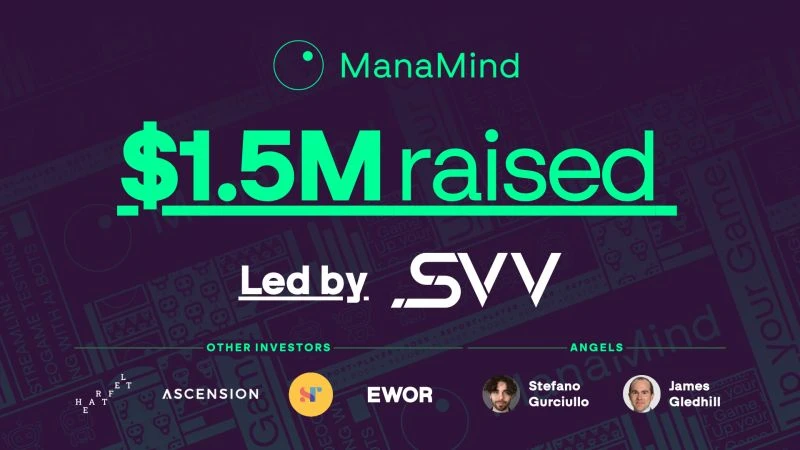
ManaMind’s recent $1.5 million pre-seed funding round highlights growing investor interest in AI applications within game development infrastructure. The funding is not just a signal of early-stage validation but also an indication that the industry is actively looking for solutions to long-standing inefficiencies in QA processes. By securing this capital, ManaMind gains the ability to expand its technology, refine its models, and engage with a broader set of studios.
The timing of this investment aligns with a period where game development cycles are becoming longer and more complex, increasing the demand for tools that can reduce bottlenecks. While the funding itself is a milestone, its significance lies in what it represents: a shift in attention toward automation in areas of development that have historically depended on manual effort.
The round was led by SVV (Sure Valley Ventures), with participation from EWOR, Ascension, Syndicate Room, and Heartfelt.
From Games to Everything: The Bigger Vision for ManaMind
Although ManaMind is currently focused on video games, the underlying concept of AI-driven testing has broader applications. Any digital environment that involves user interaction can potentially benefit from systems that simulate behavior and identify issues. This includes software applications, virtual environments, and even emerging platforms that rely on interactive experiences. By starting with games, which are among the most complex interactive systems, ManaMind is positioning itself to extend its technology into other domains over time.
The challenge will be adapting its models to different contexts while maintaining the level of detail and accuracy required for effective testing. If successful, this approach could contribute to a wider shift toward automated quality assurance across industries, where continuous simulation replaces periodic testing as the standard.
ManaMind is targeting a clear inefficiency in game development, but its long-term relevance will depend on how well its AI can handle the unpredictability of real player behavior. The promise of continuous, human-like testing is compelling, yet the balance between automation and meaningful insight will determine whether it becomes a standard tool or remains a niche solution.