


Rockstar’s Gaming Marvel: Graphics, AI, Physics and Advanced Game Engine Behind GTA 6
GTA 6: Exploring the Tech, Graphics, AI, Physics and Game Engine Powering Rockstar’s Biggest Open-World Game
Rockstar Games’ Grand Theft Auto VI represents one of the most technically ambitious projects in modern video game development. Set in the fictional state of Leonida, inspired by Florida, the game brings together advanced rendering techniques, sophisticated character animation, environmental simulation, artificial intelligence and complex world management systems. Built for the current generation of consoles, GTA 6 uses Rockstar’s proprietary RAGE engine to deliver a highly detailed open world in which visual fidelity and interactive systems work together.
At the heart of the experience is Rockstar’s RAGE engine, short for Rockstar Advanced Game Engine. The proprietary technology has powered several major releases, including Grand Theft Auto IV, Grand Theft Auto V and Red Dead Redemption 2. For GTA 6, Rockstar has further developed its engine to support more detailed environments, complex character interactions, advanced lighting and large-scale world simulation. The engine coordinates multiple systems simultaneously, including graphics rendering, physics, animation, artificial intelligence and asset streaming. Rockstar has not released a complete technical breakdown of the engine’s latest architecture.

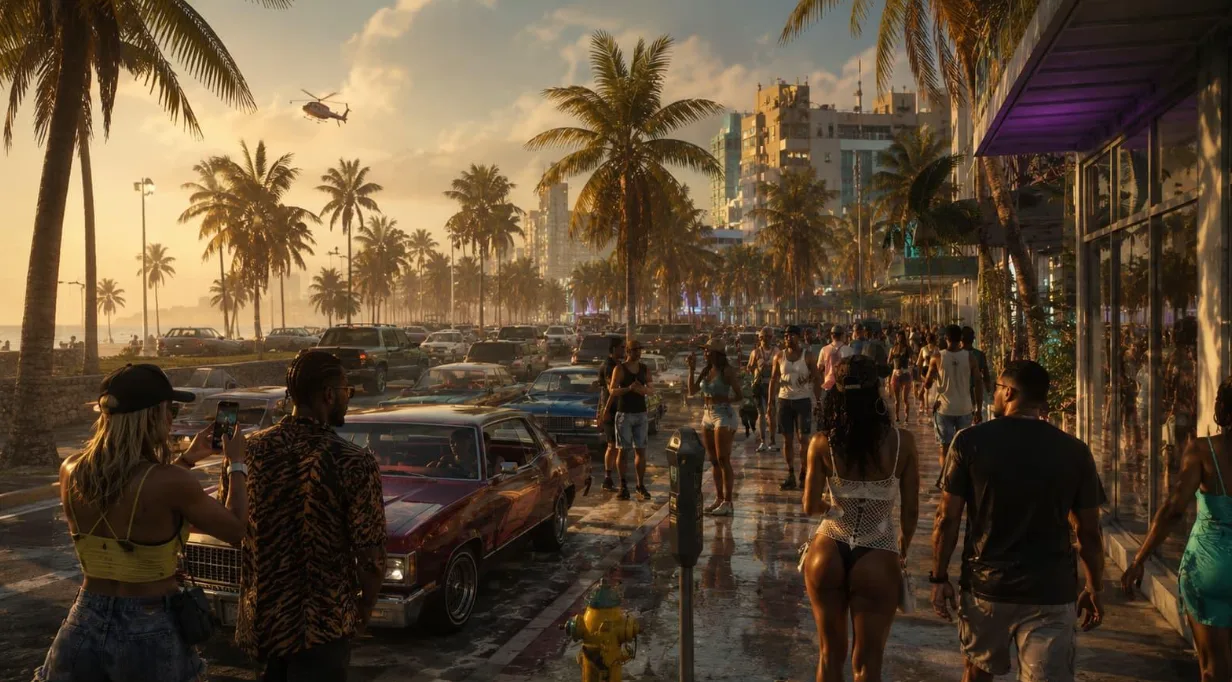
Graphics are among the most prominent aspects of GTA 6. The game uses ray tracing for global illumination and reflections, allowing light to interact more naturally with the environment. Ray tracing calculates light interactions to produce realistic reflections and lighting effects across different surfaces. Global illumination accounts for indirect light, including light bouncing from floors, walls and other objects. These techniques help create more convincing interiors, streets and outdoor environments. On PlayStation 5 Pro, ray-traced shadows provide an additional visual enhancement.
Rockstar has also developed a physically based material library and a cinematic imaging pipeline for the game. Physically based rendering, commonly known as PBR, uses material properties to determine how surfaces respond to light. Metal, glass, concrete, wood and human skin therefore display different lighting and reflection characteristics. Wet roads, reflective windows and illuminated buildings benefit from these rendering techniques. Together, the material system and lighting pipeline contribute to the game’s detailed visual presentation.

Environmental rendering is another important part of the experience. Leonida features diverse landscapes, including urban areas, beaches, wetlands and coastal regions. Volumetric clouds, atmospheric effects, changing visibility and dynamic weather contribute to the appearance of these environments. According to developer information, weather conditions can vary across different regions, allowing rainfall, fog, mist and clear skies to coexist in separate parts of the map. Wind also affects vegetation, clothing, hair and airborne particles. Rain changes surface appearance, visibility and lighting, creating different visual conditions as the weather evolves.
Character animation is another area where Rockstar has invested considerable development effort. GTA 6 uses runtime animation retargeting, a technique that adjusts animations to suit characters with different body proportions. This allows characters of varying heights and builds to perform movements and interactions more naturally without requiring entirely separate animation systems for every body type. The game reportedly features approximately 600,000 animations, according to details shared through an Edge magazine feature. Rockstar has also developed close to a thousand animation sets for ambient activities, alongside numerous custom sequences and individual events. These systems contribute to more natural movement, interactions with objects and everyday activities throughout the world.

Facial animation and character presentation also play an important role in the game’s visual realism. Detailed character models, facial expressions, eye movements and lip synchronization help communicate emotions during conversations and cinematic sequences. Hair and clothing respond to movement and environmental conditions. The objective is to maintain consistency between character appearance, animation and the surrounding environment.
Artificial intelligence and NPC behaviour contribute significantly to the world’s activity. Rockstar has reportedly assigned pedestrians different personality traits, temperaments and behavioural characteristics. Their responses can depend on their surroundings, what they have witnessed and how the player behaves towards them. The development team has also invested in writing and directing pedestrian conversations to give different locations distinct social characteristics. This approach creates greater variation in how people react to situations instead of relying entirely on repetitive crowd behaviour.
The police system introduces another layer of simulation through a mechanic known as the Criminal Profile system. Law enforcement can gather information from witnesses, victims, surveillance footage, clothing and vehicles. Investigators can use available evidence to identify suspects, while the player’s actions can influence how much information the authorities possess. Whether Jason and Lucia have been seen together can also become relevant. This system gives police investigations a more contextual structure than simply responding to crimes through an immediate wanted-level increase.

Physics simulation is equally important to the open world. Vehicles, collisions and interactions with surrounding objects require continuous calculations to determine movement and physical responses. Leonida’s extensive coastal geography also makes water and environmental rendering essential to the experience. The game features detailed ocean, beach and wetland environments, supported by reflections, lighting and environmental effects. However, Rockstar has not published a comprehensive technical specification describing the underlying water simulation.
Audio engineering adds another dimension to immersion. On PlayStation 5, GTA 6 supports Tempest 3D Audio, Sony’s spatial audio technology. It allows sounds to be positioned around the player, helping distinguish nearby conversations, traffic, helicopters and other environmental sounds. The PlayStation 5 version also supports the DualSense controller’s adaptive triggers and haptic feedback. These features provide additional tactile responses during gameplay and can be adjusted through accessibility settings.
Hardware optimization is particularly important because GTA 6 combines demanding graphics with extensive world simulation. The central processing unit handles tasks such as game logic, artificial intelligence and physics, while the graphics processing unit manages rendering, lighting and visual effects. System memory stores active game data, while solid-state storage supports the rapid streaming of environmental assets as players move through the world.
Rockstar has confirmed a 30 frames-per-second target across the console versions, prioritising environmental density and visual fidelity. PlayStation 5 and Xbox Series X use a 1440p rendering resolution upscaled to 4K, while Xbox Series S uses a lower 720p base resolution upscaled to 1080p, according to technical details reported ahead of launch. The consoles use different image reconstruction solutions, including Rockstar’s temporal anti-aliasing technology and platform-specific upscaling systems. PlayStation 5 Pro benefits from PSSR technology, improved image clarity and additional ray-traced shadows. Rockstar has explained that CPU limitations, particularly the demands of the game’s complex simulation, influence its decision to target 30 FPS rather than higher frame rates.

The technical achievement behind GTA VI lies in coordinating these systems within one continuous open world. Lighting, weather, animation, pedestrian behaviour, police intelligence, physics and audio all contribute to the player’s experience. Each system requires substantial computing resources and careful optimisation to operate alongside the others. Rockstar’s development approach builds on technologies established in earlier releases while introducing more sophisticated systems for its latest project.
GTA 6 demonstrates how far large-scale video game production has progressed in graphics engineering, simulation and interactive world design. Its combination of ray-traced lighting, detailed materials, advanced animation, dynamic weather, contextual NPC behaviour and console optimisation makes it a significant technical release. The real measure of its engineering achievement lies in how effectively these individual technologies work together to support the scale and detail of Leonida.
GTA 6 Related Articles: