

Robot Boxing: The Sport Science Fiction Promised and Technology Is Starting to Deliver
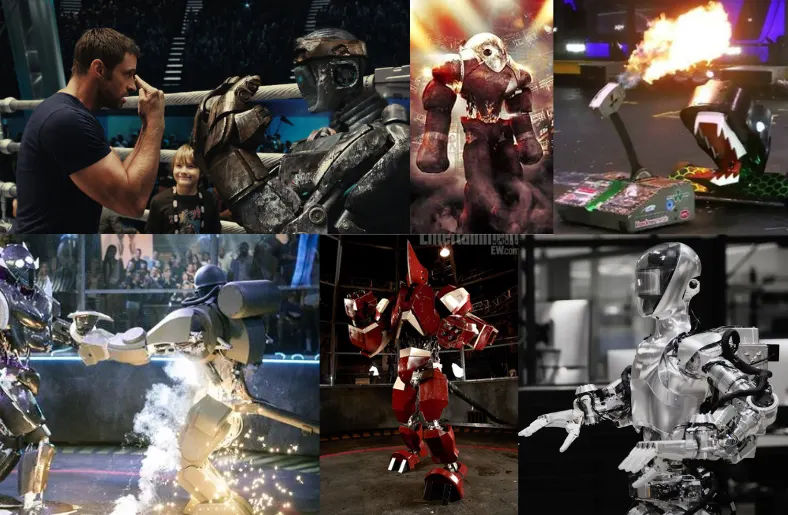
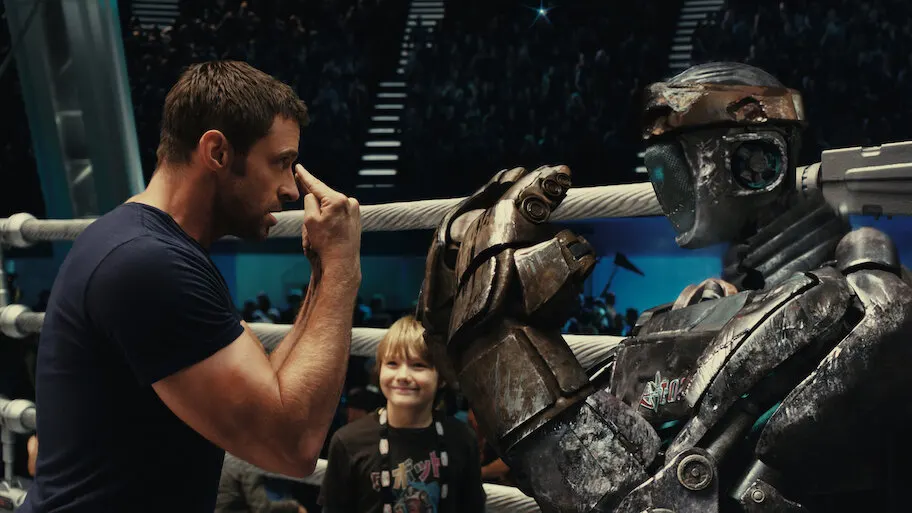
In 2011, director Shawn Levy made a film about a world where human boxing had been replaced by robot boxing. Hugh Jackman played a washed-up fighter who discovers a scrappy sparring bot called Atom and takes it all the way to a championship bout against a state-of-the-art government-sponsored giant named Zeus. The film earned $299 million at the global box office on a $110 million budget. It received an Academy Award nomination for visual effects. Audiences in 60 countries watched it and felt something identifiable: not just excitement about robots fighting, but recognition of something that felt, somehow, like an inevitable future that was taking too long to arrive.
Combat sports are among the most watched events in the world. Spectacle technology, from LED screens to broadcast cameras to live streaming, has made arena entertainment more immersive than ever. And the robotics industry, in the fifteen years since Real Steel landed in cinemas, has undergone a transformation that nobody fully predicted in 2011. The question is no longer whether robot boxing will happen. It is a question of how far the technology still needs to travel, what the economics look like, and who is going to build the league.

From Real Steel to Reality: When Robot Boxing Stopped Feeling Like Science Fiction
Real Steel succeeded commercially for a reason that had nothing to do with special effects. The film sold the idea of robot combat as a sport with stakes, personalities, rivalries, and emotional weight. Atom was an underdog. Zeus was a villain. The crowds in the arena cared, which meant the audience in the cinema cared. Every successful sport in history has been built on the same architecture: characters, conflict, and consequence. Real Steel understood this, which is why it worked as a film, and why the concept it depicted has remained culturally sticky for fifteen years. The robots were secondary. The sport was the point.
What the film got right about the broader cultural appetite was confirmed, less glamorously, by events that were already happening at the time of its release. BattleBots had been running since 2000, with robots weighing up to 340 pounds demolishing each other in enclosed arenas on national television. Its Comedy Central run ended in 2002. Its ABC revival in 2015 drew 5.4 million viewers on a Sunday night. Its Discovery Channel run ran through 2023.
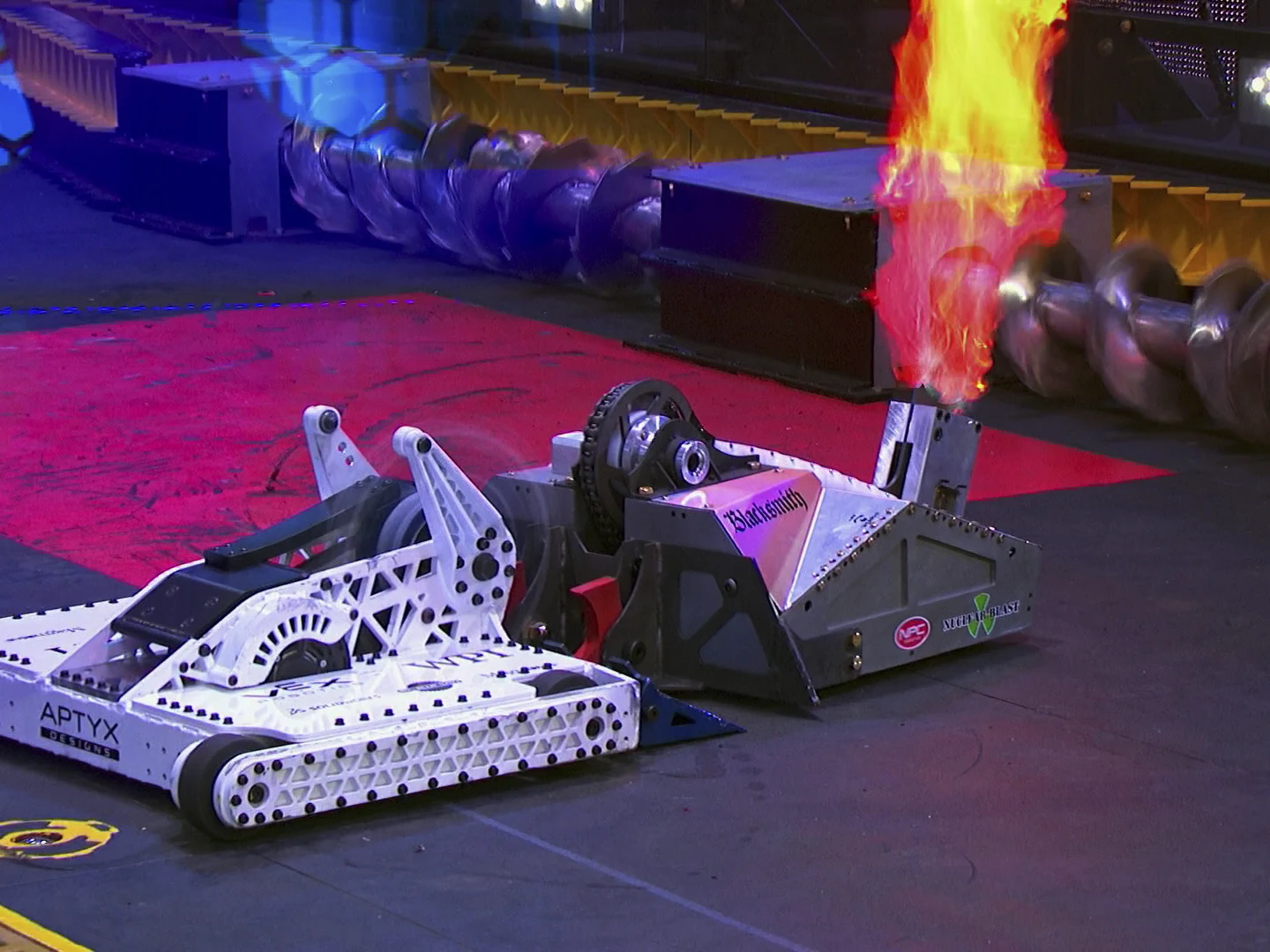
It now streams on HBO Max and is confirmed to be filming a new season of BattleBots Champions in Las Vegas in April 2026, having also launched the BattleBots Pro League powered by Bright Data, a new competition format featuring 24 of the best robots in the world.
An audience for destructive robot competition at scale has been demonstrably proven across three decades and multiple broadcast deals. The gap between what exists and what Real Steel depicted is primarily a gap in robot capability, scale, and physical form, not a gap in audience appetite.
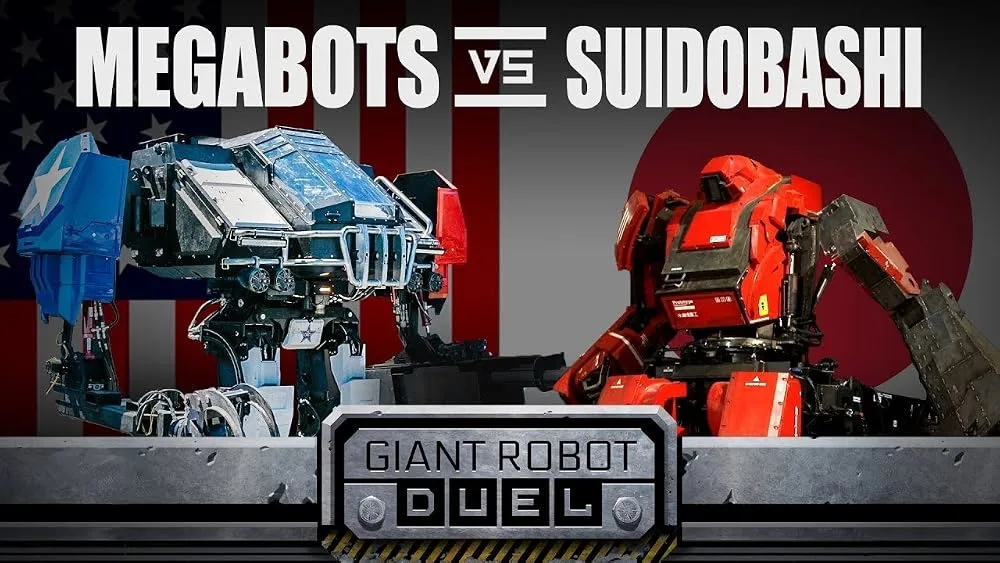
The moment that came closest to the Real Steel scenario in reality arrived in October 2017. MegaBots Inc., a Bay Area startup that had raised $3.85 million from investors including Autodesk and DCM, challenged Japan’s Suidobashi Heavy Industry to the world’s first giant robot duel. Suidobashi’s 6.5-ton, 13-foot robot Kuratas accepted. MegaBots’ 12-ton, 16-foot Eagle Prime, powered by a 430-horsepower Corvette V8 engine, fought Kuratas in an abandoned steel mill in Japan in a battle streamed live on Twitch.
After an intense battle, Eagle Prime won, MegaBots declared victory and announced plans to turn the event into a global giant robot sports league. Then, in 2019, the company ran out of money and sold Eagle Prime on eBay. The dream was real but unfortunately the economics were not ready.
MegaBots Eagle Prime vs Kuratas, 2017
The world’s first giant robot duel ended with a bankruptcy sale on eBay. Eagle Prime stood 16 feet tall, weighed 12 tons, and was powered by a 430-hp Corvette LS3 V8. It featured a pneumatic paintball cannon, a 3,000-pound-force logging claw, and a chainsaw. Two pilots rode inside. The duel was staged, partially scripted, and received a mixed audience reaction, with Twitch viewers who had waited three years for the event expressing considerable frustration at the choreographed elements.
MegaBots won the battle, lost the business, and listed Eagle Prime on eBay in 2019 alongside its liquidation. The company’s vision was correct. Its funding runway was not long enough to close the gap between vision and sustainable commercial operation.
The Closest We Have Today: Real-World Robot Boxing OR Robot Combat Competitions
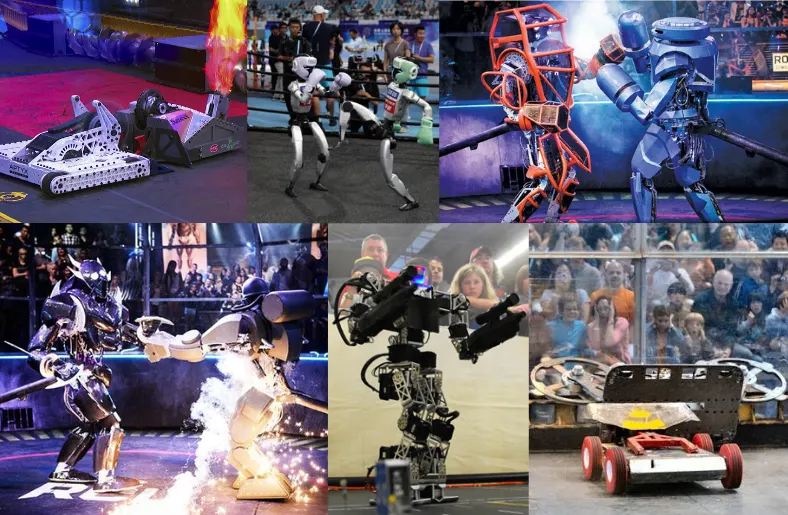
Robot boxing and robot combat, in various forms and at various scales, exist right now. The platforms range from television staples to grassroots competitions to experimental military-adjacent demonstrations, and together they form a landscape that is considerably more developed than most casual observers realise.
- BattleBots: The dominant television robot combat franchise. Robots up to 250 pounds fight in an enclosed arena called the BattleBox, with three-minute bouts decided by knockout or judges’ decision. Comedy Central (2000-2002), ABC (2015-2016), Discovery Channel (2018-2023). Currently streaming on HBO Max with BattleBots Pro League launching in 2026, featuring 24 top robots in a new competition format. The most commercially successful robot combat property in history, with a global viewing audience and a proven multi-decade broadcast track record.
- Robot Combat League: The closest television has come to Real Steel’s actual format. Syfy’s 2013 competition featured 12 humanoid robots operated by human pilots in a boxing ring. Each robot stood roughly 8 feet tall and was controlled by a person wearing a full-body motion capture suit called an Exo-Suit, with their arm and body movements directly translated into robot movements. One season aired. The technology worked for a television event but required extensive hydraulic systems and constant maintenance between fights.
- RoboGames: The world’s largest open robot competition, covering more than 70 event categories across combat, soccer, sumo, kung fu, and firefighting disciplines. Held annually (with pandemic interruptions) in San Mateo, California, RoboGames attracts competitors from more than 40 countries. Its combat categories include weight classes from 1 pound to 340 pounds. The event functions as a global showcase for robotics innovation rather than a spectator sport franchise, though its combat events attract substantial live audiences.
- Mech Warfare: A competition format in which miniature humanoid robots, typically around 30-50cm tall, navigate arenas and engage each other with pneumatic projectile weapons, with pilots operating via first-person camera feeds. Mech Warfare is explicitly designed to prototype the experience of piloted mech combat at a scale that is currently achievable, with the intention of scaling the format as hardware capabilities improve. Competitions have been held in the United States, Australia, and Japan.
- Robot Fighting League: A sanctioning body for amateur and semi-professional robot combat events across the United States, providing rulebooks, weight classes, safety standards, and event frameworks for regional competitions. The RFL operates as the grassroots infrastructure layer beneath televised events like BattleBots, developing builders, machines, and competitive formats that feed into the larger ecosystem. Dozens of regional events run annually under RFL auspices.
- Chinese Humanoid Robot Competitions: China’s government has designated humanoid robotics a national strategic priority, with a 2023 Ministry of Industry and Information Technology directive calling for production at scale by 2025. Chinese robotics competitions increasingly feature humanoid platforms in athletic and combat demonstrations, separate from industrial deployment showcases. Unitree Robotics, which shipped over 5,500 humanoid robots in 2025, has demonstrated its G1 and H1 platforms in competitive and stunt contexts.
The total picture from this landscape is an industry that has proven audience demand across decades, demonstrated the entertainment viability of humanoid-format robot combat on television, and built substantial grassroots infrastructure at the non-humanoid scale. The missing ingredient is a humanoid combat robot durable and capable enough to deliver a consistent, exciting, broadcast-quality performance across multiple fights without requiring hours of maintenance and repair between each bout.
What Technologies Could Make Giant Robot Boxing Possible?
The gap between BattleBots and Real Steel is primarily a hardware gap, and the hardware gap is primarily a function of six technology domains that are at very different stages of maturity. Understanding where each stands in 2026 is the clearest way to understand when their combination becomes viable for a sport.
Humanoid Robotics
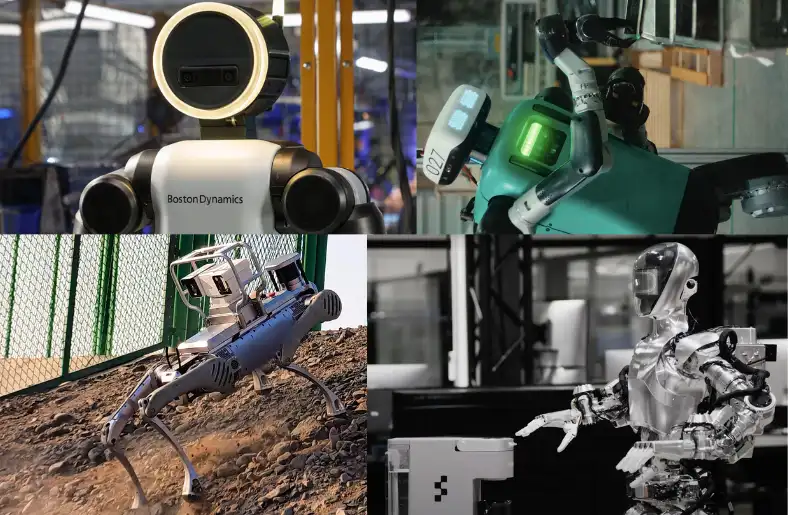
- Boston Dynamics’ electric Atlas, unveiled at CES 2026, is commercially available for the first time and shipping to Hyundai and Google DeepMind. It stands 1.5 meters tall, weighs 80kg, performs movements that exceed human range of motion, and runs on dual swappable batteries lasting around 4 hours. Figure AI’s Figure 03 is being produced at 1 robot per hour at its BotQ factory.
- Unitree shipped 5,500 humanoid robots in 2025 at prices starting at $16,000 for the G1. None of these robots are designed to take punishment. Their structural engineering is optimised for safe operation, not impact resistance. But the locomotion, balance, and dexterity capabilities that combat would require are advancing rapidly enough to bring the timeframe for combat-ready humanoids within a plausible planning horizon.
AI and Autonomy
- For a robot boxing format, two AI architectures are relevant: autonomous combat AI that makes real-time decisions based on sensor input, and teleoperation AI that translates human operator intent into precise robot motion with minimal lag. Both are advancing. Boston Dynamics’ Atlas 2026 integrates a Google DeepMind AI partnership specifically for whole-body control. Unitree’s G1 uses imitation and reinforcement learning that enables adaptive behaviour in unstructured environments.
- The Robot Combat League’s 2013 Exo-Suit model showed that direct motion translation works as a format. Modern motion capture and low-latency transmission technology has improved substantially since then.
Actuators and Motion Control
- The industry-wide shift from hydraulic to electric actuators in humanoid robots, exemplified by Boston Dynamics retiring its hydraulic Atlas in favour of an electric version, has improved controllability and reduced maintenance requirements. However, the power density of electric actuators is still lower than hydraulic systems for short, high-force movements of the kind that punches, throws, and blocks in a boxing format would require.
- Electric motors running at 80% efficiency with gearboxes dropping that to around 40% (per Qviro’s 2025 technical analysis) represent a real constraint. Addressing this for combat applications will require either better motors, better gearboxes, or hybrid actuation systems that do not yet exist at the required scale.
Battery Technology
- Four hours of factory work is not three rounds of combat. Atlas 2026 lasts approximately 4 hours using dual swappable batteries under normal operating conditions. Combat conditions, meaning high-torque impacts, rapid directional changes, defensive responses, and weapon activation, would drain energy at a far higher rate. MegaBots’ Eagle Prime ran on a 430-hp Corvette engine because electric battery technology in 2017 was entirely unsuited to powering a 12-ton mech through combat.
- The situation has improved considerably, but a combat round lasting 3 minutes at full mechanical intensity would require energy storage and discharge capabilities that current commercial humanoid batteries do not provide. Swappable battery systems could partially address this between rounds, which is a practical design path for competition formats.
Sensors and Computer Vision
- 360-degree spatial awareness is solved. Reaction speed is the frontier. The sensor and computer vision capabilities required for a robot boxing format are the most mature of the six technology domains. Atlas 2026 features 3D LiDAR and depth camera systems providing 360-degree spatial awareness. Unitree’s G1 and H1 both ship with LiDAR and depth cameras enabling real-time obstacle detection and environmental mapping.
- For combat applications, the relevant questions are sensor refresh rate, latency from sensing to actuation, and the ability to track a moving opponent in a dynamic environment. High-speed camera systems with sub-millisecond processing already exist in industrial inspection applications. Integrating these into a combat-capable humanoid is an engineering challenge, but the underlying sensor technology is available.
Materials Science
- Structural armour for humanoid robots does not exist as a commercial product. BattleBots robots are built with combat-specific armour, typically titanium alloys, UHMWPE composites, and hardened steel. Current humanoid robots are built with lightweight materials optimised for mobility and energy efficiency. A robot designed to take punches from a 12-ton opponent, or even a human-scale opponent in a structured sport, needs an entirely different structural engineering approach than current commercial humanoids represent.
- Advances in shear-thickening fluid armour, carbon-fibre reinforced polymers, and additive-manufactured titanium components are all relevant, but integrating them into a humanoid that retains functional mobility under combat conditions is a design problem that has not yet been seriously attempted at commercial scale.
The company landscape most relevant to closing these gaps includes Boston Dynamics (dynamic locomotion leadership, now commercially deploying Atlas), Unitree Robotics (volume production leadership, 5,500 units shipped in 2025, targeting 10,000-20,000 in 2026), Figure AI (Figure 03 production at 1 unit per hour from its BotQ factory, 350+ units produced as of June 2026), Agility Robotics (Digit in commercial logistics deployment at Toyota Canada), and Tesla (Optimus Gen 3 targeting low-volume production in summer 2026).
None of these companies are developing robots for combat purposes. All of them are producing the foundational hardware that a combat platform would need to build on.
- Boston Dynamics (Atlas 2026, 80kg, electric, 4hr runtime): Decades-long locomotion research leadership. Dynamic movement exceeding human range of motion. Google DeepMind AI partnership for whole-body control. The most mechanically capable commercial humanoid as of 2026. Prohibitively expensive for combat-sport volume, but the technical benchmark everything else is measured against.
- Unitree Robotics (G1 from $16K, H1/H2, 5,500 units shipped 2025): Volume leadership makes Unitree the most plausible hardware partner for a robot boxing league at scale. A competition requiring six to ten robots per event needs supply chain economics that only Unitree currently provides among humanoid manufacturers. Their G1’s open SDK accelerates third-party development of combat-specific modifications.
- Figure AI (Figure 03, 1 robot/hour production, 350+ units): Demonstrated industrial capability at BMW Spartanburg plant, with Figure 02 robots loading 90,000+ sheet metal parts with 5mm precision. Production velocity is accelerating. The manufacturing scale and dexterity development trajectory make Figure AI a credible candidate for combat-sport licensing partnerships in the late 2020s.
Every technology a robot boxing league requires exists somewhere. The challenge is combining them in one machine that can sustain three rounds without a maintenance crew between every exchange.
Would Robot Boxing Be Economically and Legally Viable?
The economic case for robot boxing as a sport is, in several respects, stronger than the economic case for many sports that already exist. The entertainment industry has proven repeatedly that audiences pay for spectacle, narrative, and novelty. Robot boxing delivers all three. The regulatory and liability landscape is considerably more complex, drawing from multiple existing frameworks that were designed for adjacent but different applications.
The revenue architecture of a mature robot boxing league would draw from multiple streams simultaneously. Television and streaming rights are the most valuable: BattleBots’ multi-decade broadcast history demonstrates sustained media appetite, and a humanoid robot combat format with a Real Steel aesthetic would command significantly higher rights fees than the current BattleBots format given its differentiated spectacle. Live arena events generate ticket revenue, food and beverage, and premium hospitality, with combat sports arenas ranging from 5,000 to 20,000 seats representing a plausible footprint for the early years of a league.
Sponsorship, particularly from technology companies, automotive manufacturers, and energy brands, aligns naturally with the aesthetic and demographic appeal of robot combat. Merchandise, video game licensing, and gambling markets, particularly in jurisdictions where sports betting on robot combat is not legally precluded, represent additional revenue layers.
|
Revenue Stream |
Maturity in Adjacent Sports | Robot Boxing Applicability |
| TV / Streaming Rights | Proven across BattleBots, UFC, WWE |
High. Differentiated format commands premium over existing robot combat |
|
Live Arena Events |
Core revenue for combat sports globally | High. 5,000-20,000 seat venues align with format scale requirements |
|
Sponsorship |
Primary revenue for Formula One, esports |
Very High. Tech, automotive, and energy brands are natural partners |
|
Gambling / Wagering |
Largest revenue adjacent to sport globally |
Medium. Legal in some jurisdictions for robotic events; regulatory pathway unclear |
| Merchandise | Significant for character-driven sports |
High. Named robots with personalities command strong merchandise potential |
|
Video Game Licensing |
Multi-billion market in UFC, WWE, F1 | High. Real Steel video game precedent exists; format translates naturally |
| Robot Manufacturers / Builders | Constructor revenue in Formula One |
High. Named constructor teams with investment incentives model from F1 |
| Maintenance and Repair Economy | Paddock and pit crew model in motor sport |
Substantial. Robot repair between rounds creates engineering jobs and televised content |
The cost side of the ledger is equally significant. A combat-capable humanoid robot of the scale and durability required for a Real Steel-format league does not currently have a market price because such a robot does not currently exist as a commercial product. Working backward from current hardware, Boston Dynamics’ Atlas is priced for enterprise industrial deployment at a level that has not been publicly disclosed but is estimated at around $150,000 per unit.
A combat-hardened version with armour, weapons systems, and structural reinforcement would cost substantially more. Insurance against damage and operator liability for arena events involving machinery of this power and weight is a genuinely novel product that does not yet have actuarial data to price it against. The Federal Aviation Administration’s approach to drone regulation, which established weight-based licensing categories and operational exclusion zones, is the most frequently cited regulatory parallel for how robot combat safety standards might develop.
Regulatory Framework Gaps In Robot Boxing
The EU AI Act establishes risk classifications for AI systems in physical products but does not specifically address autonomous or semi-autonomous robots used in competitive entertainment contexts. ISO standard 10218 covers industrial robot safety and requires physical separation between robots and humans, which a live arena event would violate by design. The UK’s Health and Safety at Work Act and equivalent legislation in most developed jurisdictions creates public liability exposure for arena operators if spectators are injured by projectile debris, which BattleBots addresses through extensive polycarbonate shielding.
Drone regulation in the United States, the UK, and the EU has established the principle of capability-based licensing for unmanned autonomous vehicles, which could provide the template for a robot combat licensing regime. None of the existing frameworks were designed with a humanoid robot boxing league in mind, which means the first league operator will spend considerable capital and time establishing regulatory precedent.
The operational economics of running events also include costs that are less visible in the revenue analysis: engineering and software teams on standby during events, emergency shutdown systems built into every robot as a regulatory requirement, battery management infrastructure, fire suppression systems rated for lithium-ion battery fires at high energy density, crowd safety barriers rated for the kinetic energy of a robot moving at speed, and insurance products covering all of the above. None of these are insurmountable. All of them add to the capital requirement for a league launch.
- $299M Real Steel global box office proves there is audience demand.
- 5.4M BattleBots average viewers on ABC, 2015 revival
- $5T Morgan Stanley projected humanoid robot market by 2050
- $16K Unitree G1 starting price. Most affordable humanoid at scale
When Could We Actually See a Real Steel-Style Robot Boxing League?
The question of timing is the most useful question because it forces a specific technology readiness assessment rather than a general one. A Real Steel-style league requires a specific combination of capabilities that are at different points on their development curves, and the readiness of the slowest of them determines the realistic earliest date.
The BattleBots Pro League is a massive 20-episode tournament that launched on June 25, 2026. Powered by Bright Data, it features a new round-robin league format where 24 of the world’s elite heavyweights are divided into six groups, with only one robot from each group advancing to the Knockout Finals. The televisual and streaming infrastructure for robot combat entertainment is active and expanding. This is the base the next format builds on.
Potential Future of Robot Boxing
- 2027-28: Humanoid robot commercial availability widens. Boston Dynamics expands Atlas beyond Hyundai and DeepMind. Figure AI’s production ramp continues. Unitree targets 10,000-20,000 units in 2026. The hardware required for a competitive format begins to exist at purchasable scale. First purpose-built combat modification programmes on commercial humanoid platforms likely begin in this window.
- 2028-30: Battery and actuator technology improvements reach combat viability. Solid-state battery commercialisation, currently projected by multiple manufacturers for 2027-2028, could double energy density while improving discharge rates. If actuator power density improves on a similar trajectory, the power and endurance requirements for a 3-minute combat round become achievable. This window is the most technology-dependent and therefore the most uncertain.
- 2030-32: First credible humanoid robot boxing events. Likely teleoperated rather than autonomous. Probably starting as exhibition events rather than a structured league. Likely produced for streaming rather than broadcast television first. The format that MegaBots attempted in 2017, with better robots, better production values, and a more durable commercial structure. A Real Steel-equivalent in scale and spectacle, probably not. A commercially viable and genuinely entertaining first step, plausibly yes.
- 2035+: Structured league with multiple teams, regular seasons, and championship events. This timeline requires the regulatory framework to exist, the insurance market to have actuarial data, the robot manufacturer ecosystem to support team-level hardware investment at competition scale, and a broadcast or streaming deal with economics that sustain league operations. Formula One took decades to develop from ad-hoc manufacturer races into a structured commercial league.
The critical variable in all of this is not technology. Technology is advancing on a predictable and broadly positive trajectory. The critical variable is whether someone is willing to commit the capital required to develop combat-specific hardware, navigate the regulatory frameworks, absorb the operational losses of early events, and build the narrative infrastructure around specific robots and teams that transforms a spectacle into a sport that audiences follow across seasons.
MegaBots tried this and ran out of money. The difference between 2019 and 2030 is that in 2030 the underlying hardware will be dramatically cheaper, more capable, and available from multiple commercial suppliers, which changes the capital requirement significantly.
The sport exists in fragments. BattleBots has the audience, the broadcast relationships, and the grassroots builder ecosystem. Syfy’s Robot Combat League proved the humanoid format works on screen. MegaBots proved people will watch giant robots fight, even imperfectly. Boston Dynamics, Unitree, Figure AI, and a dozen other companies are building the hardware generation that would make the sport physically viable.
The Morgan Stanley projection of a $5 trillion humanoid robot market by 2050 suggests the economic environment in which robot sports exist as a natural extension of a mature hardware ecosystem. Real Steel came out in 2011 and earned $299 million by tapping an appetite that was already there. Fifteen years later, the robots are real, the audience is waiting, and the technology gap is closing faster than anyone in 2011 anticipated.