


API-First Insurance Infrastructure Company Axle Builds AI Agents to Automate Insurance Workflows
Axle’s AI-Powered Insurance Infrastructure Automates Workflows and Reduces Risk
Insurance sits behind countless business transactions, from renting a car and financing a home to purchasing a vehicle or managing commercial assets. Yet many insurance workflows still depend on manual verification, documents, phone calls, emails, and fragmented systems. Axle is attempting to modernize this infrastructure by building an AI-native clearinghouse for insurance that allows businesses to automate these processes through APIs and intelligent software agents. The company works with third parties that need to verify, monitor, and update insurance information, helping them turn complicated insurance administration into automated digital workflows.
Its platform includes AI-powered agents for insurance verification, policy monitoring, document processing, and validation. According to Axle, its technology has helped companies including Rocket Mortgage, Avis, and Experian accelerate workflows by up to 20 times while recovering more than $220 million in losses. Rather than trying to replace insurers, Axle is focused on becoming the infrastructure layer connecting businesses with the insurance information and workflows they need. This approach could be particularly valuable in industries where proving active coverage is essential but manually checking policies can create delays, operational costs, and financial risk.

Axle’s Solutions Automate Insurance Workflows Across Key Industries
Axle’s technology is designed around the reality that different industries interact with insurance in different ways. In the rental-car market, for example, businesses need to determine whether customers have valid coverage before allowing vehicles to leave their facilities. It can automate insurance verification and monitoring to reduce the amount of manual work involved. Similar challenges exist in loaner and courtesy-car programmes, where dealerships need to ensure that customers borrowing vehicles maintain appropriate insurance coverage.
Axle also supports automotive dealerships during vehicle sales, helping automate insurance tracking as part of the transaction process. In mortgage origination, insurance verification becomes another critical step because lenders need confidence that properties securing loans are appropriately insured. It’s platform can help automate the collection, validation, and monitoring of this information rather than forcing employees to repeatedly chase documents and manually interpret policy details. Its Document AI and validation technologies are particularly important here because insurance information can appear across complex documents and formats.
By combining structured APIs with AI agents, Axle is effectively trying to create a common digital layer through which businesses can interact with insurance information. The company also provides consumer-facing capabilities, extending its infrastructure beyond enterprise workflows and toward a broader insurance ecosystem. The larger opportunity is to make insurance data more accessible and actionable without requiring every business to build its own integrations, document-processing systems, or policy-monitoring infrastructure.
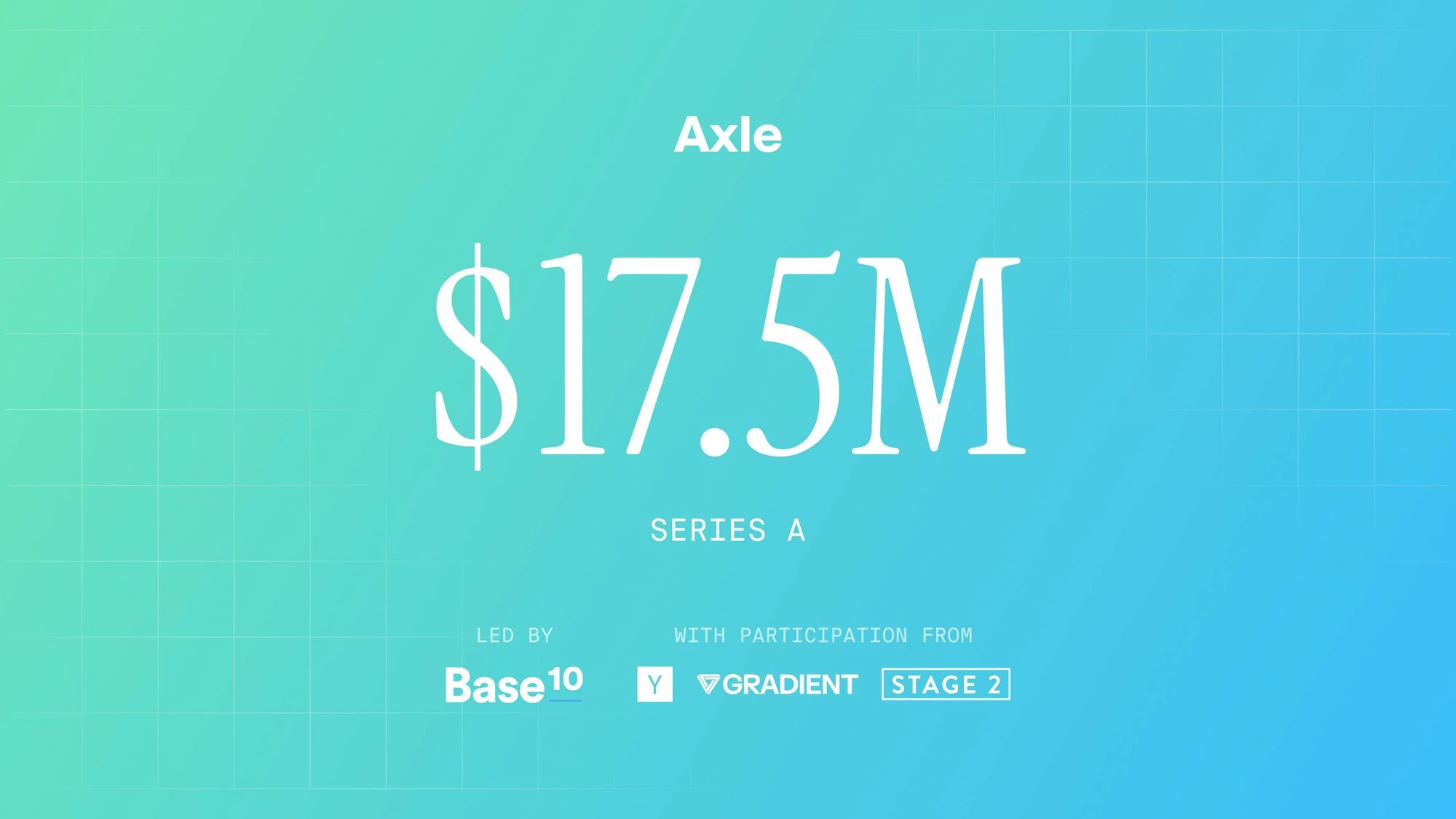
Axle Raises $17.5M Series A Led by Base10
Axle’s ambitions have attracted significant backing as businesses increasingly look for ways to automate repetitive insurance operations. The company has raised $17.5 million in Series A funding led by Base10 Partners, adding capital to its existing support from Gradient, Y Combinator, and members of the early Plaid team. The funding provides Axle with resources to expand its AI-native insurance infrastructure, develop additional agents, and grow its presence across industries where insurance verification and monitoring remain operational bottlenecks.
The investment also highlights a broader trend in financial and enterprise software: AI is moving beyond chatbots and copilots toward systems that can actually execute structured workflows. Insurance is particularly suited to this transition because many processes involve repetitive document analysis, data verification, compliance checks, monitoring, and communication between multiple parties. Axle’s strategy is to turn those processes into programmable infrastructure that businesses can integrate directly into their existing systems.
If the company succeeds, insurance could become less of a manual administrative hurdle and more of an invisible digital service running behind everyday transactions. Its $17.5 million Series A therefore represents not only confidence in Axle, but also a bet that AI agents and API-first infrastructure can fundamentally change how businesses interact with insurance.