

RankNexus: The AI Search Visibility Platform Trying to Automate Your Entire SEO Workflow
RankNexus: SEO + AI-Search Visibility Platform
SEO has traditionally meant optimising websites for search engines, tracking rankings, fixing technical problems, building content, and waiting for the results. The rise of ChatGPT, Gemini, Perplexity, and Google AI Mode has added another layer: brands now need to understand whether AI systems are mentioning them, what sources those systems cite, and why competitors appear in answers instead. RankNexus, built by marketing company Creative Nexus, positions itself as a full-stack SEO, AEO, and GEO platform that brings both sides together.
The platform audits websites, tracks conventional search performance, monitors AI visibility, identifies technical and content gaps, and turns those findings into fixes that users can approve and deploy. Instead of treating AI-search visibility as a separate reporting product, RankNexus is designed around a continuous workflow connecting discovery, optimisation, publishing, and measurement.
RankNexus Turns SEO Into AI-Powered Workflows
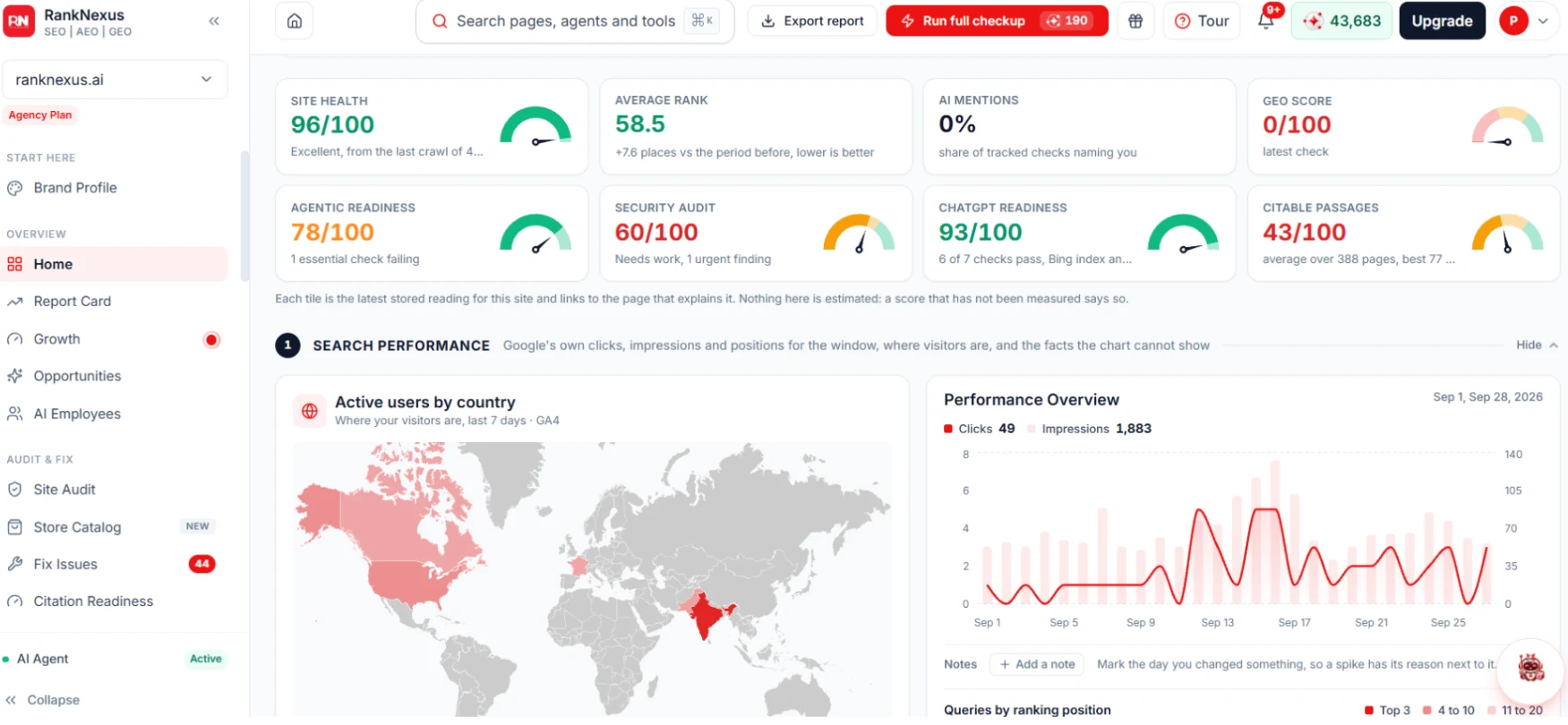
The core idea behind RankNexus is automation. Its platform begins with a live website crawl and evaluates technical factors including metadata, canonical tags, structured data, internal linking, broken links, image attributes, mobile parity, and other Google-related signals. It then connects those findings with keyword opportunities, competitor gaps, Search Console data, and AI-search visibility. This creates a workflow where the platform does more than produce another list of SEO problems.
RankNexus generates proposed changes, presents them as before-and-after differences, and allows users to approve, dismiss, or undo individual fixes. The company describes this as a loop of audit, fix, deploy, track, and improve, with the aim of reducing the handoffs that traditionally exist between SEO specialists, content teams, developers, and analysts.
From SEO Audits to Automated Fixes
One of RankNexus’s biggest differentiators is the distance between identifying an issue and actually fixing it. Its audit engine currently checks websites against dozens of technical SEO signals, while its workflow can generate page-specific fixes for titles, meta descriptions, Open Graph information, schema, and image alt text. Approved changes can be deployed through a single script or, for WordPress sites, through a one-click application workflow. The platform can also submit updated URLs through Google and Bing indexing systems.
On the content side, RankNexus can use Search Console queries to identify opportunities, generate articles with internal links and structured data, and create pages from datasets through its Page Factory. The result is closer to an SEO execution system than a conventional dashboard, although human approval remains part of the process.
Beyond Google: RankNexus Optimizes for AI Search
The shift toward AI-generated answers is where RankNexus is attempting to distinguish itself from traditional SEO platforms. Its AI Visibility tools track whether brands appear in answers from ChatGPT, Perplexity, Gemini, and Google AI Mode, while showing which sources those systems cite and where competitors are being mentioned instead. The platform also evaluates AI citability using signals such as named authors, cited sources, brand and entity clarity, organisation and author schema, and visible freshness.
RankNexus separates structural readiness from citability, allowing users to see whether a site is technically accessible to AI systems and whether its content contains signals that can support citation. It also monitors what AI systems say about a brand, including potentially inaccurate claims, creating another layer of visibility beyond conventional keyword rankings.
Inside RankNexus’s 60 Free SEO Tools and One Larger AI Ecosystem
RankNexus is also using free tools as an entry point into its broader ecosystem. Its public toolkit covers individual SEO tasks while the main platform connects those functions to site-wide audits, content, tracking, AI visibility, and automation. The company also provides an SEO and GEO Academy with free educational material covering conventional SEO as well as AI-search optimisation.
For agencies, the platform adds white-label dashboards and client-management capabilities, allowing the same infrastructure to be used across multiple accounts. This ecosystem approach matters because modern search optimisation increasingly involves a collection of specialised tasks that are usually distributed across multiple tools. RankNexus is attempting to consolidate those workflows into one environment, from diagnosis and content creation to deployment and measurement.
Manual SEO Team vs RankNexus
RankNexus is effectively making a bet that much of SEO execution can become software. A traditional team might require separate specialists or tools for technical audits, keyword research, content production, implementation, rank tracking, AI visibility, reporting, and ongoing optimisation. RankNexus attempts to connect those activities into an automated loop where AI performs much of the repetitive work while people retain control over what gets published or changed. Its public pricing currently starts at $99 per month for its entry-level plan, while higher-tier and agency offerings scale considerably beyond that.
The harder question is whether automation can consistently match the strategic judgement of experienced SEO professionals, particularly for competitive markets where brand positioning, original research, authority, and high-quality content matter as much as technical optimisation. RankNexus does not need to eliminate SEO teams entirely to be disruptive. If it can reliably automate enough of the repetitive execution, it could fundamentally change how much human time businesses need to dedicate to keeping their websites visible across both traditional and AI-driven search.