

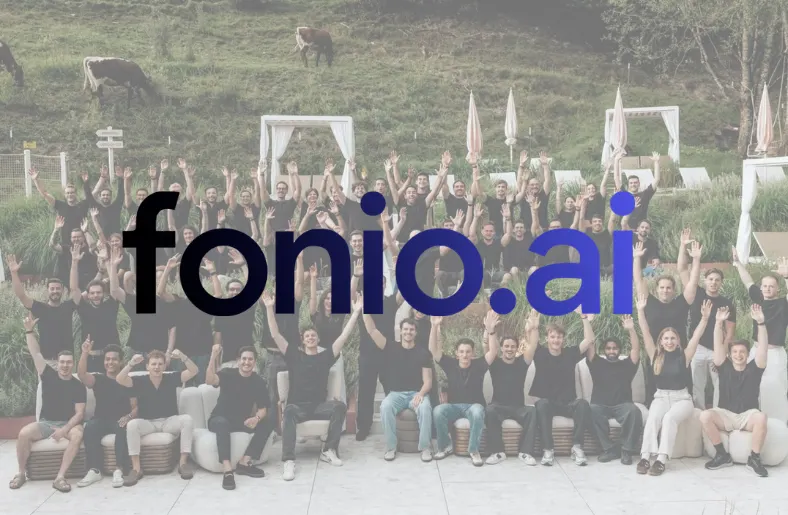
Austria-Based Fonio Uses AI to Handle Your Business Calls 24/7
Fonio Replaces Your Support Staff, Secretary, and Answering Machine
For many businesses, the telephone remains one of the most important channels for communicating with customers. Yet calls frequently arrive when employees are busy, offices are closed, or nobody is available to answer. For an SMB, a missed call can mean a missed lead, an abandoned appointment, or a customer who simply moves on to a competitor. Fonio.ai is attempting to solve this problem by putting AI directly on the front line of customer communication. Founded in Vienna in 2024 by Daniel Keinrath and Matthias Gruber, the company has evolved from an AI telephone assistant into a broader communication platform designed around the way modern businesses interact with customers.
Its AI Phone Agent can answer incoming calls, understand what customers need, qualify enquiries, provide information, and route conversations when human intervention is required. Rather than functioning as a basic automated answering machine, the system is designed to have conversations and handle recurring tasks around the clock. This can make Fonio useful as a virtual receptionist, secretary, customer support representative, or lead qualification assistant. Businesses can use AI to handle appointment requests, frequently asked questions, inbound enquiries, and other repetitive conversations without requiring additional employees.
Fonio is also expanding beyond voice. Its communication suite is being developed to include channels such as WhatsApp, email, and chat, while a dedicated calendar is already available and the company plans to introduce its own CRM. The broader ambition is therefore not simply to automate phone calls, but to create an AI-powered communication layer that can manage customer interactions across multiple channels.

How Fonio Serves Businesses Across Healthcare, Legal, QSR, Real Estate, Retail, and More
One of Fonio’s biggest opportunities is the sheer range of businesses that depend on customer communication. The company has developed solutions across numerous industries, including healthcare, legal services, restaurants, retail, real estate, automotive, hospitality, recruitment, government, and professional services. Healthcare provides a particularly clear example. Doctors’ offices, dentists, physiotherapists, and pharmacies regularly receive calls about appointments, opening hours, services, and other routine questions. An AI phone agent can answer these enquiries and manage appointment-related conversations, reducing the administrative burden on staff.
The same principle applies to lawyers, tax advisers, notaries, recruiters, and property managers. These businesses often receive calls that require basic information or initial qualification before reaching the appropriate employee. Fonio can potentially handle this first layer of communication and ensure that relevant requests are routed correctly. For restaurants and other quick-service businesses, AI phone agents can provide another type of value. Calls can involve reservations, opening hours, menu questions, or other routine enquiries. In retail and automotive businesses, customers may call about products, services, appointments, or availability.
Fonio’s use-case strategy reflects an important characteristic of AI communication software: the underlying technology can be adapted to many industries even though the specific workflows differ. A medical practice may need appointment scheduling, while a property manager may need tenant support and a car workshop may need service bookings. Fonio says more than 9,000 businesses across Europe already run on its platform. That adoption gives the company an opportunity to expand from a narrowly defined AI phone assistant into a broader omnichannel communication platform.

Vienna-Based Fonio Reaches $10M as Demand for AI-Powered Business Calls Grows
Fonio’s expansion is being supported by substantial investor interest. In June 2026, the company secured €14.6 million in seed funding at a €120 million valuation, with the round led by 20VC. The funding gives Fonio additional resources to expand internationally and develop its broader AI communication platform. The financing arrives as businesses increasingly explore AI agents that can perform tasks rather than simply generate text. Voice AI is particularly interesting because phone communication remains deeply embedded in industries where customers expect immediate answers.
For SMBs, the economics can be compelling. Hiring employees to provide 24/7 telephone coverage is expensive, while relying entirely on voicemail can result in lost business. An AI agent offers another possibility: continuous availability without requiring a proportional increase in headcount. Fonio’s funding also reflects the company’s shift toward becoming an end-to-end communication platform. Voice remains central, but WhatsApp, email, chat, calendar functionality, and eventually CRM capabilities could allow Fonio to manage significantly more of the customer journey.
The challenge will be maintaining high-quality conversations as those responsibilities expand. Customers are increasingly able to recognize poor AI interactions, meaning accuracy, response quality, context, escalation, and reliability will determine whether businesses trust AI agents with their most valuable customer interactions.

How Fonio Could Reshape the Future of Business Communications?
Fonio’s long-term opportunity goes beyond answering calls. If AI agents can reliably understand customer intent, access business information, schedule appointments, qualify leads, update records, and transfer complex cases to humans, they could become a new operational layer for SMBs. That would represent a significant change in how businesses think about communications. Instead of treating phone calls, WhatsApp messages, emails, and website enquiries as separate channels, companies could manage them through one intelligent system capable of maintaining context across conversations.
For smaller businesses in particular, this could help close the gap between them and larger organizations with dedicated call centers and customer service teams. A local clinic, restaurant, property agency, retailer, or workshop could potentially offer 24/7 communication without building a large support operation. Fonio’s evolution toward an AI communication suite suggests where the market could be heading. The next generation of business software may not simply record customer interactions. It could actively participate in them.
The company’s biggest test will be whether it can maintain that reliability while expanding across countries, industries, and communication channels. If it succeeds, Fonio could transform AI from an internal productivity tool into the first point of contact between businesses and their customers. With thousands of businesses already using its technology and significant new capital behind its expansion, the Vienna-based startup is positioning itself for a much larger role in the future of business communications.