

Fractile and the $220M Bet That Inference Is the Next Frontier of AI Hardware
The AI hardware conversation has been dominated by training. The race to build ever larger GPU clusters, to secure NVIDIA allocations, to measure success in petaflops and parameter counts, has consumed billions of dollars of capital and years of engineering attention. But that conversation is shifting. Training happens once. Inference happens billions of times a day, every time someone asks a question of ChatGPT, generates an image, runs a reasoning chain, or receives an AI-powered recommendation.
And as frontier AI models grow larger and the tasks they are asked to perform grow more demanding, the cost and latency of inference is fast becoming the binding constraint on what AI can actually do at scale. This is the bet that Fractile was founded on. On May 13, 2026, with a $220 million Series B that values the company at approximately $1 billion, a significant portion of the venture capital community placed the same bet alongside it.

The Memory Wall: The Constraint That Training Hardware Was Never Designed to Solve
To understand what Fractile, the London-based AI chip startup, is building, it helps to understand the specific problem that existing AI hardware creates during inference. Graphics Processing Units were designed for parallel computation. They are extraordinarily effective at the matrix multiplication operations that dominate neural network training, where large batches of data are processed simultaneously and the calculation-to-data-movement ratio is favourable. But inference is different.
A query arrives, the model needs to process it and generate a response, and in doing so it must load enormous quantities of model weights, the numerical parameters that encode everything the model has learned, from memory into the compute cores where calculations happen. For frontier models running to hundreds of billions of parameters, this data movement between memory and compute is continuous, massive, and slow relative to the speed of the computation itself.
This is the memory wall: the fundamental constraint that arises from the physical separation of compute and memory in conventional chip architectures. As AI models have grown larger and as inference workloads have shifted toward longer-running, more complex tasks requiring tens of millions of tokens, the memory wall has moved from a background inefficiency to an acute operational and economic bottleneck. It is why inference is expensive. It is why frontier models are slow on hard problems. And it is what Fractile’s architecture is specifically designed to eliminate.
Conventional GPU Architecture (Compute and memory are separate)
Model weights must be constantly shuttled from off-chip memory to compute cores. At frontier model scale, this data movement creates latency, consumes energy, and limits throughput. Designed for training workloads, not for the continuous, low-batch inference demands of deployed AI.
Fractile Memory-Compute Fusion (Computation happens inside memory)
In-memory compute architecture processes model weights where they reside, eliminating the data movement bottleneck entirely. Custom logic chips paired with a proprietary server rack memory architecture maximises bandwidth without the latency penalty of off-chip transfers.
Oxford Robotics to Inference Hardware: The Founding of Fractile
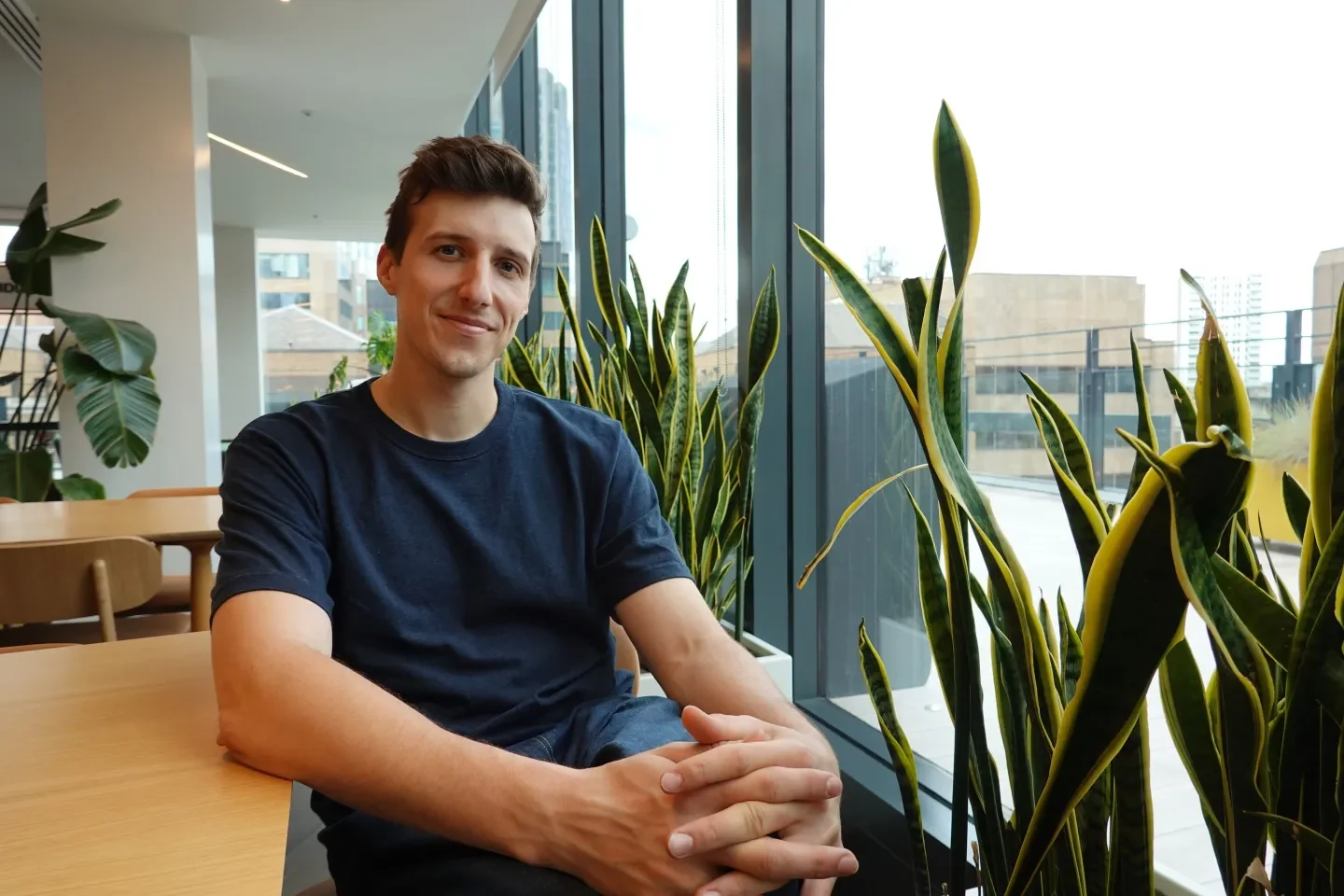
Fractile was founded in 2022 by Dr. Walter Goodwin, then a PhD student at the University of Oxford’s Robotics Institute. Goodwin’s founding conviction was specific and falsifiable: that the world’s most capable AI models would eventually be limited by how long it takes them to produce useful outputs at scale. He bet that the only viable path to solving this was to radically rethink the hardware from the ground up, rather than incrementally optimising architectures that were designed for a different workload profile entirely.
“We bet everything on the logical conclusion: that the only way to truly unlock this latent value, to make speed viable at scale, was to radically re-invent the hardware that we run our frontier AI models on,” Goodwin wrote in a blog post announcing the Series B. “Faster speed is not just about going from 10 seconds to 100 milliseconds. It is about going from days, weeks, months, down to something that is much, much shorter.”
The company’s approach, which it calls memory-compute fusion, involves designing a custom logic chip paired with a proprietary architecture for attaching memory within a server rack, keeping computation as close to data storage as physically possible. The full stack, from silicon microarchitecture to foundry process innovation to AI research, is developed in-house, giving Fractile the ability to optimize across every layer simultaneously rather than being constrained by the assumptions of general-purpose hardware.
The performance claims that have emerged are striking: chips capable of running large language models 25 times faster at 10 percent of the cost of current alternatives, with broader claims of up to 100 times speed improvements and 90 percent cost reductions in specific inference configurations. Fractile has declined to release detailed technical specifications ahead of commercial deployment, which is targeted for 2027.
The $220M Round: Who Backed It and What It Signals
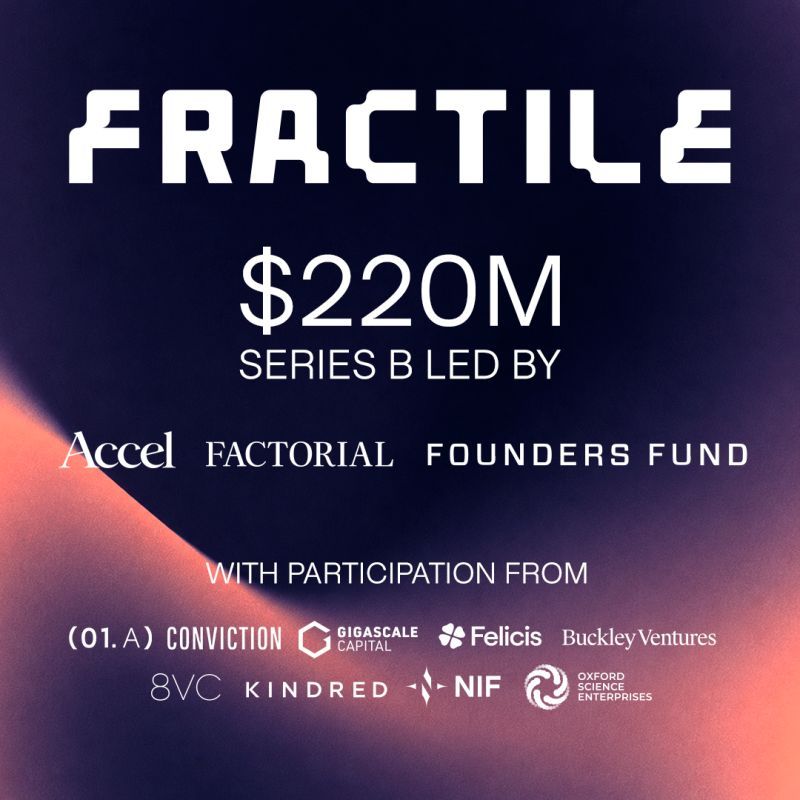
The Series B is the largest external validation yet of Fractile’s technical thesis. It was led by three firms with distinct but complementary perspectives on the AI infrastructure opportunity. Led by Accel, Factorial Funds, and Founders Fund. Eight investors total.
Accel, the lead investor, brought both London roots and a globally recognised venture platform with deep exposure to AI and developer infrastructure. It was joined by co-leads Factorial Funds, a specialist hardware and deep tech investor with concentrated semiconductor expertise, and Founders Fund, Peter Thiel’s firm, which has a long history of backing foundational technology companies at early scale. The broader syndicate included Gigascale Capital, founded by former Meta CTO Mike Schroepfer and focused on compute and AI infrastructure, alongside Conviction, Felicis, and 8VC. Buckley Ventures also participated, joining existing backers including Oxford Science Enterprises and the NATO Innovation Fund.
The composition of Fractile’s angel investor base is equally significant. Hermann Hauser co-founded Arm, whose processor architecture underpins most of the world’s mobile devices and an expanding share of modern data centre infrastructure. Pat Gelsinger previously led Intel, while Stan Boland held senior roles at both Arm and Acorn, the company from which Arm originally emerged. These are not conventional venture investors making broad technology bets. They are senior semiconductor operators who have firsthand experience designing, commercialising, and scaling chip architectures at global scale. Their backing represents more than financial support; it is a strong technical validation from individuals who understand the complexities of building foundational computing infrastructure.
The Commercial Roadmap: 2027 Deployment, Anthropic Talks, and UK Investment
Fractile’s chips are not expected to be ready for data centre deployment until 2027, a timeline that reflects the reality of hardware development cycles: designing a chip, validating it at foundry, iterating on the architecture, and scaling to commercial production is a multi-year process that cannot be compressed by capital alone. The $220 million Series B is being deployed to fund that process: production of the initial chip design, global expansion of the engineering team, and continued foundry process innovation.
Fractile is reported to be in active discussions with Anthropic, the AI safety company and Claude developer, about a chip supply arrangement. If confirmed, that partnership would represent a significant commercial anchor for the company’s 2027 launch and provide meaningful real-world validation of the memory-compute fusion architecture under frontier model inference conditions.
In February 2026, separate from the Series B, Fractile announced a commitment to invest £100 million in its UK operations over the following three years, covering the expansion of its existing London and Bristol engineering sites and the creation of a new hardware engineering facility in Bristol.
The Taipei presence is significant. Taiwan sits at the centre of the global semiconductor industry, with TSMC and a highly concentrated ecosystem of foundry, packaging, and manufacturing expertise that advanced chip development depends on. Establishing operations there signals that Fractile is focused on turning its architecture into a commercially manufacturable product while embedding itself within the supply chain most critical to advanced semiconductor production.
Walter Goodwin’s framing of the long-term opportunity offers perhaps the clearest explanation of Fractile’s broader significance. In his view, the value of faster inference extends far beyond improving the speed of existing AI workloads. Greater performance changes the economic and operational feasibility of entirely new classes of computation. Workloads that currently require weeks of continuous processing could be reduced to days, while tasks that now take days may eventually run within hours. The cumulative impact of those efficiency gains has implications not only for AI performance, but also for the range of applications that become commercially viable. From that perspective, Fractile’s ambition centres on developing the infrastructure capable of supporting the next generation of AI-scale computing.