


Positron Is Betting on a More Heterogeneous Future for AI Compute
Positron Is Building AI Hardware Around Memory, Not Just Compute
The AI hardware market has traditionally been dominated by the idea that more compute means better performance. But as AI models become larger and users expect faster responses, another constraint is becoming increasingly important: memory. Large language models need to store enormous amounts of model weights and continuously move information between memory and processing units while generating tokens. This can make memory capacity and bandwidth just as important as raw computational power, particularly for inference workloads where the same model may need to serve many users simultaneously.
The company develops AI hardware and software specifically for generative AI and large language models, with the goal of delivering faster inference while reducing power consumption and total cost of ownership. Rather than optimizing for a broad range of computing workloads, Positron is concentrating on the characteristics of modern AI models. Its architecture is intended to make it economical to run open-source LLMs with high token rates and long context lengths, potentially giving enterprises and research organizations another option for deploying AI workloads at scale.
The opportunity is significant because inference is becoming one of the largest costs associated with deploying AI. Training a model may require enormous amounts of compute during a relatively concentrated period, but inference continues every time a user asks a question, an AI agent completes a task, or an application generates content. As AI moves from occasional experimentation into always-on enterprise software, the amount of inference required could grow dramatically.
Positron is betting that specialized hardware can make AI inference more efficient. Its approach reflects a broader view that the future of AI infrastructure will be increasingly heterogeneous, with different architectures optimized for the workloads they are best suited to handle.
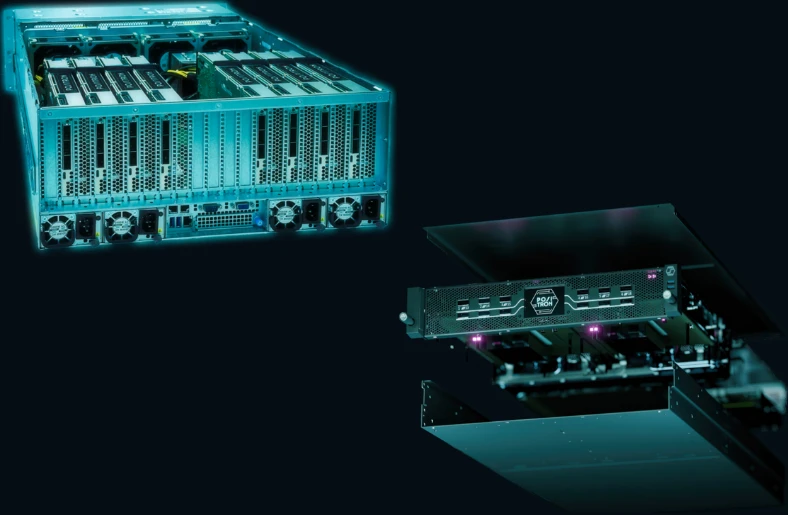
Inside Positron’s AI Inference Systems: Atlas and Titan
Positron’s product strategy centers on specialized systems designed to make AI inference more efficient and accessible. Its Atlas platform is built for generative AI inference and is designed around the memory and computational requirements of modern language models. The system combines Positron’s accelerator technology with the surrounding software stack required to deploy and manage AI workloads. The company positions Atlas as specialized infrastructure for organizations that need to run open-source LLMs with high throughput and long context windows.
The second part of Positron’s product portfolio is Titan, which extends the company’s hardware strategy toward a broader range of AI workloads. Rather than treating an AI accelerator as an isolated chip, Positron is developing an integrated hardware and software platform intended to provide the performance, memory capacity, and efficiency required by increasingly demanding models. The company’s focus on inference is particularly relevant because the economics of deploying AI can vary significantly depending on how hardware is utilized. A powerful general-purpose GPU may offer enormous peak performance, but running a relatively narrow workload on hardware designed for a much broader range of applications can leave some of that capability underutilized.
Specialized accelerators can potentially improve the economics by dedicating more of the architecture to the operations AI models perform most frequently. Positron also emphasizes vendor freedom, giving enterprises and research teams another hardware option rather than forcing them to build their AI infrastructure around a single dominant ecosystem.
Positron’s approach therefore extends beyond the accelerator itself, combining hardware with software designed to make deploying models straightforward at scale. If it can deliver meaningful improvements in the economics of inference, the company could target one of the fastest-growing segments of AI compute.
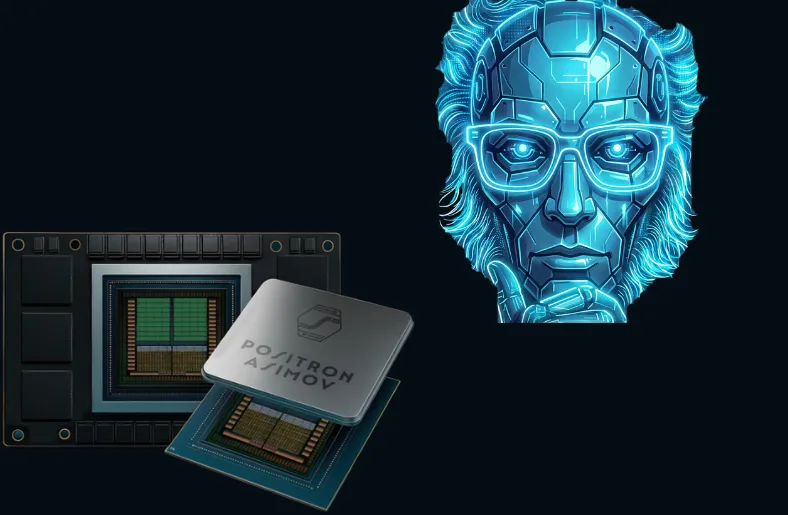
From Vision to Asimov: Inside Positron’s Next-Generation AI Chip
Positron’s longer-term ambitions extend beyond today’s inference products. Its Vision reflects the company’s broader architectural philosophy: building computing infrastructure specifically around the requirements of modern AI rather than adapting general-purpose architectures to increasingly specialized workloads. The company is developing Asimov, its own application-specific integrated circuit designed to expand Positron’s capabilities beyond inference and fine-tuning toward training and other parallel compute workloads. That transition could be strategically important. Inference provides a large and growing market, while training remains one of the most demanding workloads in artificial intelligence.
Developing an ASIC capable of supporting training would give Positron the opportunity to address a broader portion of the AI compute lifecycle. It would also increase the technical challenge considerably. Training requires enormous computational throughput, high-bandwidth memory access, efficient communication between accelerators, and software capable of scaling workloads across large clusters. Positron’s approach suggests that specialized AI architectures can be designed around the specific requirements of different workloads, with the potential to improve efficiency by optimizing the entire system rather than focusing solely on peak processor performance.
The company’s momentum has already attracted substantial financial backing. In February 2026, Positron AI announced a $230 million Series B financing at a valuation above $1 billion, with the capital intended to accelerate its development and deployment of energy-efficient AI inference technology. The funding gives the company resources to expand manufacturing, engineering, software, and commercial operations as demand for AI compute continues to grow.
The broader significance of Positron’s strategy is that the AI semiconductor market is becoming increasingly diverse. Rapid growth in AI workloads is creating opportunities for companies developing inference accelerators, custom ASICs, memory technologies, networking systems, and full-stack AI infrastructure. Positron is positioning itself within that emerging ecosystem by starting with the economics of inference and building toward a broader computing architecture.
If Asimov successfully extends Positron’s specialized approach into training and other parallel workloads, it could give the company a role across a broader range of AI computing applications. More broadly, Positron’s strategy reflects a shift toward heterogeneous compute, where different architectures can be optimized for the workloads they are best suited to handle.