


Meet Stathera: The Startup Modernizing Electronic Timing
The Hidden Technology That Keeps Every Chip in Sync
Modern computing depends on an invisible technology that rarely receives attention: electronic timing. Every processor, memory chip, communication interface, and sensor relies on highly accurate clock signals to coordinate billions of operations every second. For decades, these timing signals have been generated primarily by quartz crystal oscillators, a mature technology that has served the electronics industry remarkably well. However, the rapid growth of artificial intelligence, hyperscale data centers, autonomous systems, 5G infrastructure, and edge computing is exposing the limitations of conventional quartz devices.
Designers increasingly require timing components that occupy less board space, consume less power, integrate more easily with semiconductor manufacturing, and scale efficiently for modern electronics. This has created growing interest in Micro-Electro-Mechanical Systems (MEMS) timing technology. Canadian semiconductor company Stathera is among the companies leading this transition by developing silicon-based timing solutions that aim to modernize one of electronics’ most fundamental building blocks.

One Resonator, Two Clocks: Inside Stathera’s DualMode® MEMS Technology
At the heart of Stathera’s platform is its patented DualMode® MEMS resonator, a technology that differs significantly from traditional timing architectures. Conventional timing systems often require separate components to generate low-frequency (kHz) and high-frequency (MHz) clock signals, increasing circuit complexity, board space requirements, power consumption, and overall system cost.
Stathera’s DualMode® technology combines both timing functions within a single silicon MEMS resonator. By generating both kilohertz and megahertz outputs from one device, the company enables designers to reduce component counts while simplifying circuit layouts and lowering bill-of-material costs. Because the resonators are fabricated using semiconductor manufacturing techniques rather than quartz processing, MEMS technology also offers advantages in scalability, integration, and long-term manufacturing efficiency. These characteristics are becoming increasingly important as AI infrastructure, cloud computing platforms, and connected devices demand higher levels of performance while operating within tighter power and space constraints.
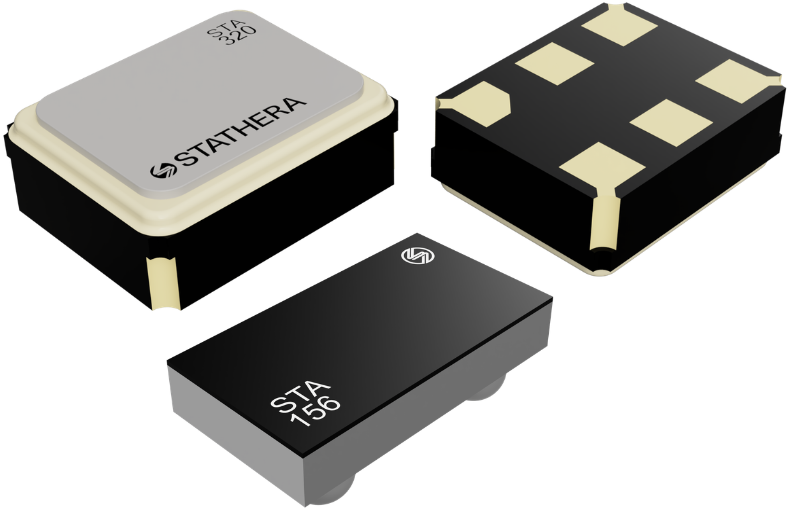
From Innovation to Products: Meet the STA320 and STA156
Stathera’s technology has moved beyond laboratory research into commercial products designed for modern electronic systems. The company’s STA320 and STA156 timing devices incorporate its DualMode® MEMS architecture to provide highly integrated timing solutions for applications requiring precise synchronization across multiple operating frequencies.
These products target markets where timing accuracy directly influences system reliability and performance, including AI servers, hyperscale data centers, networking equipment, telecommunications infrastructure, industrial electronics, automotive systems, and Internet of Things devices. As processor performance continues increasing, even extremely small timing inaccuracies can affect communication efficiency, data integrity, and overall system stability. By delivering compact silicon timing devices capable of replacing multiple conventional components, Stathera aims to simplify electronic design while supporting the increasingly demanding requirements of next-generation computing platforms.
To accelerate commercialization, the company recently announced a US$55 million Series B funding round to expand production of its silicon timing technology and strengthen its position within AI data center infrastructure. The investment reflects growing confidence that MEMS timing will play an increasingly important role as computing systems become more complex, power-efficient, and highly integrated.
While timing components rarely receive the same attention as processors or AI accelerators, they remain essential to every electronic system. Companies like Stathera are demonstrating that innovation at even the smallest hardware layers can influence the performance, efficiency, and scalability of the technologies driving the future of computing.