

How Australia-based ThinkMD uses AI to support frontline healthcare workers?
Why Do Healthcare Systems Need Clinical Decision Support?
Many healthcare systems around the world continue facing severe workforce shortages, particularly across low and middle-income countries where access to trained clinicians remains limited. In many regions, frontline healthcare delivery depends heavily on community health workers, pharmacists, nurses, teachers, and general practitioners operating under constrained conditions with limited specialist support. Diagnostic delays, inconsistent triage, and fragmented health data can significantly affect patient outcomes, especially in rural or underserved communities where healthcare infrastructure is already stretched thin.
ThinkMD is focused on addressing this gap through AI-enabled clinical decision support systems designed for frontline healthcare environments. The company combines deterministic clinical logic with machine learning approaches to help users conduct structured health assessments and generate guidance similar to a physician-led evaluation process. Its broader goal is not to replace healthcare professionals, but to expand the reach and consistency of clinical intelligence in environments where medical expertise may not always be immediately available.
This matters because healthcare access challenges are increasingly operational rather than purely technological. Many regions already possess mobile infrastructure and healthcare workers, but lack scalable systems capable of supporting accurate clinical decision-making consistently across distributed environments.

How ThinkMD Uses AI in Low-Resource Healthcare Settings?
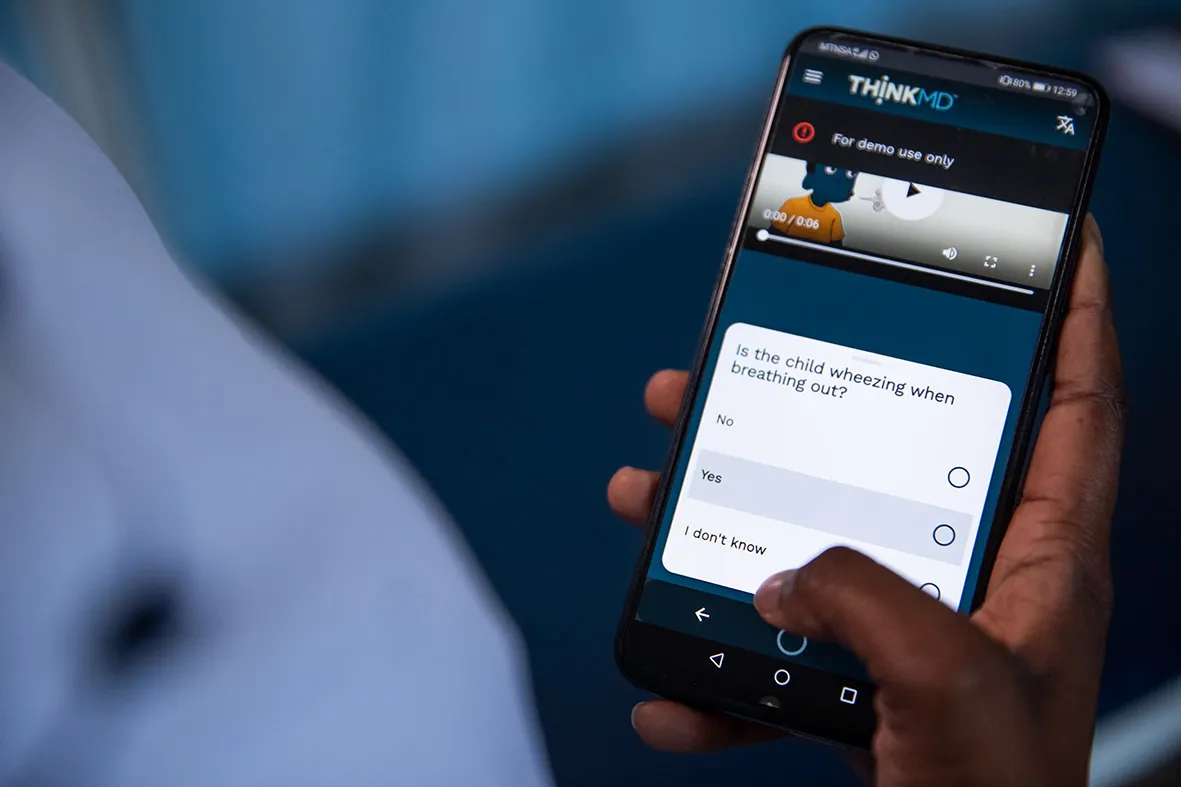
ThinkMD’s platform operates through a mobile application capable of functioning both online and offline, which is particularly important in areas with inconsistent internet connectivity. The system allows healthcare workers and other users to conduct guided health assessments using research-backed clinical logic combined with AI-supported analysis of patient data and symptoms.
Unlike many healthcare AI systems designed primarily for hospitals or highly digitized clinical environments, ThinkMD focuses specifically on low-resource deployment settings. Its platform is configurable across multiple user types, including clinicians, nurses, pharmacists, teachers, and community health workers. This flexibility allows the system to operate across broader public health environments where formal healthcare infrastructure may be limited.
The company’s deterministic clinical logic core is strategically important because healthcare systems require consistency, explainability, and operational reliability. Instead of relying entirely on black-box generative AI models, ThinkMD combines structured clinical pathways with adaptive intelligence systems designed to support real-world healthcare workflows more predictably.
The platform also generates broader health intelligence insights for policymakers and healthcare administrators. This creates an additional operational layer where aggregated clinical assessments can potentially improve public health visibility across underserved regions where reliable healthcare data is often difficult to collect consistently.
Why Offline AI Healthcare Infrastructure Matters?
One of ThinkMD’s more important operational advantages is its offline functionality. Many AI healthcare systems depend heavily on stable internet infrastructure and centralized cloud environments, which can limit usability in rural or lower-resource settings. ThinkMD’s mobile-first, offline-capable architecture reflects a more practical understanding of healthcare delivery realities across many developing regions.
This is particularly relevant because healthcare AI often receives attention primarily in the context of advanced hospital systems and high-income markets. Yet some of the most meaningful healthcare infrastructure gaps exist in environments where physician shortages, geographic isolation, and fragmented public health systems create severe access challenges.
ThinkMD’s deployment across multiple countries in Africa and Southeast Asia highlights how healthcare AI adoption may increasingly depend on operational adaptability rather than purely technological sophistication. Systems designed for constrained environments may ultimately have broader global utility because they are forced to prioritize efficiency, reliability, and accessibility from the outset.
The company’s broader positioning around “clinical intelligence on the frontline” also reflects a larger healthtech trend where AI systems are moving closer to first-contact healthcare interactions instead of operating only inside centralized medical institutions.

What Comes Next for AI-Powered Public Health Systems?
The broader significance of companies like ThinkMD lies in how AI may eventually reshape healthcare accessibility rather than only hospital efficiency. Many healthcare AI startups focus primarily on workflow optimization for existing healthcare systems. ThinkMD is targeting a more foundational challenge: extending clinical support into environments where medical expertise itself remains limited.
This creates a different operational category where AI systems function less like administrative tools and more like distributed healthcare infrastructure. If these systems become reliable enough, they could help improve early detection, triage consistency, and care accessibility across underserved populations globally.
At the same time, healthcare AI remains highly sensitive because clinical recommendations directly affect patient outcomes. Systems operating in low-resource environments must balance scalability with safety, explainability, and localized implementation challenges. Long-term trust will depend heavily on whether platforms can maintain clinical reliability across highly variable deployment conditions.
ThinkMD is positioning itself within this difficult but strategically important category by combining structured clinical logic with adaptable AI-driven assessment systems. Its long-term relevance will depend on whether frontline healthcare increasingly shifts toward distributed intelligence models where clinical support systems become accessible beyond traditional hospital infrastructure.
ThinkMD is addressing one of global healthcare’s most practical infrastructure challenges by focusing on frontline clinical support in underserved regions. The company’s long-term impact will depend on whether AI-driven clinical decision systems can deliver reliable healthcare guidance consistently across constrained real-world environments.