

UK-Based Neuronostics Is Making Routine Brain Scans Far More Powerful
Meet Neuronostics: The Startup Reimagining Neurological Diagnosis
Neurological disorders remain among the most challenging conditions to diagnose accurately. Diseases such as epilepsy often require neurologists to interpret electroencephalograms (EEGs), a process that depends heavily on specialist expertise and can sometimes produce inconclusive results, particularly when seizures are not captured during recording. As healthcare systems face growing demand for neurological services, there is increasing interest in technologies that can extract more clinically useful information from routine brain scans. UK-based Neuronostics is approaching this challenge through mathematical modelling rather than conventional pattern recognition alone.
The company develops digital biomarkers designed to quantify hidden physiological signals within EEG recordings, helping clinicians make more informed diagnostic and prognostic decisions. Its long-term vision is to shift neurology toward a more proactive model of care, where objective computational biomarkers support earlier diagnosis, personalized treatment, and continuous monitoring across a range of neurological disorders.

Inside BioEP™: The AI Engine Powering Smarter Epilepsy Diagnosis
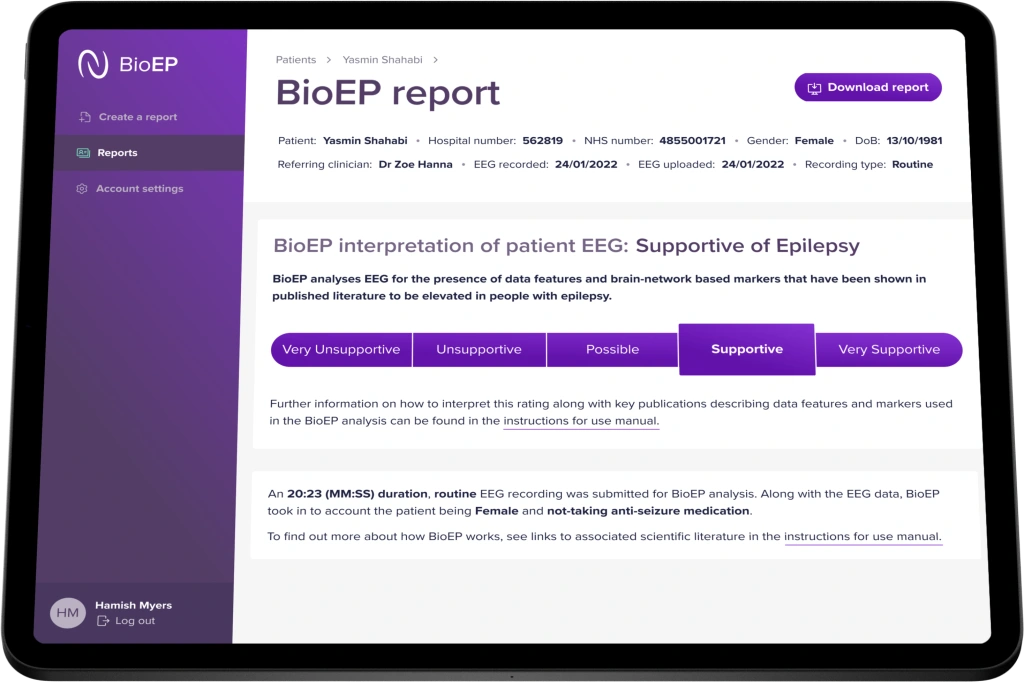
At the center of Neuronostics’ platform is BioEP™, a digital biomarker developed specifically for epilepsy. Unlike conventional EEG interpretation, which primarily focuses on visually identifiable abnormalities, BioEP analyzes background EEG activity using mathematical models to estimate an individual’s likelihood of experiencing seizures. This approach allows clinically meaningful information to be extracted even when obvious seizure activity is absent during the recording.
Rather than replacing neurologists, BioEP is designed to complement clinical expertise by providing an additional quantitative risk score that can support diagnosis, prognosis, and treatment planning. The technology reflects a broader trend within precision medicine, where computational analysis is increasingly used to uncover biological signals that remain invisible to traditional clinical assessment. By combining mathematical modelling with routine EEG data, Neuronostics aims to provide clinicians with a richer understanding of neurological function while improving confidence in epilepsy-related decision-making.
Reading Between the Brainwaves: How Neuronostics Unlocks Hidden EEG Insights
Electroencephalograms generate vast amounts of electrical brain activity, much of which is too subtle or complex for manual interpretation alone. Neuronostics seeks to unlock this untapped information by transforming EEG recordings into measurable digital biomarkers through advanced mathematical analysis. Instead of relying exclusively on visual waveform interpretation, the company evaluates underlying electrical dynamics that may reveal clinically relevant characteristics associated with neurological disease.
This strategy illustrates how computational neuroscience is expanding the value of existing diagnostic tools rather than requiring entirely new medical hardware. Routine EEG equipment already exists in hospitals around the world. By applying sophisticated algorithms and mathematical models to those recordings, clinicians may gain deeper insights without changing established clinical workflows. Beyond epilepsy, similar approaches could eventually support earlier diagnosis and monitoring across a broader range of neurological disorders as digital biomarkers continue to mature.

Neuronostics Raises £3M to Advance Digital Biomarker Platform for Epilepsy
Neuronostics recently secured £3 million in new investment, co-led by Empirical Ventures and The FSE Group, alongside participation from Ascension Ventures, QantX, New Wave Venture Partners, Angel Investors Bristol, and an additional £400,000 Innovate UK Investor Partnerships grant. The funding will support continued development of the company’s digital biomarker platform and advancement of BioEP toward broader clinical adoption.
The investment reflects growing confidence in computational diagnostics as artificial intelligence, mathematical modelling, and digital biomarkers become increasingly integrated into healthcare. Rather than focusing exclusively on developing new drugs or imaging devices, companies like Neuronostics are demonstrating how software-based innovations can significantly enhance the clinical value of existing diagnostic technologies.
If successful, the company’s platform could contribute to a broader transformation in neurology, where objective digital biomarkers complement physician expertise, improve diagnostic accuracy, and enable more personalized patient care. While continued clinical validation remains essential, Neuronostics highlights the growing role of mathematical intelligence in the future of neurological medicine.
Neuronostics is part of a growing wave of companies applying mathematical modelling and digital biomarkers to routine diagnostics, with the goal of making neurological care earlier, more objective, and increasingly data-driven. While further clinical validation will determine its long-term impact, the company’s approach represents a promising direction for precision medicine.