


Inside SigTuple’s AI-Powered Approach to Medical Diagnosis
The Problem With Traditional Medical Microscopy
For decades, microscopy has remained a fundamental part of diagnosing diseases from blood, urine, and other biological samples. Yet the process of examining samples under a microscope is still highly manual. A laboratory professional must prepare the sample, locate relevant regions, examine cells, classify abnormalities, and interpret what they see. As diagnostic volumes increase, this creates challenges around turnaround time, consistency, workload, and access to specialist expertise.SigTuple was founded in Bengaluru in 2015 with the goal of addressing this bottleneck by automating microscopic analysis.
The company points to a shortage of qualified pathologists as one of the central challenges facing diagnostic systems, particularly in regions where specialist expertise is concentrated in major cities. Its approach is therefore built around digitising microscopy and allowing AI to perform repetitive analytical tasks while keeping medical professionals involved in reviewing and validating results. SigTuple’s current platform has expanded from blood analysis into urine and veterinary diagnostics, with more than 350 deployments across seven countries according to the company.
How SigTuple Is Turning Microscopes Into AI-Powered Machines
SigTuple’s technology brings together several components that traditionally operate separately. Robotics handles sample scanning and image acquisition, high-resolution microscopy converts physical slides into digital images, and AI models analyse the resulting visual data.
Its AI100 platform, for example, can digitise both peripheral blood smears and urine samples, with AI identifying and classifying more than 30 cell types while providing visual evidence that pathologists can review and override. Its Shonit application automates peripheral blood smear analysis, including white blood cell differentials, red blood cell morphology, and platelet assessment, while Shrava analyses urine sediment and classifies elements such as cells, casts, crystals, and organisms.
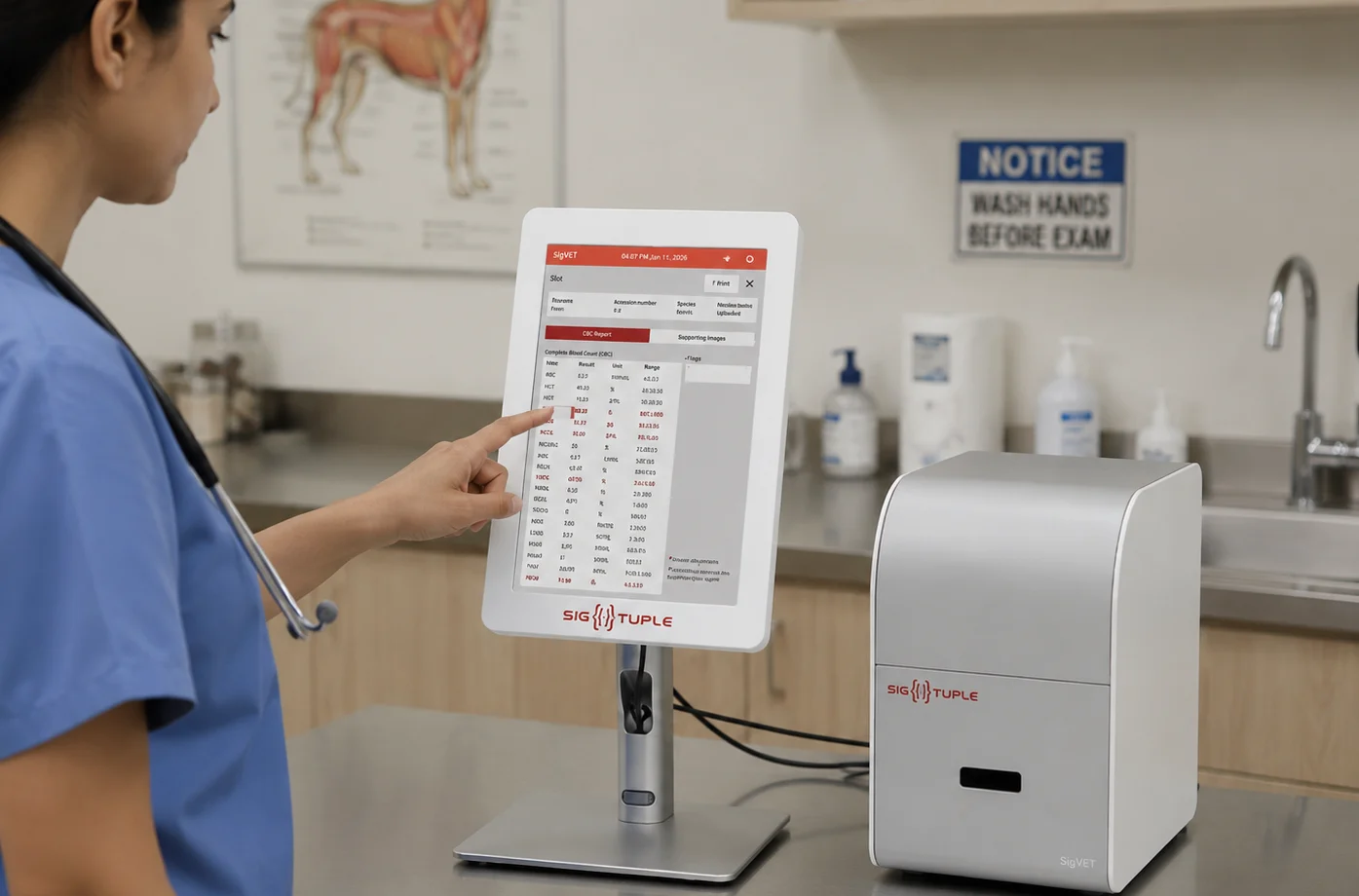
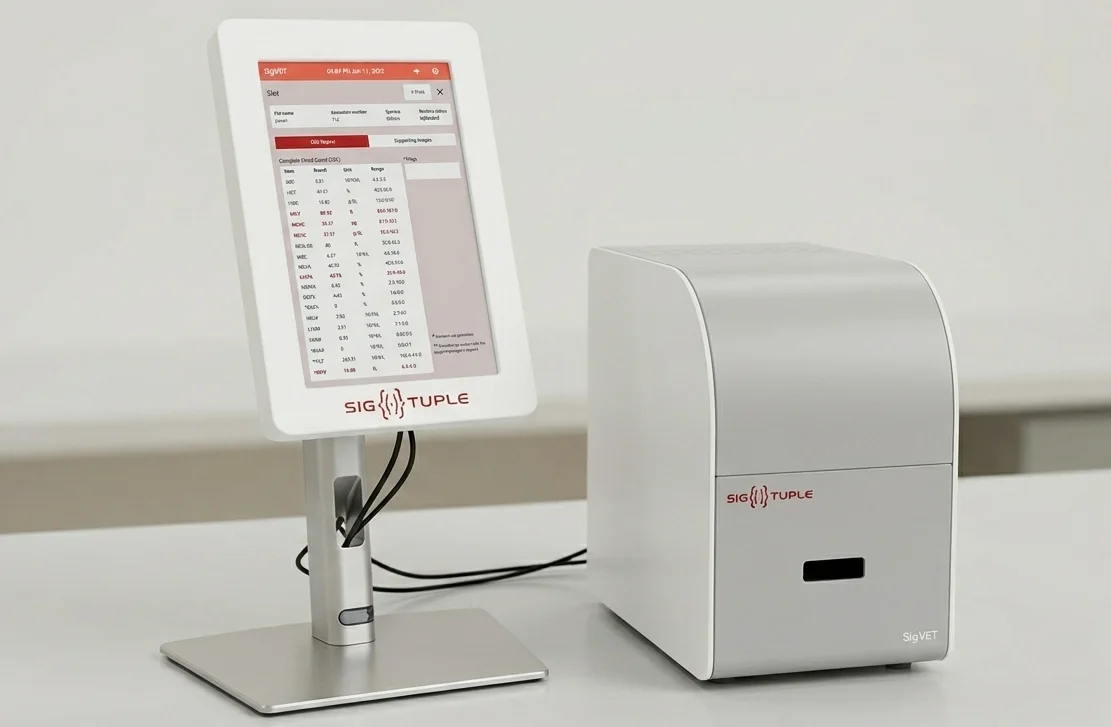
The newer AS76 takes the concept further by running AI inference directly on the device, using true 100x oil-immersion imaging and analysing up to 200 white blood cells and more than 2,000 red blood cells. Because the AS76 does not require cloud connectivity for AI inference, SigTuple says patient data can remain within the laboratory while reports are generated near instantly. The company’s portfolio also includes SigVet, an AI-powered veterinary platform combining microscopy, microfluidics, and intelligent workflows for blood and other biological samples.
What AI-Powered Diagnostics Could Mean for the Future of Healthcare
The significance of SigTuple’s technology extends beyond simply making microscopes faster. Once biological samples become digital data, they can be analysed computationally, reviewed remotely, stored systematically, and connected to broader diagnostic workflows. SigTuple’s cloud-enabled AI100 platform, for instance, allows pathologists to review AI-preclassified cases through a web browser, creating possibilities for telepathology and centralized specialist review across multiple locations.
At the same time, its edge-AI approach with AS76 demonstrates another direction, where analysis can happen locally without depending on an internet connection. This combination could be particularly relevant for healthcare systems where specialist pathologists are unevenly distributed and diagnostic laboratories need to process increasing sample volumes. SigTuple has already received U.S. FDA 510(k) clearance for AI100 and has developed a research portfolio spanning AI microscopy, microfluidics, automated urinalysis, and diagnostic imaging. The company’s longer-term proposition is therefore less about replacing the pathologist and more about changing what the pathologist spends time doing.
By automating repetitive screening and presenting structured visual evidence for expert review, AI-powered microscopy could allow specialists to focus more heavily on complex cases and clinical judgement while making high-quality diagnostic capabilities accessible to more laboratories.