

Premium Fruit Gap in India: Fragaria is here to save the day!
India is one of the world’s largest fruit producers, yet the country still depends heavily on imports for premium fruits like strawberries, blueberries and raspberries. Most of these berries are grown in temperate climates, making them expensive and seasonal in Indian markets.
This is the challenge that Fragaria Fruits, a Chennai-based agritech startup, is aiming to solve. The company’s mission is simple yet ambitious: to produce high-quality, climate-resilient berries locally, using controlled environment technology that ensures freshness, consistency and sustainability year-round. The result could be transformative, making premium fruits both affordable and accessible to millions of Indian consumers, while reducing dependency on imports.
Fragaria’s Tech-Driven Farming Model
Founded in 2022, Fragaria Fruits combines agricultural science, data analytics and engineering to grow strawberries and other delicate fruits in a fully controlled setting. Through hydroponic and vertical farming methods, the company minimizes soil and water use, enabling precise control over temperature, humidity and nutrients. Unlike traditional open-field cultivation that depends on unpredictable weather, Fragaria’s model allows for year-round production with minimal waste.
The company sells its produce under its in-house brand, “Oh! Fruits”, which is quickly gaining traction among premium retailers and online consumers for its freshness and consistent quality. By embracing controlled environment agriculture (CEA), Fragaria is also setting an example of how deeptech can modernize India’s agri value chain, turning farming into a high-precision, high-yield enterprise.

Seed Funding & Scaling Ambitions
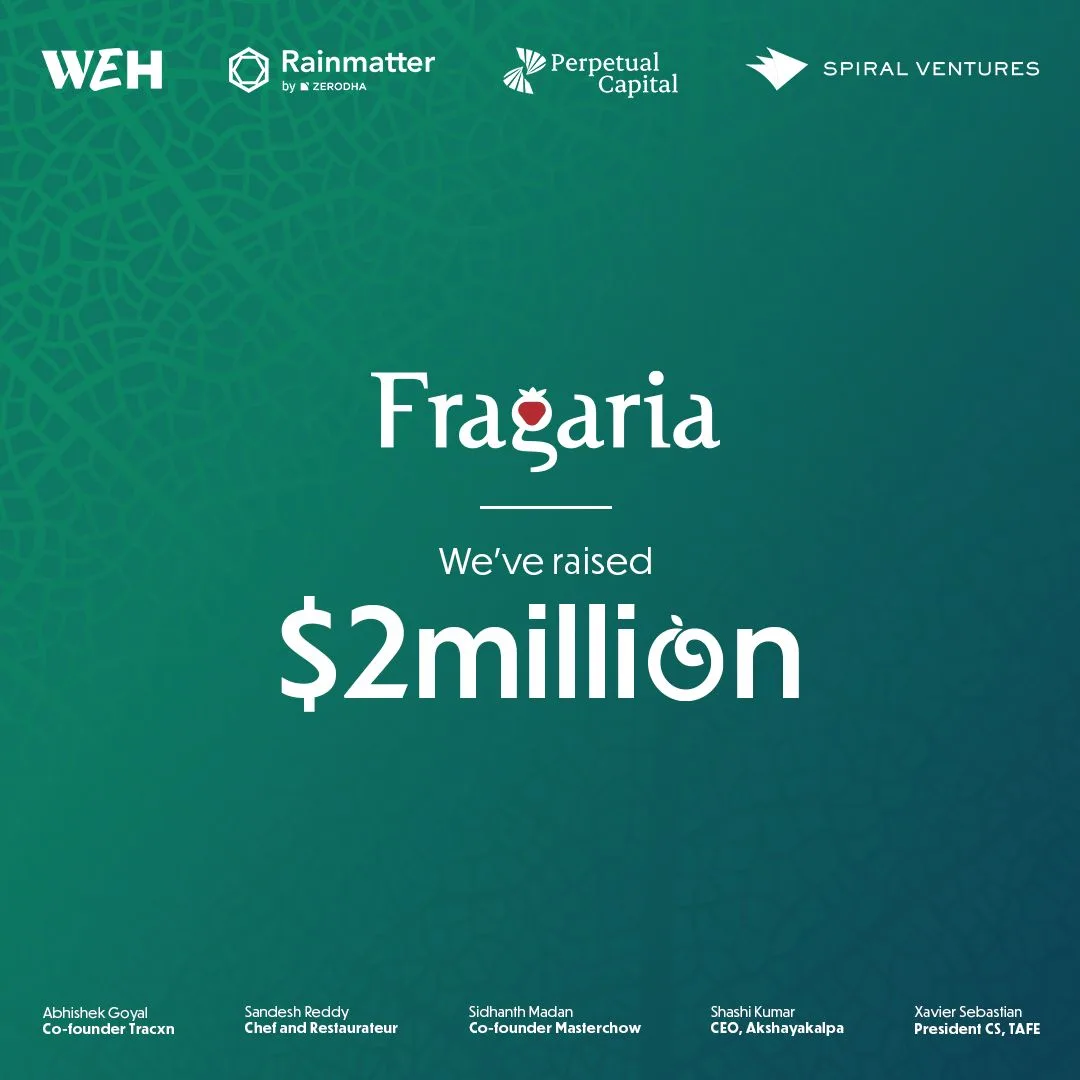
Fragaria Fruits has raised $2 million (₹17.66 crore) in its seed funding round, led by WEH Ventures, with participation from Rainmatter, Spiral Ventures and Sashi Kumar, the founder and CEO of Akshayakalpa Organic.
The new capital will be deployed to scale up production capacity in Bengaluru, where the company operates one of its main controlled-environment facilities. The target is ambitious, to increase daily production from just 2–3 kilograms to 120–150 kilograms per day in the coming months.
Beyond strawberries, Fragaria plans to expand into blueberries and raspberries, introducing a wider variety of premium fruits that are locally grown yet globally competitive With this round, Fragaria aims not only to expand its footprint but also to demonstrate the commercial viability of high-tech fruit farming in tropical climates like India.
Sustainability, Technology & Supply Chain Impact
Fragaria’s approach goes beyond yield. It is about redefining what sustainable farming can look like in the 21st century. Each facility is designed for minimal environmental footprint:
- 90% less water usage compared to traditional farming through hydroponic recycling.
- No soil degradation, as plants grow in nutrient-rich water solutions.
- No chemical pesticides, ensuring cleaner, safer produce.
- Localized cold-chain infrastructure for same-day harvest-to-store delivery.
By integrating production and logistics, Fragaria minimizes post-harvest losses, one of India’s biggest agri inefficiencies.
This vertical integration could help shorten the journey from farm to plate, ensuring fresher fruits, lower carbon emissions and better farmer economics.
The Futurism Today’s on this fruitful venture!
Fragaria Fruits embodies the new face of Indian agritech, the one where innovation meets integrity and technology grows food, not just profits. Its journey reflects a critical shift in India’s agricultural future: from volume to value, from commodities to experiences.
With sustainable farming models, transparent sourcing and a focus on local production, startups like Fragaria are turning agriculture into an innovation-driven industry. As India moves closer to becoming a self-reliant producer of premium foods, Fragaria’s success could inspire a new generation of startups to ask a simple but powerful question:
“What if the fruits we import could grow right here: fresher, cleaner and smarter?”