

RemotePass: Global HR, Payroll & Workforce Management Platform?
Why Global Hiring Still Feels Broken for Most Companies
Global hiring has become mainstream, but operational infrastructure has struggled to keep pace. Companies hiring across borders still face fragmented payroll systems, compliance complexity, inconsistent onboarding processes, tax regulations, contract localization challenges, and payment friction tied to multiple currencies and banking systems. Managing remote employees and contractors across different legal jurisdictions often requires businesses to coordinate between payroll providers, HR software, legal consultants, and local entities simultaneously. This operational fragmentation creates administrative overhead that slows international expansion and makes remote workforce management unnecessarily complex.
RemotePass is positioning itself as an all-in-one infrastructure platform designed to centralize these workflows into a more unified operating environment. The company enables businesses to onboard, pay, manage, and retain international workers across more than 150 countries while handling payroll, contractor management, Employer of Record services, compliance infrastructure, and workforce operations from a single system. Its broader thesis is that remote work is no longer an edge case inside global business. Companies increasingly need operational infrastructure capable of supporting distributed teams by default rather than through fragmented manual coordination.
How RemotePass Turns Global HR, Payroll, and Compliance Into One Smooth Workflow?
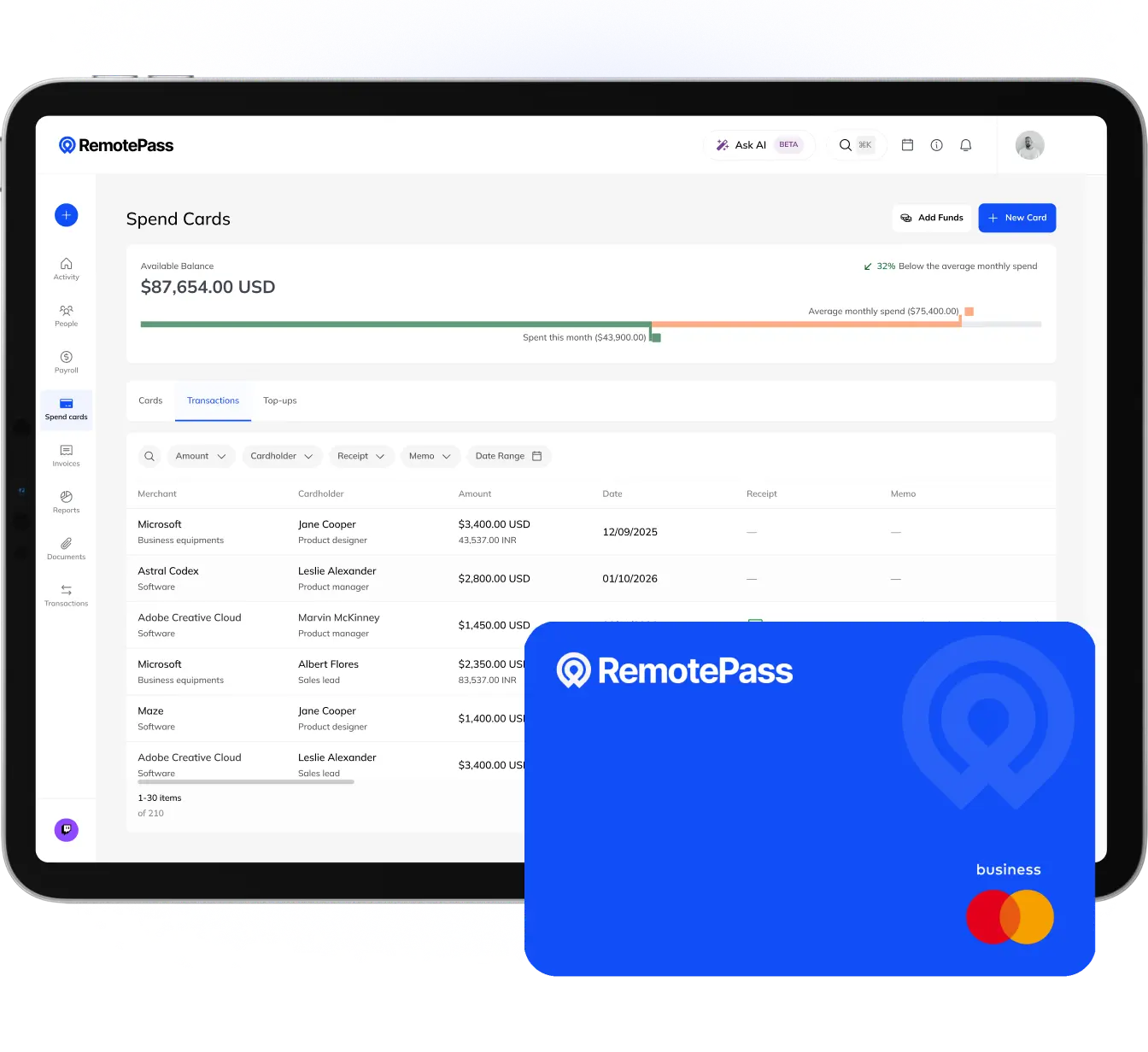
RemotePass combines HR management, payroll infrastructure, contractor operations, compliance workflows, and financial services into a centralized platform built for globally distributed teams. Companies can generate localized contracts, automate onboarding workflows, collect compliance documentation, verify identities, process international payroll, and manage workforce operations through a single operational system rather than relying on disconnected providers. The platform supports multiple employment structures, including contractors, Employer of Record (EOR) workflows, Contractor of Record (COR) services, local payroll management, and employee relocation support. This flexibility is strategically important because international workforce structures vary significantly depending on jurisdiction, tax requirements, and employment regulations.
RemotePass also focuses heavily on the worker experience itself. Remote employees and contractors can receive payments in their preferred currencies through multiple payout methods while accessing financial services and benefits through the company’s Super App infrastructure. This creates a more consumer-grade operational layer around international employment workflows, which historically remained heavily administrative and operationally rigid. The company’s integration of HR infrastructure with embedded fintech services reflects a broader trend where workforce management and financial operations are increasingly converging into unified software environments.
The Features That Make RemotePass Stand Out in a Crowded HR Tech Market
The global HR and payroll market has become increasingly competitive, but RemotePass differentiates itself by combining workforce operations with financial infrastructure more deeply than many traditional HR platforms. In addition to payroll and compliance tooling, the company provides multi-currency expense management, bulk payout systems, time-off management, localized onboarding, benefits infrastructure, and embedded financial services through one operational ecosystem. Its coverage across 150+ countries also positions the platform for businesses operating in highly distributed hiring environments where geographic flexibility is strategically important. Many HR platforms still require companies to coordinate multiple vendors depending on region or workforce type. RemotePass attempts to reduce this fragmentation by creating a broader global operational layer.
The company’s AI-focused initiatives are also notable because HR infrastructure is gradually becoming more automated and intelligence-driven. Workforce management systems increasingly incorporate AI for compliance workflows, operational recommendations, payroll coordination, and employee support automation. RemotePass’s emphasis on user experience matters as well. Historically, international payroll and HR infrastructure prioritized compliance functionality over usability. As remote work becomes normalized, companies increasingly expect workforce infrastructure to operate with the simplicity and flexibility associated with modern SaaS and fintech platforms rather than legacy enterprise systems.

RemotePass’s $17.4M Series B Funding Signals Bigger Global Ambitions
RemotePass recently raised $17.4 million in Series B funding as global employment infrastructure and fintech systems continue converging operationally. The investment reflects growing investor confidence that distributed workforces are becoming a permanent structural component of global business rather than a temporary post-pandemic adjustment. The company operates inside a rapidly expanding category where payroll, compliance, workforce operations, and embedded financial services increasingly overlap. Businesses hiring globally now require infrastructure capable of supporting not only payroll execution but broader workforce coordination across multiple jurisdictions simultaneously.
The funding will likely support international expansion, engineering growth, AI capabilities, and deeper product integration across workforce and financial operations infrastructure. More importantly, it positions RemotePass among a growing group of companies attempting to become foundational infrastructure for borderless employment ecosystems. The challenge moving forward will involve balancing operational simplicity with the complexity of international labor regulations, taxation frameworks, compliance requirements, and financial infrastructure differences across hundreds of jurisdictions.

Why RemotePass Could Become the Operating System for Remote-First Teams?
RemotePass reflects a broader transformation happening across work itself. Distributed teams are no longer limited to startups and digital nomads. Large enterprises, growth-stage companies, and multinational organizations increasingly build globally distributed workforces as a core operating model rather than an exception. This shift creates demand for infrastructure platforms capable of treating global employment as a continuous operational workflow instead of a fragmented legal and administrative process. Payroll, onboarding, compliance, benefits, contractor management, and financial services are gradually converging into unified workforce operating systems.
RemotePass is positioning itself inside this convergence by combining HR infrastructure with embedded fintech capabilities and operational compliance systems. Its platform suggests a future where companies can hire internationally with nearly the same operational simplicity as local hiring. The broader implication is that workforce infrastructure may increasingly become border-agnostic. Companies capable of simplifying international employment while maintaining compliance and financial flexibility could become critical infrastructure providers for the next generation of remote-first businesses. RemotePass is targeting one of the most operationally difficult layers of global business by combining payroll, compliance, HR, and fintech infrastructure into a unified platform. The company’s long-term relevance will depend on whether distributed international workforces continue becoming the default operating model for modern companies.