

Avrea: The New AI-Powered CI/CD Platform Developers Should Watch
The Growing CI/CD Bottleneck in the AI Coding Era
Software development is accelerating rapidly as AI coding assistants generate larger volumes of code, automate repetitive engineering tasks, and shorten development cycles. Yet while code generation has become dramatically faster, software delivery infrastructure has not evolved at the same pace. Engineering teams increasingly face CI/CD bottlenecks where testing pipelines, validation systems, and deployment workflows struggle to keep up with growing code velocity. Slower build times, flaky tests, poor observability, and unreliable pipelines create friction that limits how quickly teams can safely ship software. Avrea is targeting this emerging problem with a CI/CD platform designed specifically for the AI-assisted development era.
The company positions itself around the idea that modern software delivery infrastructure must adapt to a world where both human developers and AI agents contribute code continuously. Instead of treating CI/CD pipelines as static automation systems, Avrea focuses on building faster, more observable, and AI-assisted workflows capable of handling higher development throughput without sacrificing reliability or software quality. This reflects a broader infrastructure shift where software delivery systems are increasingly becoming operational bottlenecks as code creation itself becomes easier and more automated.
What Is Avrea and How Does It Work?
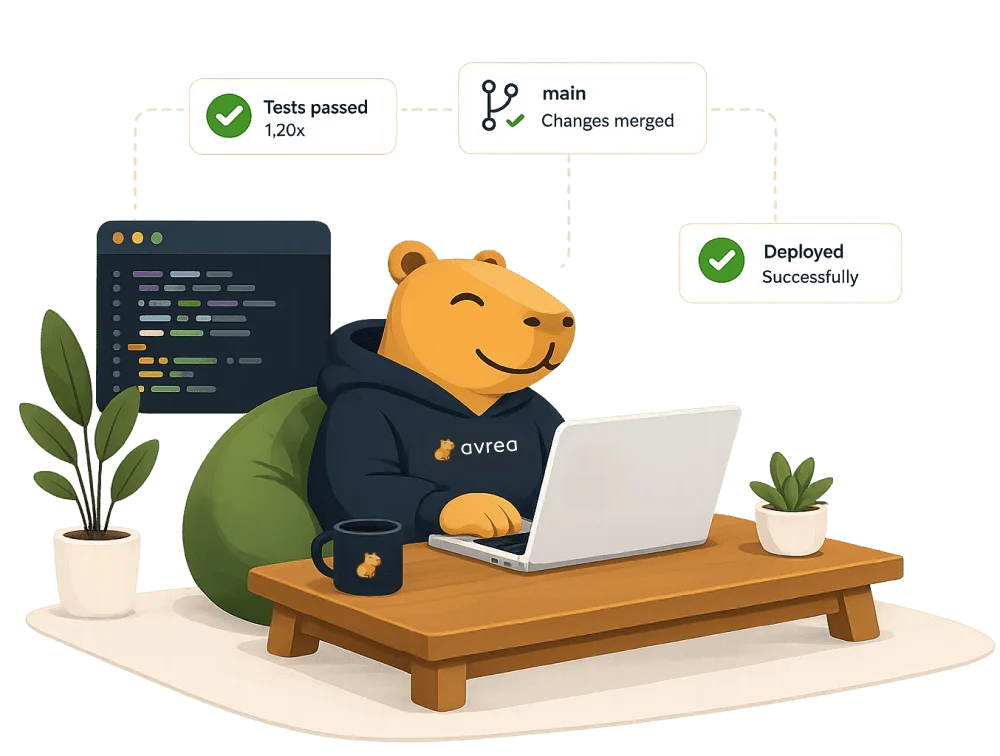
Avrea provides a CI/CD platform designed to help engineering teams test, validate, and deploy software faster while improving pipeline reliability and operational visibility. The platform includes high-performance CI/CD runners optimized for speed, pipeline observability tooling, and AI-powered features intended to improve test quality and build stability. Its infrastructure is designed to integrate into existing developer workflows with minimal migration overhead. According to the company, switching to Avrea requires only a one-line workflow change, which is strategically important because engineering teams are often reluctant to adopt infrastructure tools requiring large-scale migration effort or workflow disruption.
The platform’s observability layer is one of its more important differentiators. Modern CI/CD environments generate large amounts of operational telemetry around builds, test failures, dependency issues, and deployment bottlenecks. Avrea attempts to surface this information more effectively so teams can diagnose pipeline problems faster and improve delivery efficiency over time. The company also emphasizes build reliability and test quality rather than focusing only on execution speed. This matters because AI-assisted development environments may generate larger volumes of code changes, increasing the importance of validation systems capable of detecting instability and reducing deployment risk consistently.
Its ISO 27001 certification additionally positions the platform toward enterprise engineering environments where infrastructure security and compliance standards remain operational requirements.

Key Features That Make Avrea Different
Avrea’s positioning combines three infrastructure priorities that increasingly matter in modern software delivery: speed, observability, and reliability. The company’s high-speed CI/CD runners focus on reducing execution latency so teams can iterate and deploy code faster without creating operational delays inside development workflows. Its observability tooling reflects a broader industry trend where developer infrastructure platforms increasingly provide operational intelligence layers rather than functioning purely as automation systems. Engineering organizations now expect visibility into pipeline health, test performance, infrastructure reliability, and deployment bottlenecks in real time.
The platform’s AI-powered capabilities are particularly notable because developer tooling is gradually shifting toward adaptive infrastructure systems that optimize workflows dynamically rather than operating as static execution environments. As AI-generated code becomes more common, CI/CD systems may increasingly require intelligent validation mechanisms capable of identifying unstable patterns, flaky tests, or inconsistent deployment behaviors automatically. Avrea also appears focused on minimizing infrastructure friction for adoption. Developer tooling markets are highly competitive, and migration complexity often slows adoption even when technical advantages are clear. By emphasizing compatibility and lightweight migration paths, the company positions itself for teams seeking performance improvements without major operational disruption.
The broader implication is that CI/CD platforms themselves are evolving from background automation utilities into active operational infrastructure layers for modern software engineering.

Can Avrea Change the Future of Software Delivery?
Avrea reflects a larger transformation happening across developer infrastructure as AI changes how software gets built. Earlier generations of CI/CD systems were designed for environments where code generation speed was constrained primarily by human developer productivity. AI coding tools are changing that assumption by dramatically increasing the rate at which code can be produced and modified. This creates pressure on testing, validation, and deployment systems that were not originally optimized for continuous AI-assisted development environments. CI/CD platforms increasingly need to support higher throughput, faster feedback loops, deeper observability, and more intelligent quality assurance mechanisms simultaneously.
Avrea is positioning itself inside this infrastructure transition by treating software delivery as an adaptive operational system rather than a static automation pipeline. Its long-term relevance will depend on whether engineering organizations increasingly prioritize pipeline intelligence and delivery reliability as core infrastructure requirements in AI-driven development environments. At the same time, developer tooling markets remain highly competitive and technically demanding. Engineering teams expect reliability, performance, security, and compatibility from infrastructure platforms operating deep inside production software environments. The companies most likely to succeed will be those capable of improving development velocity without introducing operational instability.
Avrea’s focus on AI-native CI/CD infrastructure suggests a future where software delivery systems themselves become increasingly intelligent, observable, and optimized for continuous machine-assisted development cycles.
Avrea is targeting an increasingly important bottleneck inside modern software engineering by focusing on CI/CD infrastructure built for AI-assisted development workflows. The company’s success will depend on whether software delivery systems become as strategically important as code generation tools in the next phase of developer infrastructure evolution.