


What Is CuspAI? The AI Startup Transforming Materials Discovery
Cambridge-Based CuspAI and the Problem It Aims to Solve
Every major technological revolution has been enabled by advances in materials science. The lithium-ion battery powered the rise of smartphones and electric vehicles. High-performance semiconductors made modern computing possible. Lightweight composites transformed aerospace engineering, while specialized catalysts have become essential for chemical manufacturing and clean energy. Yet discovering new materials remains one of science’s slowest and most expensive processes. Researchers often spend years or even decades designing, testing, and refining molecules before identifying one with the desired properties. The sheer number of possible molecular combinations makes traditional experimentation both time-consuming and resource-intensive.
Cambridge-based CuspAI was founded to change that equation. The company is building an AI platform that applies machine learning to materials discovery, enabling scientists to explore an enormous design space far beyond what conventional laboratory methods can realistically achieve. Its vision is ambitious: while nature has spent billions of years evolving molecules, CuspAI aims to accelerate that process so groundbreaking materials can be designed in months rather than millennia. Backed by a founding team that includes globally recognized researchers in artificial intelligence, chemistry, and engineering, the company is positioning itself at the intersection of scientific research and computational innovation.

How CuspAI Uses AI to Discover and Design New Materials?
Rather than replacing laboratory research, CuspAI’s technology is designed to make scientific discovery significantly more efficient. Its artificial intelligence models analyze vast amounts of chemical and physical data to predict how newly designed molecules and materials are likely to behave before they are synthesized in a laboratory. By narrowing millions or even billions of possible candidates to a much smaller group with the highest probability of success, researchers can focus experimental resources where they are most likely to produce meaningful breakthroughs.
This AI-driven approach has applications across numerous industries. Advanced battery materials could improve energy density and charging speeds for electric vehicles and grid-scale storage. New semiconductor materials may enable more efficient computing hardware. Carbon capture technologies depend on materials capable of selectively absorbing greenhouse gases, while next-generation catalysts could make industrial manufacturing cleaner and more energy efficient. By shortening the discovery cycle from years to months, CuspAI hopes to accelerate innovation across sectors where materials have traditionally been one of the largest bottlenecks.
The company’s broader objective is to move toward an era of on-demand materials engineering, where artificial intelligence becomes an essential partner in scientific research rather than simply a data analysis tool.
Why CuspAI Matters for the Future of Materials Science?
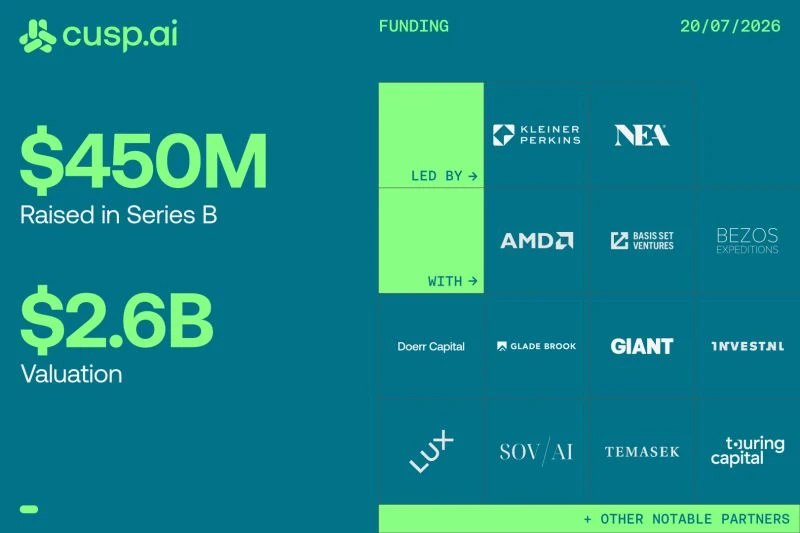
The growing importance of AI in scientific research is reflected in strong investor confidence. CuspAI recently secured $450 million (£334 million) in Series B funding, providing substantial resources to expand its platform, strengthen research capabilities, and accelerate collaboration with industry and scientific partners. The investment highlights increasing recognition that advances in artificial intelligence could reshape not only software development but also the pace of discovery in the physical sciences.
Materials science sits at the foundation of countless technological industries. Progress in renewable energy, sustainable manufacturing, healthcare, aerospace, electronics, and quantum computing all depends on developing materials with properties that do not yet exist or cannot currently be produced at scale. Artificial intelligence offers researchers a way to navigate this enormous search space more intelligently, identifying promising candidates long before traditional trial-and-error experimentation would uncover them.
For CuspAI, the opportunity extends beyond discovering individual molecules. The company is working toward a future where AI becomes an integral component of scientific innovation, helping researchers solve some of the world’s most complex engineering challenges. If this approach continues to mature, the next generation of transformative materials may emerge not only from laboratories but also from AI systems capable of exploring possibilities at a scale no human team could achieve alone.
Artificial intelligence is increasingly proving its value beyond text generation and automation. In fields such as materials science, it has the potential to accelerate discoveries that underpin entire industries, from energy storage and semiconductor manufacturing to carbon capture and advanced healthcare. CuspAI represents this new frontier, where AI is used not merely to process information but to expand the boundaries of scientific exploration itself. If successful, its approach could significantly shorten the journey from scientific hypothesis to real-world technological breakthrough.