

Geordie AI Is Building What Every Enterprise Will Soon Need: Agent Security
The Rise of AI Agents Is Creating a New Enterprise Challenge
The enterprise AI conversation is rapidly moving beyond chatbots and copilots toward autonomous AI agents capable of executing workflows, accessing systems, making decisions, and interacting with other software without constant human oversight. While these systems promise major productivity gains, they also introduce a new category of operational and security risks. Unlike traditional software applications, AI agents can behave dynamically, access sensitive information, trigger actions across multiple systems, and evolve their behavior based on context.
Many organizations are already experimenting with agentic AI, but few have clear visibility into what these agents are doing, what data they can access, or how their actions align with corporate policies. Geordie AI was founded around this emerging challenge. The company believes enterprises need entirely new security and governance infrastructure built specifically for AI agents rather than relying on existing cybersecurity tools designed for human users and conventional software. As agent adoption accelerates, Geordie AI is positioning itself as a platform that helps organizations understand, monitor, secure, and govern autonomous AI systems operating across enterprise environments

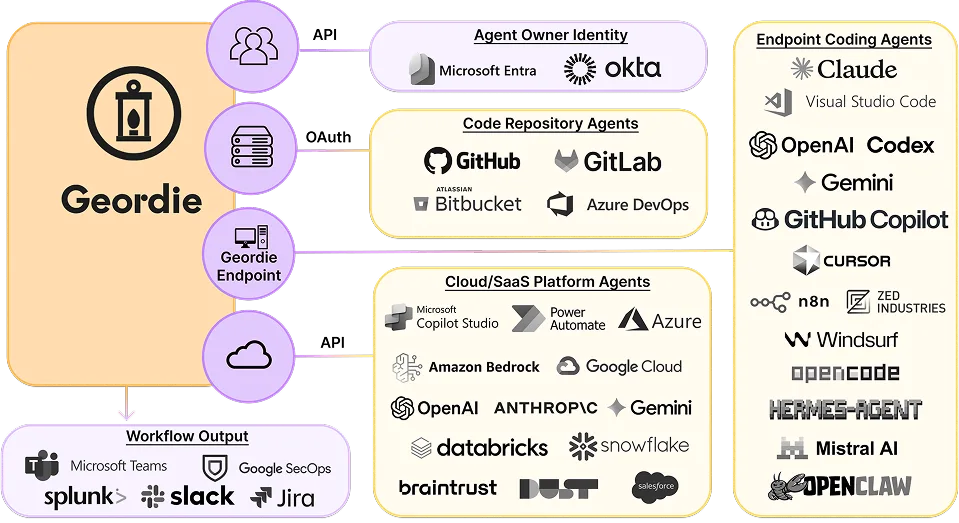
Geordie AI wants to solve this! (Image Source: Geordie AI)
What Is Geordie AI and How Does It Work?
Geordie AI provides what it describes as an agent-native security and governance platform. The company focuses on helping enterprises discover AI agents, understand their behavior, monitor their activities, and implement controls that reduce operational risk. Rather than treating AI agents as ordinary applications, Geordie recognizes that autonomous systems require continuous observability and contextual oversight.
The platform combines posture management, visibility, monitoring, and intervention capabilities designed specifically for agentic environments. Organizations can use the platform to identify where agents are operating, what systems they are interacting with, what permissions they hold, and how they are behaving over time. This visibility is important because many enterprises are deploying AI agents across multiple departments, workflows, and software environments simultaneously.
Geordie also emphasizes contextual interventions, allowing organizations to establish guardrails around agent behavior. Instead of simply detecting problems after they occur, the platform is designed to proactively mitigate risks before agents create compliance, operational, or security issues. As enterprises move toward larger AI-driven workforces, this kind of governance infrastructure may become as essential as identity management and endpoint security systems are today.
Why AI Agent Security Could Become a Billion-Dollar Market?
The rise of agentic AI is creating a new security category that many analysts believe could become one of the fastest-growing segments within enterprise software. Organizations are increasingly comfortable allowing AI systems to access internal knowledge bases, enterprise applications, communication tools, databases, and workflow automation platforms. However, every new capability also expands potential attack surfaces and governance challenges.
Traditional cybersecurity solutions were designed around protecting networks, devices, applications, and human users. AI agents introduce entirely different questions. What permissions should an agent have? How should agent decisions be audited? How can organizations prevent unintended actions? How do security teams monitor thousands of autonomous systems operating simultaneously across enterprise environments?
These challenges are creating demand for specialized infrastructure focused on AI governance rather than conventional cybersecurity alone. Geordie AI is entering the market at a time when many organizations are realizing that agent adoption cannot scale safely without dedicated visibility and control layers. If agentic AI becomes a core component of enterprise operations over the next decade, platforms designed to secure and govern these systems could become foundational enterprise infrastructure.

Inside Geordie AI’s $30M Series A and the Race to Govern Autonomous AI Agents
In May 2026, Geordie AI announced a $30 million Series A funding round led by Balderton Capital. The investment reflects growing investor confidence that AI governance and agent security will become major infrastructure categories as enterprises accelerate AI deployment.
The funding arrives during a period of intense competition among companies building tools for agent observability, AI compliance, governance, monitoring, and operational oversight. Investors increasingly recognize that autonomous AI systems cannot simply be deployed without corresponding security controls and accountability mechanisms.
The new capital will support Geordie’s product development, team expansion, and broader market growth as enterprises move from AI experimentation toward large-scale deployment. More importantly, the funding highlights a shift in how the market views AI adoption. The challenge is no longer simply building capable AI agents. The challenge is ensuring those agents remain secure, compliant, observable, and aligned with organizational objectives once deployed. As AI systems gain greater autonomy, governance infrastructure may become just as important as the underlying models themselves.
Can Geordie AI Become the Security Layer for the Agentic Enterprise?
The long-term opportunity for Geordie AI depends on a simple but increasingly important assumption: autonomous AI agents will become a permanent part of enterprise operations. If that happens, organizations will require new infrastructure capable of managing these systems at scale. Visibility, governance, accountability, policy enforcement, and risk management will become operational necessities rather than optional features. Geordie’s strategy is built around becoming that foundational layer.
By focusing specifically on agent-native security rather than adapting legacy cybersecurity tools, the company is attempting to establish itself within a category that barely existed a few years ago. The timing may prove significant. Many enterprises are still in the early stages of agent adoption, creating an opportunity for governance platforms to become embedded before operational standards are fully established.
Whether Geordie ultimately becomes the dominant player in this market remains uncertain. However, the problem it addresses appears increasingly real. As organizations deploy larger numbers of autonomous systems across critical business functions, understanding what those agents are doing and ensuring they operate safely may become one of the defining enterprise technology challenges of the AI era. Geordie AI is targeting a problem that many enterprises have not fully recognized yet but may soon face at scale. If AI agents become common across business operations, governance and security infrastructure purpose-built for autonomous systems could become as essential as traditional cybersecurity platforms are today.