


Singularity Defense Wants to Rewrite the Economics of Modern Air Defense
The Economics of Air Defense No Longer Make Sense
Modern warfare is increasingly defined by inexpensive autonomous weapons. Commercial drones costing only a few hundred dollars can now perform reconnaissance, deliver explosives, overwhelm air-defense systems, or disrupt critical infrastructure. Cruise missiles, loitering munitions, and coordinated drone swarms have demonstrated that relatively low-cost aerial weapons can inflict significant military and economic damage. Yet the systems designed to stop them often cost hundreds of thousands or even millions of dollars per interceptor. This imbalance has created a growing strategic problem for militaries around the world.
Defenders can quickly exhaust expensive missile inventories while attackers continue deploying large numbers of low-cost systems. As conflicts continue to demonstrate the effectiveness of mass-produced autonomous weapons, defense planners are increasingly searching for interception technologies that are not only effective but also economically sustainable. This changing battlefield has created an opportunity for a new generation of defense technology companies focused on reducing the cost of air defense without sacrificing operational capability.
Why Singularity Defense Believes Air Defense Must Scale Like Software?
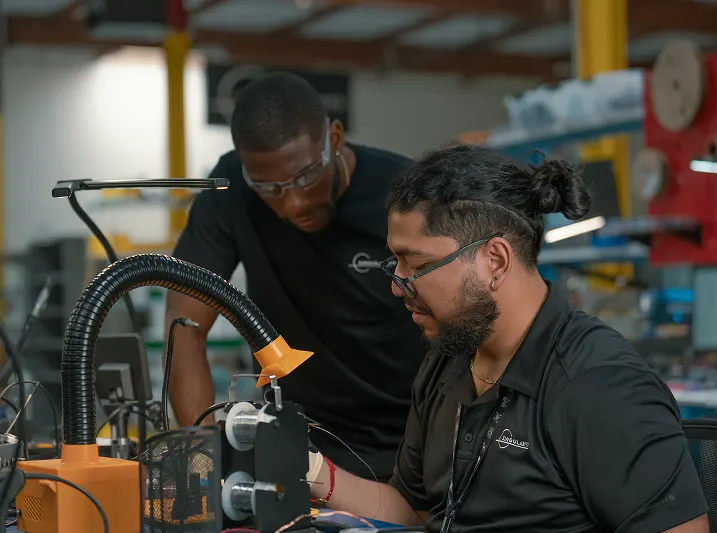
US-based Singularity Defense was founded around a simple but ambitious premise: successful air defense should be measured by the number of lives protected. Rather than competing with traditional defense contractors by building increasingly expensive missile systems, the company is developing affordable counter-weapons that can be manufactured and deployed at the scale required to address today’s rapidly evolving aerial threats.
The company emphasizes rapid engineering cycles and vertically integrated development, producing its systems in-house to accelerate iteration and reduce manufacturing complexity. This approach allows Singularity Defense to adapt more quickly as new drone technologies and emerging threats appear on the battlefield. By prioritizing scalability, production speed, and affordability, the company seeks to create defensive systems that can be deployed widely instead of remaining limited to only the highest-priority military assets.

Building Air Defense for an Era of Drone Swarms
The next generation of air defense will likely look very different from the systems developed during the Cold War. Future conflicts are expected to involve large numbers of autonomous drones, loitering munitions, and coordinated aerial attacks that challenge traditional interceptor-based defense strategies. Defending against these threats requires interception methods that remain economically viable when hundreds of hostile aircraft are involved simultaneously.
Singularity Defense is positioning itself within this broader transformation by focusing on scalable counter-weapons designed to match the cost structure of modern threats. Instead of accepting a future where every interception carries an unsustainable financial burden, the company argues that defensive technologies must become as manufacturable and adaptable as the systems they are designed to defeat. If successful, this philosophy could influence how future air-defense architectures are designed, emphasizing production capacity, modularity, and affordability alongside traditional performance metrics.

Singularity Defense Raises $80 Million Series A to Scale Affordable Air Defense
To accelerate its vision, Singularity Defense recently secured $80 million in Series A funding at a $400 million valuation. The investment will support continued development of its counter-weapons platform, manufacturing capabilities, and production capacity as the company expands its role within the rapidly growing defense technology sector.
The funding reflects increasing investor confidence that modern military challenges require new approaches to defense manufacturing. Venture capital has flowed steadily into defense startups developing autonomous systems, software-defined weapons, advanced sensors, and low-cost interceptors as governments seek faster innovation cycles than traditional procurement models have typically delivered.
As geopolitical tensions continue to reshape defense priorities, companies capable of producing affordable, scalable defensive systems are attracting growing attention. For Singularity Defense, the objective extends beyond building another weapons platform. It is attempting to change the underlying economics of air defense itself, making large-scale protection feasible against the inexpensive autonomous threats that are increasingly defining modern warfare.
Modern warfare is increasingly becoming an economic competition as much as a technological one. When inexpensive drones can force the use of million-dollar interceptors, even successful defenses become difficult to sustain. Companies like Singularity Defense are challenging that equation by focusing on scalable, affordable counter-weapons. If this model proves effective, the future of air defense may be defined by the ability to defend at the same scale and cost as the threats themselves.